
Armin Koller, MD
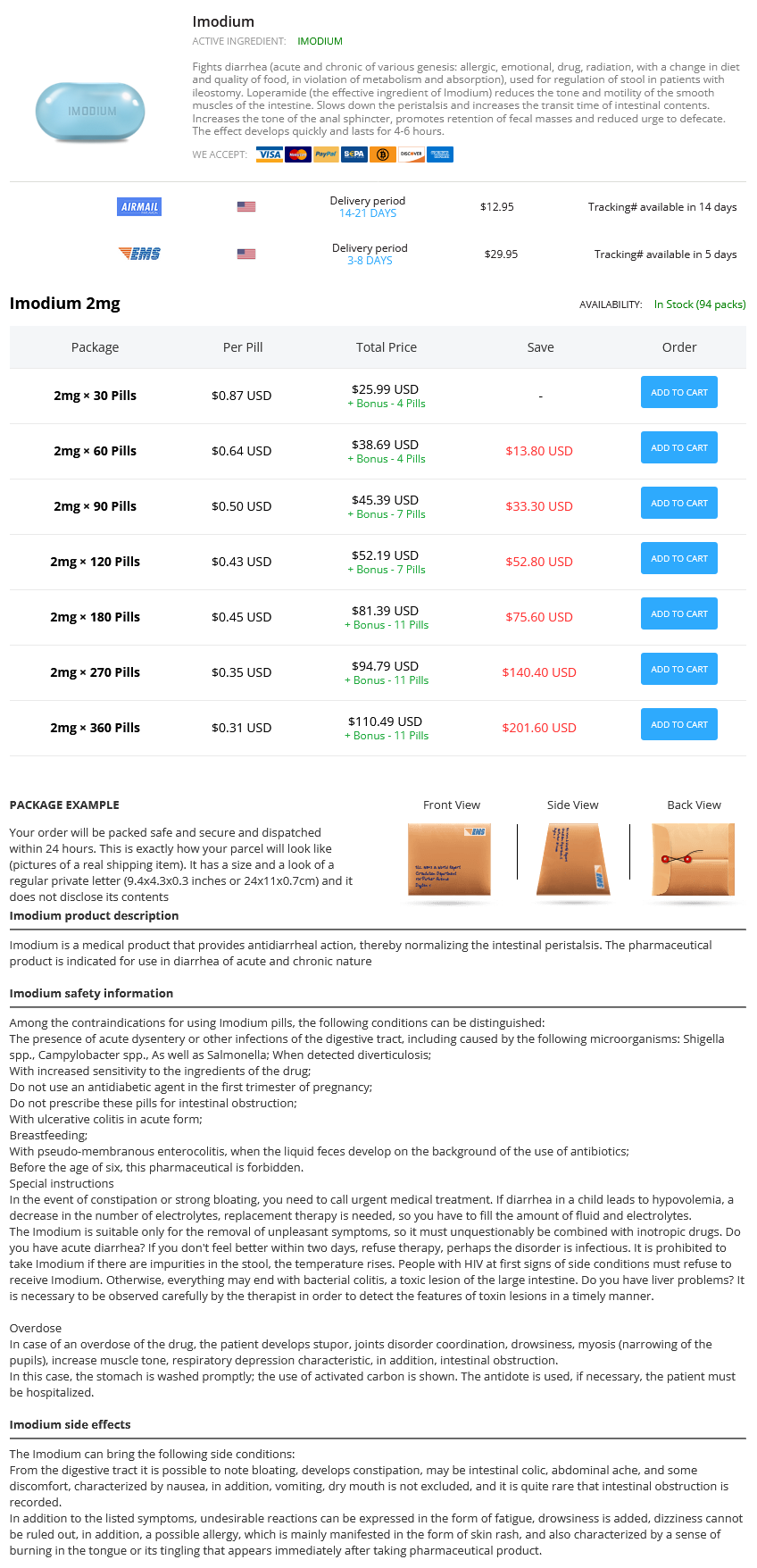
Imodium dosages: 2 mg
Imodium packs: 30 pills, 60 pills, 90 pills, 120 pills, 180 pills, 270 pills, 360 pills

The function of adenosine in apnea of prematurity is recommended by the flexibility of the methylxanthines, theophylline, and caffeine, that are nonspecific adenosine receptor inhibitors, to decrease the incidence of apnea of prematurity. However, the exact mechanism and location of action of adenosine, in addition to the interplay of adenosine with different neurotransmitters, remain to be identified. Exogenous endorphin and enkephalin analogues have been shown to produce a constant decrease in respiration in fetal and neonatal animals. Endorphin ranges are elevated within the human neonate at start, and endogenous opioids had been found to modulate the hypoxic ventilatory response in new child infants and animals. Prostaglandin E1 has been proven to lower and indomethacin has been proven to improve phrenic exercise in new child piglets. Although the involvement of serotonin in respiratory management is nicely established, the nature of this involvement is advanced. Both activation and inhibition of respiratory have been described with different doses and, routes of administration. The completely different responses might owe, partially, to the impact on completely different subtypes of serotonin receptors preferentially expressed on respiratory neurons. Serotonin has been implicated as a regulatory issue in the manufacturing of apneusis. There is increasing proof to counsel an necessary function for serotonergic neurons within the raphe nuclei in maturation of central chemoreception. Apnea is historically categorised into three categories: central, obstructive, and combined (both central and obstructive components). Central apnea is characterized by whole cessation of respiratory effort with no proof of obstruction. In obstructive apnea, the toddler tries to breathe against an obstructed upper airway, resulting in chest wall movement with out nasal airflow. The site of upper airway obstruction is mostly in the pharynx; nonetheless, it may also happen on the larynx and probably at both websites. It should be emphasized that these three patterns of apnea seem to type a continuum in which airway obstruction may be concerned in purely central occasions and vice versa. Although the precise incidence of apnea depends on the diagnostic standards employed, the frequency and length of apnea decreases with advancing postnatal age. This is understandable in view of the constraints of learning human infants and the shortage of an animal mannequin that exhibits spontaneous apnea. Therefore, most of our information is derived from each physiologic research in preterm infants and research in immature animals. Immaturity of respiratory responses in preterm infants impacts all levels of respiratory management, together with central and peripheral chemosensitivity, in addition to inhibitory pulmonary afferents. This immaturity is manifested by impaired ventilatory responses to hypoxia and hypercapnia, and an exaggerated inhibitory response to stimulation of airway receptors. Although a direct relationship has not been demonstrated between a disturbed respiratory management mechanism and the occurrence of apnea in preterm infants, sturdy associations are very well established. Histologically, immaturity of the preterm mind is manifested by a decreased variety of synaptic connections, dendritic arborizations, and paucity of myelin. Functionally, auditory evoked responses are impaired in infants with apnea compared with matched preterm management subjects, indicating a delay in brainstem conduction time. Interestingly, this delay improves after therapy with aminophylline, signifying a practical rather than an anatomic immaturity. Shorter events (<15 seconds) may also be identified as apnea if accompanied by oxygen desaturation and bradycardia. Prolonged desaturation episodes within the absence of apnea or bradycardia, each in healthy preterm infants and more regularly in infants with persistent lung illness, may represent obstructive apnea, hypoventilation, or intrapulmonary right-to-left shunting. Although the significance of such episodes is unclear, the long-term consequences of apnea, bradycardia, and hypoxemia remain a priority. This impairment of hypercapnic ventilatory response is extra pronounced in preterm neonates with apnea compared with their controls with out apnea. The peripheral chemoreceptors are positioned primarily within the carotid physique and are liable for stimulating breathing in response to hypoxia. Both enhanced and lowered peripheral chemoreceptor perform might result in apnea, bradycardia, or desaturations in the untimely infant. In utero, the carotid chemoreceptor O2 sensitivity is adapted to the normally low PaO2 of the mammalian fetal environment (23-27 mm Hg).
Low dose nitric oxide remedy for persistent pulmonary hypertension of the new child. Safety of withdrawing inhaled nitric oxide remedy in persistent pulmonary hypertension of the newborn. Intravenous sildenafil within the treatment of neonates with persistent pulmonary hypertension. Improvement of oxygenation induced by aerosolized prostacyclin in a preterm toddler with persistent pulmonary hypertension of the newborn. Inhaled prostacyclin for time period infants with persistent pulmonary hypertension refractory to inhaled nitric oxide. Regulation of phosphodiesterase three within the pulmonary arteries during the perinatal period in sheep. Phosphodiesterase 3A expression is modulated by nitric oxide in rat pulmonary artery easy muscle cells. Prostacyclin and milrinone by aerosolization enhance pulmonary hemodynamics in new child lambs with experimental pulmonary hypertension. Additive results of inhaled nitric oxide and intravenous milrinone in experimental pulmonary hypertension. Phosphodiesterase-3 inhibition prevents the increase in pulmonary vascular resistance following inhaled nitric oxide withdrawal in lambs. Milrinone improves oxygenation in neonates with extreme persistent pulmonary hypertension of the new child. Role of endothelin receptor antagonists in the therapy of pulmonary arterial hypertension. Persistent pulmonary hypertension of the newborn with transposition of the nice arteries: profitable remedy with bosentan. Longitudinal follow-up of a cohort of new child infants treated with inhaled nitric oxide for persistent pulmonary hypertension. Early inhaled nitric oxide therapy for time period and near-term new child infants with hypoxic respiratory failure: neurodevelopmental follow-up. The major chromosomal defects and syndromes are summarized in Table 81-1, though there are tons of more acknowledged deletions with a recognized affiliation with coronary heart disease (see Chapter 31). The focus of this section is to alert readers to some of the more widespread genetic and environmental abnormalities that contribute to congenital heart disease and make them further references to investigate those described on this chapter. Infants with syndromes which would possibly be clearly related to either an excess or deleted chromosomal materials have a pattern of anomalies that tend to be pathogenetically related. More than 40% of infants with trisomy 21 have congenital heart illness, and 65% of those have endocardial cushion defects, a proportion many times more frequent than seen in youngsters with normal chromosomes. Genomic Defects There are numerous well-defined contiguous gene deletion syndromes that have congenital heart defects as part of the phenotype. It is related to a deletion of a number of contiguous genes on chromosome 7, one of which is the elastin gene. The sheer number of sufferers with this chromosomal deletion elevated the interest in abnormalities in this chromosome as a explanation for other conotruncal defects. Single Gene Defects Cardiovascular abnormalities are a function of a quantity of syndromes which would possibly be clearly brought on by single gene defects. An instance is Marfan syndrome, by which the defect has been linked to mutations within the fibrillin gene on chromosome 15. The timing of exposure throughout early cardiogenesis is important, and in some instances, as in exposure to lithium,1 the proof remains controversial. Abuse of substances such as ethanol and cocaine has been shown to improve the danger for congenital coronary heart defects. Anticonvulsant remedy with phenytoin and/or valproic acid has also been related to fetal congenital heart defects. Warfarin therapy is a major concern for mothers with congenital coronary heart defects because the chance for congenital heart illness in offspring might be additive with any potential genetic danger. They have been related to fetal pulmonary hypoplasia, in addition to persistent patent ductus arteriosus.

The depth and severity of the neonatal mind disorder (defined by medical and electrographic criteria), due to this fact, may reflect persistent harm to the fetus, who subsequently becomes symptomatic after a tense intrapartum interval, with or without more recent damage (see Chapter 61). The epidemiology of neonatal encephalopathy with a subset with hypoxic-ischemic encephalopathy must be acknowledged. A logistic model to predict seizures emphasizes the buildup of each antepartum and intrapartum components to enhance the likelihood of neonatal seizure incidence. Intrauterine components in the hours to days before labor may end up in antepartum fetal asphyxia with out later documentation of acidosis at start or instantly earlier than birth. Maternal illnesses corresponding to thrombophilia or preeclampsia, or specific uteroplacental abnormalities corresponding to abruptio placentae or twine compression could contribute to fetal asphyxial stress without providing the opportunity to doc in utero acidosis on the finish of parturition. Intravascular placental thromboses, infarction of the placenta (fetal or maternal surfaces), or umbilical cord thrombosis famous on placenta/cord examinations postnatally are further surrogates for remote peripartum or intrapartum fetal asphyxia (see Chapter 27). Meconium passage into the amniotic fluid may also promote an inflammatory response in the placental membranes, causing vasoconstriction and additional asphyxia. A case-control research of time period infants with clinical seizures reported a fourfold enhance in the risk of unexplained early-onset seizures after intrapartum fever. These 38 newborns, compared with 152 management topics, experienced intrapartum fever as an unbiased risk factor on logistic regression that predicted seizures. The authors speculated on the function of circulating maternal cytokines that triggered "physiologic occasions" contributing to seizures. The report acknowledges that as many as 90% of youngsters have antepartum timing to a brain damage, with the caveat that newer asphyxial injury might occur either within the intrapartum or peripartum periods as a lot as forty eight hours before supply. Postasphyxial encephalopathy refers to an evolving clinical syndrome over days after delivery melancholy throughout which neonatal seizures may occur, usually in youngsters who also exhibit severe early metabolic acidosis, hypoglycemia or hypocalcemia, and multiorgan dysfunction. Seizures after asphyxia could also be related to trauma, intracranial hemorrhage, or other brain damage based on neurologic diagnoses besides asphyxia. Postasphyxial seizures normally occur inside the first 3 days of life, depending on the length and diploma of asphyxial stress in the course of the intrapartum interval. Earlier seizure onset, inside 4 hours of delivery, in encephalopathic newborns could predict a particularly opposed consequence independent of etiology for asphyxia. Low 1- and 5-minute Apgar scores point out the continued want for resuscitation, but solely low scores at 10, 15, and 20 minutes more precisely predict sequelae. Meconium staining through the chorionic layer to the amnion suggests a longer-standing asphyxial stress, corresponding to over four to 6 hours (see Chapter 27). Placental weight below the tenth or above the ninetieth percentile suggests persistent perfusion abnormalities to the fetus. Microscopic proof of lymphocytic infiltration, altered villous maturation, chorangiosis, and erythroblastic proliferation of placental villi each help chronic asphyxial stresses to the fetus. The encephalopathic newborn with depressed arousal and hypotonia nonetheless may paradoxically reflect an antepartum disease process with neonatal dysfunction or superimposed harm on account of a problematic intrapartum period. Children may seem neurologically depressed after asphyxial stress in the course of the intrapartum period. Evidence of antepartum fetal mind harm is supported by pre-existing maternal disease, placental lesions, neuroimaging findings, or neuropathologic-postmortem findings. Infants born of diabetic or toxemic mothers, notably infants who had been small for gestational age, are also in danger for hypoglycemia. Cerebrovascular lesions in posterior brain areas have been reported in children with hypoglycemia. Vulnerability of mind to ischemic insults is enhanced by concomitant hypoglycemia. As with hypoglycemia, the exact level of hypocalcemia at which seizures happen is debatable. Hypocalcemia owing to high-phosphate toddler formulation has been beforehand cited as a cause of late-onset seizures. Rarely, congenital hypoparathyroidism in affiliation with different genetic abnormalities corresponding to DiGeorge syndrome. These infants may have extreme congenital coronary heart disease as well as a hypoparathyroid state with hypocalcemia and hypomagnesemia that precipitates seizures. Hyponatremia and Hypernatremia Hyponatremia is a metabolic disturbance that will end result from inappropriate secretion of antidiuretic hormone after extreme mind trauma, infection, or asphyxia,107 however is an unusual isolated explanation for neonatal seizures (see Chapter 44).


In preterm infants not receiving supplemental carnitine, plasma and tissue carnitine levels fall even within the presence of enough precursor amino acid concentrations. Carnitine is found in human milk and is presently added to normal time period and preterm formulas in quantities somewhat greater than in human milk. Achieving full and constant enteral diet in infants with extremely low delivery weights is particularly challenging, given the inherent problems of immature intestine motility and function, as properly as the concern of necrotizing enterocolitis. Many establishments make the most of a neonatal "inventory" or "starter" amino acid answer to ensure speedy availability. This solution, made upfront by the pharmacy, is typically comprised of a neonatal amino acid resolution combined in dextrose. To reduce deficits in energy consumption, intravenous lipids must be began at three g/kg per day with the first day of full parenteral vitamin. In addition, trophic or minimal enteral feedings (10-20 mL/kg per day) ought to be initiated with expressed human milk as soon as attainable after start. Strategies associated to the advancement of enteral feeds and weaning of parenteral nutrition shall be discussed subsequently. When neonatal amino acid solutions turned obtainable, many physicians chose to use parenteral diet completely in sick preterm infants due to considerations about necrotizing enterocolitis. Parenteral nutrition was thought to be a logical continuation of the transplacental diet the infants would have obtained in utero. However, this view discounts any function that swallowed amniotic fluid might play in vitamin and in the growth of the gastrointestinal tract. In reality, by the tip of the third trimester, amniotic fluid supplies the fetus with the identical enteral volume intake and roughly 25% of the enteral protein intake of a term breastfed infant. Provision of Nutritional Support the extraordinarily premature neonate is born with glucose stores of only 200 kcal and loses 1% of body protein per day when supplied with intravenous glucose alone. A number of observational studies have described the influence of nutritional practices on development and have discovered that variations in caloric and protein intake within the first weeks account for the largest difference in development amongst untimely infants. This part evaluations the basis of suggestions for nutritional help of untimely infants. Proposed advantages embrace maturation of the preterm intestine (both structurally and functionally), reduced liver dysfunction, and improved feeding tolerance. In a neonatal piglet model, a minimal of 40% of complete nutrient consumption supplied enterally is needed to sustain regular gastrointestinal progress. Initiation of enteral diet is often delayed in untimely infants with intrauterine growth restriction because of the concern that these infants are at an increased danger of necrotizing enterocolitis. However, a current randomized trial evaluated early versus delayed initiation of enteral feeding for preterm growth-restricted infants and found no proof of a difference within the incidence of necrotizing enterocolitis between groups. Consequently, the authors concluded that there was no proof of benefit in delaying the introduction of minimal enteral feeds in preterm infants with intrauterine progress restriction past 24 to forty eight hours of age. Although a large multicenter trial that more clearly evaluates early feeding could additionally be desirable, such a trial appears unlikely. Standardized Feeding Guidelines Enteral feeding practices differ considerably among completely different centers. In addition, standardized feeding pointers, regardless of the content material of the rule, have been shown to scale back the incidence of necrotizing enterocolitis in premature infants. Despite variations in research populations and composition of amino acid solutions, all studies demonstrated positive nitrogen stability in response to parenteral amino acids and improved protein balance with larger amino acid consumption. Consequently, the preliminary goal of limiting catabolism and preserving endogenous protein stores in untimely infants could be completed with provision of as little as 1. Stable isotope techniques have also been used to evaluate the effect of amino acids on protein metabolism in premature infants. In these studies, secure isotope tracers of one or more important amino acids are used to reflect complete body protein kinetics. Thureen and colleagues conducted a randomized trial of low (1 g/kg per day) versus excessive (3 g/kg per day) amino acid consumption in infants with extraordinarily low start weights instantly after start. Infants in the control group obtained glucose alone on the primary day of life, with a stepwise increase in amino acid consumption thereafter (1. Infants who acquired amino acids on the first day of life have been found to have positive nitrogen balance with none major antagonistic results, whereas infants within the management Rate of Advancement of Enteral Feeds the speed at which enteral feedings must be advanced in preterm infants has additionally been the topic of a lot debate. Similar to the research mentioned beforehand, the upper amino acid dose resulted in larger improvement in nitrogen stability with out proof of opposed effects. In premature infants, rates of urea manufacturing are greater than in term neonates and adults, according to high rates of protein turnover and oxidation.

The Ross/Konno process in neonates and infants: intermediate-term survival and autograft operate. Balloon angioplasty of native aortic coarctation in infants 3 months of age and younger. The extracardiac conduit Fontan operation utilizing minimal approach extracorporeal circulation: early and midterm outcomes. Long-term results after major one-stage restore of transposition of the nice arteries and aortic arch obstruction. Primary bidirectional superior cavopulmonary shunt in infants between 1 and 4 months of age. Routine primary restore of tetralogy of Fallot in neonates and infants lower than three months of age. Surgical outcomes of arterial switch operation for Taussig-Bing anomaly: is place of the good arteries a risk issue Effectiveness and security of balloon dilation of native aortic coarctation in premature neonates weighing 2,500 grams. Risk factors for mortality after the Norwood procedure utilizing proper ventricle to pulmonary artery shunt. Blood flow pattern of the interatrial communication in patients with complete transposition of the great arteries: a pulsed Doppler echocardiographic research. Independent factors associated with outcomes of parachute mitral valve in eighty four sufferers. Patterns of anomalous pulmonary venous connection/drainage in hypoplastic left coronary heart syndrome: diagnostic role of Doppler move mapping and surgical implications. Results of definitive repair of full atrioventricular septal defect in neonates and infants. Long-term noninvasive arrhythmia assessment after complete anomalous pulmonary venous connection restore. Outcomes of 829 neonates with full transposition of the good arteries 12-17 years after repair. The normal association, during which right-sided buildings are on the best side of the physique and vice versa, is named situs solitus. The term visceroatrial situs is usually used to check with the situs of the viscera, or noncardiac organs, and atria when their situs is in agreement. In normal atrial arrangement or atrial situs solitus, the left atrium is on the left facet and proper atrium is on the proper side. In atrial situs inversus, the left atrium is on the best side and proper atrium is on the left facet. The morphology of the lungs and the relation between the bronchial tree and the pulmonary arteries are helpful in figuring out situs. A morphologically right lung sometimes has three lobes, and a morphologically left lung typically has two lobes. Tracheobronchial anatomy can generally be assessed from examination of the chest radiograph. The assessment of abdominal situs could be made by bodily examination and other routine checks, such as radiography and ultrasound. The liver is palpable on the left in situs inversus with the abdomen bubble on the best facet. Ultrasound of the stomach will affirm these findings together with demonstration of different structure such as the kidneys and spleen. Another possible location for the heart is mesocardia, where the apex is within the midline. Situs solitus is the conventional location of the atria and abdominal organs as described previously, whereas situs inversus is current when the right atrium is on the left, the left atrium is on the best, and the liver and stomach are equally reversed. Situs ambiguous, with the liver and stomach within the midline, is seen in neonates with both bilateral right-sidedness or left-sidedness additionally generally referred to as heterotaxy syndrome. Babies with bilateral right-sidedness are inclined to have asplenia, and their atrial and pulmonary morphologic options are characteristic of bilateral right atria and lungs. Babies with bilateral leftsidedness tend to have polysplenia and bilateral morphologic left atria and lungs.
Investigating white matter improvement in infancy and early childhood utilizing myelin water faction and rest time mapping. The origin and nature of ramified and amoeboid microglia: a historic review and current ideas. Autosomal recessive main microcephaly: an analysis of locus heterogeneity and phenotypic variation. Mutations in alpha-tubulin cause irregular neuronal migration in mice and lissencephaly in people. Neuronal migration disorder in Zellweger mice is secondary to glutamate receptor dysfunction. Periventricular leukomalacia has classically been described as a disorder characterised by multifocal areas of necrosis, forming cysts within the deep periventricular cerebral white matter, which are sometimes symmetrical and occur adjoining to the lateral ventricles. This chapter presents the present concepts of mind damage to the immature brain, which has been termed encephalopathy of prematurity, summarizing the old and new neuropathologic findings, mechanisms of pathogenesis by way of animal models,85 and the characteristics of this kind of lesions in trendy neuroimaging. Microscopically, these lesions were characterized by glial hyperplasia with the presence of foamy macrophages and indicators of tissue destruction with necrosis. Interestingly, Virchow related the illness to acute infection, as most of the cases have been seen in infected mothers. Parrot, in 1873, first linked the pathologic entity to 866 Microscopic Neuropathology the earliest recorded adjustments have been of coagulation necrosis of all cellular components with lack of cytoarchitecture and tissue vacuolation. Since these early research, many standard neuropathology studies have famous a widespread diffuse central cerebral white matter astrocytosis, often with abnormal glial cells,90 which they called perinatal telencephalic leukoencephalopathy. From these research, Leviton and Gilles launched for the first time a differentiation between focal and diffuse white matter injury. Anatomical options of the developing brain implicated in pathogenesis of hypoxic-ischemic damage. Developmental traits of vessel density within the human fetal and toddler brains. Oligodendrocyte progenitor cells proliferate and die by programmed cell dying (see Chapter 58) regulated by trophic components corresponding to platelet-derived growth factor and insulinlike growth factor. Direct axonal contact appears to be another essential factor for the survival and maturation of oligodendrocytes. This cell population might comprise multipotent cells capable of differentiating in some other type of cells and taking part in a job in axonal growth and myelination, and in regeneration after injury with useful integration in neural circuitry. These cells are totally able to producing potentially poisonous inflammatory mediators, free radicals, and reactive oxygen intermediates. Thalamocortical projections that course by way of the white matter develop previous to the practical development of cortical neurons. Therefore, the following disruption to these circuits and to the subcortical plate might not only affect the operate, but also the density, survival, and organization of cortical neurons and the cortex itself70,86 (see Subplate Damage). Damage to the early developing subplate neurons, with their critical function for the organization of the cortical plate (see Chapter 58), has lengthy been postulated as a attainable mechanism by which injury to the immature mind results in long-lasting motor and cognitive deficits. The growth and characterization of distinct but complementary animal models should assist to unravel the complex cellular and molecular pathophysiologic mechanisms underlying perinatal white matter lesions and encephalopathy of prematurity. In available animal models or in in vitro paradigms, the insults most often used to induce white matter injury or oligodendrocyte cell death, respectively, are generally hypoxia, hypoxiaischemia, an infection, inflammatory elements, oxidative stress, or excitotoxic agents. The reader thinking about a deeper perception will discover extra data and a more complete bibliography in published critiques on this matter. Periventricular leukomalacia, irritation and white matter lesions throughout the developing nervous system. Brain damage in untimely infants: a fancy amalgam of damaging and developmental disturbances. In most instances, these insults produce particular gray matter harm (mimicking lesions observed in human full-term infants), which has been the main target of most of those studies, whereas observed white matter damage is usually considered as an extension of gray matter harm in the most extreme cases. However, notable exceptions highlight some doubtlessly important options of perinatal white matter injury.
Most current ventilators use flowtriggering gadgets as a result of this requires much less effort to set off and is thus related to less work of respiration. Traditionally, stress has been used as a restrict variable, however quantity and circulate are different variables that can limit inspiratory circulate. Most neonatal ventilators, together with highfrequency ventilators, are time cycled, but modifications in airway flow can also be used to finish the inspiratory Classification of Mechanical Ventilators Over the previous decade, newer mechanical ventilation units have been launched into neonatal follow, and units which would possibly be based mostly on sound physiological ideas. The proliferation of units and strategies has brought on confusion about nomenclature and classification, which are regularly system particular. In a basic sense, mechanical ventilators may be divided into two teams: people who ship physiologic tidal volumes, usually referred to as typical mechanical ventilators, and those that deliver tidal volumes which may be lower than physiologic useless space, referred to as high-frequency devices, which might be mentioned under. These variables fall into two classes, those who control the type of ventilation (called ventilatory modalities) and people who determine the breath kind (called ventilatory modes). Flow biking more precisely mimics the physiologic respiration sample and permits for the mechanical breath to be absolutely synchronized to the spontaneous breath throughout each inspiration and expiration. Changes in transthoracic electrical impedance that occur during spontaneous respiration may additionally be used to generate a trigger sign. A latest addition to neonatal air flow has been Neurally Adjusted Ventilatory Assist. This modality uses the electrical activity of the diaphragm to set off, cycle, and management the extent of help. Efforts to cut back asynchrony include growing the speed to override the spontaneous drive and "seize" the baby, generous use of sedatives, and in some situations, the administration of skeletal muscle relaxants. When the affected person triggers the ventilator to ship a mechanical breath, the breath is alleged to be assisted. This mode also supplies the protection of a assured minimal mechanical breath fee (the control fee, set by the operator) in case no affected person effort happens or is detected. During A/C air flow, so lengthy as the baby breathes above the control price, reducing the management price could have no impact on the whole respiratory price, and thus the reduction of stress ought to be the first weaning technique (see later). This discrepancy may be offset by utilizing flow Pressure Support Ventilation Pressure help air flow was developed to assist intubated patients overcome the imposed work of respiratory created by the slim lumen (high resistance) endotracheal tube, circuit dead house, and demand valve (if one is being used). The ventilator may even adapt the inspiratory circulate to provide a breath waveform that matches what the affected person is making an attempt to do. To achieve this, the ventilator constantly measures the respiratory effort of the baby, proportionally adjusting strain and move. Pressure-Targeted Modalities Pressure-targeted modalities are characterised by limiting the quantity of stress that can be delivered throughout inspiration. The quantity of fuel delivered to the child will range in accordance with lung compliance and the degree of synchronization between the infant and the ventilator. It accelerates quickly early in inspiration then decelerates rapidly, producing a characteristic waveform. This enables "fantastic tuning" of move to keep away from pressure overshoot or move hunger and helps to achieve optimal hysteresis of the pressure-volume loop. Pressure-limited air flow has been used to deal with neonatal respiratory failure for almost a half century. It was developed from adult ventilators by including continuous circulate to the bias circuit to enable the baby to have a recent supply of gas from which to breathe between mechanical breaths. It is relatively simple to use and was presumed to be protected because the delivered inspiratory strain could be restricted, thus reducing the risks associated with barotrauma. Although the inspiratory strain may be very constant on a breath-to-breath basis, the delivered tidal volume will fluctuate, as noted above. In the post-surfactant era, lung compliance might vary significantly following the administration of surfactant, and unless the clinician is vigilant, growing tidal quantity can lead to overexpansion and volutrauma. A fast rise in move early in inspiration leads to earlier pressurization of the ventilator circuit and delivery of gasoline to the baby early in inspiration. Variable circulate should be advantageous when resistance is high, similar to when a small endotracheal tube is used. Volume-Targeted Modalities Broadly talking, volume-targeted ventilation can be provided in several methods. Hybrid ventilators are essentially pressure-targeted but goal to deliver the tidal quantity inside a set range utilizing computer-controlled feedback mechanisms. Finally, standard pressure-targeted air flow can perform in a quasiolume-targeted capacity if strict and vigilant consideration is paid to volume delivery. The new ventilators incorporate subtle devices to trigger, ship, and precisely measure the tiny tidal volumes required by infants weighing as little as 500 g.

Similarly, on machines wherein the inspiratory: expiratory (I: E) ratio is adjusted, imply Paw will enhance because the inspiratory section is lengthened or the expiratory phase is shortened. At quicker rates, the mean Paw will rise, as a outcome of there are extra breaths delivered per minute and the cumulative area under the curve per unit of time will increase. The injurious results of improper airway circulate have been referred to as rheotrauma. During standard air flow carbon dioxide removal is the product of tidal volume and frequency. Clinically, that is normally expressed as the minute volume, or mL/kg/min, of exhaled fuel. During high-frequency air flow, carbon dioxide elimination is the product of frequency and the square of the tidal quantity. Control of ventilation during patient-triggered ventilation requires an understanding of the physiology of fuel trade. Most newborns will have intact chemoreceptors and can seek to preserve normocapnia. Thus, if the clinician units the amplitude too low, the child will compensate by growing the spontaneous (and hence, triggered) breathing fee. Of these two parameters, adjustment in tidal quantity (by adjusting the amplitude) has a more predictable effect on minute air flow. The pulmonary time constant refers to the time required to permit stress and volume equilibration of the lung. Early on, when compliance is poor, the infant will breathe rapidly and take shallow breaths. As the illness process remits, compliance improves, and the infant breathes extra slowly and takes deeper breaths. Ventilatory modalities can goal either strain or quantity as the first variable. Because volume is the integral of flow, volume- and flowcontrolled air flow are literally the same. When strain is managed, quantity will fluctuate according to the compliance of the lungs, and conversely, when quantity is controlled, stress will fluctuate as a perform of compliance. The first of those is the variable that initiates or triggers inspiration (trigger). The third is the variable that modifications inspiration to expiration and vice versa (cycle). The clinician programmed either a set inspiratory time or ventilator rate and inspiratory: expiratory ratio, and the exhalation valve would open and close in accordance with the lapse of time. More just lately, different triggering variables have been introduced, permitting for the synchronization of the onset of mechanical breaths to spontaneous breathing. The clinician can set a threshold circulate or strain, above which the ventilator initiates a mechanical breath. These variables are used as a surrogate for spontaneous effort and include stress or flow, with time as a backup. Volume-controlled ventilation for newborns differs from "adult" volume-cycled air flow, the place inspiration is terminated and the machine is cycled into expiration when the particular goal tidal quantity has been delivered. However, using uncuffed endotracheal tubes in newborns results in some extent of gasoline leak across the tube and precludes the flexibility to cycle primarily based on a true delivered tidal quantity. Thus, volume cycling is a misnomer in neonatal ventilation, and the phrases volumecontrolled, volume-targeted, or volume-limited higher describe this modality. Many current ventilators present the option of utilizing a leak compensation algorithm to a minimal of partially offset this downside. This is referred to as compressible quantity loss, which is greatest when pulmonary compliance is lowest. It is, due to this fact, important that the delivered tidal quantity is measured as close to the proximal airway as attainable. Because these are very completely different, sure disease states may be extra amenable to one type than the opposite. These hybrid forms try to obtain the same objective, the optimization of tidal quantity supply, though each has a unique mechanism. Clinicians should familiarize themselves with the precise features of particular person machines to maximize safety and efficacy.
Darmok, 28 years: Delivery room continuous constructive airway pressure/positive end-expiratory pressure in extremely low delivery weight infants: a feasibility trial.
Tamkosch, 35 years: Prognosis and morphologic characteristics in childish Marfan syndrome may be fairly different from these reported in older sufferers.
Corwyn, 59 years: In neonates, this situation is often brought on by respiratory distress syndrome, meconium aspiration syndrome, pulmonary infections, or congenital diaphragmatic hernia.
References

Desarrolló: Grupo Guadalupe S.R.L.