
Allan L. Klein, MD, FRCP(C), FACC, FAHA, FASE
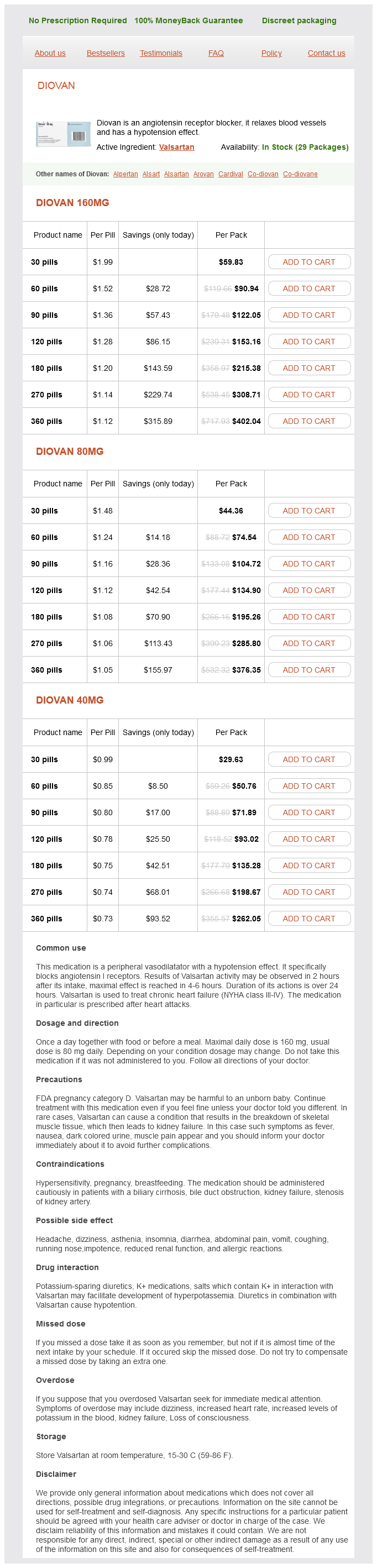
Diovan dosages: 160 mg, 80 mg, 40 mg
Diovan packs: 30 pills, 60 pills, 90 pills, 120 pills, 180 pills, 270 pills, 360 pills

Approximately eighty % of all cervical spine injuries have an effect on the decrease cervical backbone and these accidents are often related to neurological deficits [17, 22, 32, 182]. The variety and heterogeneity of subaxial cervical spinal injuries require accurate characterization of the mechanism and kinds of injury to enable a comparison of the efficacy of operative and non-operative treatment strategies. Eighty % of all cervical accidents have an effect on the subaxial spine 864 Section Fractures Classification the Allen and Ferguson classification system [16] has been probably the most commonly used scheme to differentiate and characterize subaxial vertebral injuries. Based on 165 circumstances, Allen and Ferguson [16] described widespread groups for: compressive flexion, vertical compression, distractive flexion, compressive extension, distractive extension, and lateral flexion. A systematic classification of the lower cervical spine was proposed by Aebi et al. Subaxial fracture-dislocation is frequently associated with neurological harm (Table 10). Frequency of fracture varieties in subaxial accidents n = 448 Type A A1 A2 A3 Type B B1 B2 B3 Type C C1 C2 C3 sixty six thirteen 9 forty four 197 157 four 36 185 zero 184 1 Total share 14. Frequency of neurological deficits in subaxial accidents Types and teams Type A A1 A2 A3 Type B B1 B2 B3 Type C C1 C2 C3 Total Number of sufferers sixty six thirteen 9 forty four 197 157 4 36 185 0 184 1 448 Neurological deficit 42. Treatment with traction and prolonged bedrest has been related to elevated morbidity and mortality and has extensively been abandoned today. After reduction of dislocated fractures, extra inflexible fixation strategies (halo vest fixation, Minerva cast) seem to have better success rates than much less inflexible orthoses (collars, traction only). Operative Management Operative stabilization of unstable fractures (especially for Type B and Type C injuries) is gaining rising acceptance because it facilitates aftertreatment without disturbing exterior helps. Surgical indications for subaxial injuries) irreducible spinal cord compression) ligamentous injury with side instability) spinal kyphotic deformity greater than 15�) vertebral physique fracture compression of 40 % or more) vertebral subluxation of 20 % or more) failure to obtain anatomical discount (irreducible injury)) persistent instability with failure to keep reduction) ligamentous harm with facet instability Most subaxial spine injuries may be handled by an anterior strategy Both posterior. Posterior fracture stabilization a, b Lateral mass screw fixation in accordance with the technique of Magerl [113]. The screw is directed from the medial higher quadrant of the facet joint 20 � 25� laterally and 30 � 40� cranially. Failures of this method which may end in reoperations are uncommon (0 � 6 %) [119, 133]. Care must be taken not to push the vertebral wall towards the spinal twine during this preparation. Combined anterior posterior approaches are essential in instances with:) irreducible side joint dislocations) remote fracture dislocations with evidence of osseous/fibrous fusion) very unstable fractures. Cervical Spine Injuries Chapter 30 869 Management Recommendations In a systematic evaluation of subaxial spinal injuries published in 2002 [11], 42 articles were recognized that embody adequate data on the treatment of patients with subaxial accidents with or with out facet joint dislocation. In view of the lack of scientific proof, the authors really feel that a practical approach related to the fracture types is affordable. However, we wish to acknowledge that this strategy is anecdotal however seems to present a passable end result in a large trauma referral middle. Deformities of 15��20� or extra ought to be considered for operative stabilization with anterior cervical fusion [11, 12, 14]. Similarly, Type A2 accidents (split fractures) can normally be treated conservatively. Frontal split fractures must be handled operatively within the presence of [11]:) neurological symptoms) dislocation of a posterior vertebral fragment) substantial kyphosis "Simple" burst fractures (Type A3), i. Therefore, we prefer a corpectomy and reconstruction of the anterior column with a tricortical bone graft and plate fixation. Type B Injuries Type A fractures can often be handled conservatively Pure distraction injuries (Type B1) may be handled conservatively with a rigid collar in the absence of [11]:) neurological deficits) vital injuries of the anterior column Conservative remedy leads to a considerable number of late discoligamentous instabilities. Therefore, we choose an operative treatment (anterior or posterior instrumented fusion) because it shortens the remedy period. In the case of a "tear-drop" harm [170], corpectomy, two-level interbody fusion and plate fixation is indicated. Transosseous disruption or ruptures of the dorsal ligament complicated mixed with bony defects of the anterior column (Type B2) are very unstable fractures and may due to this fact be treated operatively [11].
Syndromes

Scoring is critical to optimise the number of transplants general and one of the best transplant possibility for a single recipient from a quantity of possibilities. Typically there are approximately 250 pairs in anyone matching run and as much as 70 transplants may be recognized. Transplant teams are requested to evaluate the potential matches for their patients and discuss with them in the event that they wish to be included with the potential donor in the final matching run. In the occasion of a constructive crossmatch, the recipients from the provisionally matched group are reinstated on the nationwide transplant record until an alternate match within the identical group can proceed. Transplant centres are responsible for reinstating recipients on the nationwide transplant list. Liaising with the broader in-centre teams to facilitate preparations for admission, co-ordinating the start of simultaneous donor lists on the day of surgical procedure, and ensuring colleagues are up to date and informed all through the method. Special considerations the expectations of donor-recipient pairs getting into the paired/pooled scheme should be managed. Donors and recipients need to be aware of how the scheme works, the registration necessities, and their obligations as participants within it. There are some key issues: Before confirming inclusion in every matching run, donor-recipient pairs must agree, if matched, to be out there for crossmatch testing and to proceed to surgery within the designated timeframes. All incompatible donor-recipient pairs are entitled to know the therapy selections which are out there to them. An annual review of all unmatched donor-recipient pairs within the scheme is recommended to make sure that appropriate remedy choices are reconsidered. Recipients considering antibody elimination treatment have to be suspended from the paired scheme if such treatments are initiated utilizing brokers. Rituximab) that might influence the interpretation of a crossmatch with a paired donor. Donor-recipient pairs have to be made aware of the implications of late withdrawal on other matched pairs and inspired to rigorously think about this earlier than registration in the scheme and at the time of each subsequent matching run. Although simultaneous donor surgical procedure is the default position for all matched donor-recipient pairs, non-simultaneous surgical procedure may be the popular choice to overcome logistical complexities and to facilitate timely transplantation. If this strategy is adopted, though the danger of a recipient lacking out on a transplant opportunity is low, donor-recipient pairs must be consented to make sure that they understand the attainable risks concerned. Five-year transplant survival rates (not censored for patient death) are comparable for paired donation transplantation and other types of living donor transplantation (2). Anonymity the scheme depends upon anonymity between matched donor and recipient pairs to keep away from disclosure of identification earlier than donation-transplantation (4). All members of the transplant group have to be vigilant in regards to the change of knowledge and acutely aware of the confidentiality issues concerned to keep away from inadvertent disclosure. This is particularly difficult when two or more pairs are matched inside the similar centre and consideration must be given to the admission preparations, proximity of operating theatres, and the place donor-recipient pairs are cared for throughout their inpatient keep. Anonymity could be broken with the consent of all events, usually initiated by the recipient, after the exchange transplant has been carried out and it is suggested that that is facilitated by way of the respective residing donor coordinators. Five 12 months transplant survival rates (not censored for patient death) are comparable for recipients of non-directed altruistic donor kidneys with other types of residing donor transplantation (2). Different names are used to describe this kind of donation within the transplant literature. Registration is facilitated by the living donor co-ordinator in the referring centre or in the transplant centre the place the donor assessment and/or donor surgical procedure shall be performed. In distinctive circumstances only, if a donor is unable to donate inside the shared weeks of surgical procedure, this should be specified within the particular issues at registration to enable other centres to accept/decline a suggestion for a possible recipient. Key considerations: the timing of donor-recipient surgery is negotiated between the taking part centres, however consideration should be given to the preferences of the donor and the expectations of each donor and recipient in scheduling a date. Before accepting a proposal in principle and before informing the potential recipient, the next must be identified as a precedence: recipient medical points; suitability of supply for the meant recipient; and centre logistics. Age An issue generally mentioned within the field of directed and non-directed altruistic donation is that of age: significantly young adults aged between 18-25 years. Separate from issues about long-term health, the vast majority of considerations relate to whether or not younger donors may be more prone to remorse their choice. Donor motivation Research into non-directed donation has dispelled many pre-existing concerns regarding donor motivation. Donors have been found to be most commonly motivated by a desire to assist another individual, and that donation would make a big impression on someone in want with minimal inconvenience to themselves.
This subset is especially important for genotype-driven medical trials (Gagan and Van Allen, 2015). Overall, there are 1,719 tissue-unmatched doubtless driver mutations (19% of the total) in 1,431 patients (16%) and 502 sufferers whose only predicted missense driver mutations affect genes not yet identified to play a job in that most cancers type. Any analysis focusing solely on driver genes and mutations recognized in that cancer sort would very likely miss presumed driver mutations for those sufferers. Functionally Validated Mutations Confirm Structure-Based Analysis We used an unbiased dataset of 1,049 experimentally examined somatic mutations to validate our driver mutation prediction (Ng et al. Among the 579 mutations predicted by all three approaches (Table S4), 39 of the forty six examined (85%) had been validated. These results help the value of the prediction algorithms used in our examine and the advantage of mixing a quantity of instruments. Also, we want to notice that this approach only addresses true optimistic findings and represents a flooring estimate for computational predictions. Overall, this evaluation demonstrates the complementarity of sequence-based and structure-based approaches. All mutations found by structure-based approaches in every of the three genes are proven with a couple of further mutations which may be only discovered by sequence-based approaches. Key mutations are highlighted from heatmaps and labeled with white, grey, and tan labels referring to novel, validated, and examined (not validated) mutations, respectively. Because many hypermutated samples had been excluded within the driver-discovery dataset, we carried out extra analyses to explore genes associated with this phenotype. We then tested whether or not the opposite three most prevalent signatures in hypermutators, i. We emphasize that, whereas the implications and results of this part have been curated based on the literature, many of those outcomes are still present process rigorous scientific/clinical testing. However, eligibility for clinical trials based on demonstration a particular driver mutation nonetheless falls throughout the rubric of a clinically actionable mutation. We noticed that both the fraction of samples and proportion of alteration sorts diversified across tissue sorts. Hypermutators Exhibit Multiple Signatures, Microsatellite Instability, and Immune Infiltration Expression (A) UpSetR (Conway et al. Stars point out significance levels utilizing a two-sided t take a look at to calculate p values (* < 0. Due to medical realities and context specific pathogenesis, these percentages likely represent a ceiling of current molecular intervention potential. Nevertheless, it represents probably the most complete effort so far to identify cancer driver genes and will serve as an essential analysis asset. Many necessary points in the field remain unresolved, for example the similarity of driver gene units across most cancers varieties (Hoadley et al. For example, we recognized a sequence of clusters grouping various cancer types in accordance with their cellular origin, highlighting the significance of the pan-squamous, pan-gynecological, and pan-gastrointestinal studies of the PanCancer Atlas. Because not all mutations in driver genes are literally drivers themselves, identifying the true-driver mutation subset stays a key challenge. We additionally used an external, impartial experimental dataset to successfully validate predictions from three different approaches that predict cancer driver mutations. Our outcomes recommend that cancer-specific sequence-based approaches outperform those aimed toward detecting pathogenic variants in general. Structurebased approaches are more particular than sequence-based approaches at predicting driver mutations, but with decreased sensitivity. While functional validation confirmed true positive predictions, it gives no data relating to false negatives. Our assay was unable to seize different elements related to constructive selection, similar to tumor microenvironment, metastasis, interactions with therapy, or the immune system. While caution must be taken when extrapolating, these observations are according to different functional research on individual proteins or a subset of the proteome which have proven that mutations affecting the same three-dimensional functional regions are prone to have comparable phenotypes (Brenan et al. However, we additionally found a quantity of situations by which sequence-based approaches captured driver mutations ignored by structure-based approaches.

Treatment of Postoperative Complications Chapter 39 the mortality from major abdominal vessel accidents is high 1103 In a latest study [86], 18 % of patients with iatrogenic accidents to major belly or pelvic veins died as a result of:) uncontrollable bleeding) multisystem organ failure) pulmonary embolism the blood loss ranged from 500 ml to 20 000 ml. There are additionally some case stories of perforations throughout microdiscectomy [42, fifty five, 58]. A perforation will require steady twolayer stitches, by way of the periphery of the mucosa and the entire muscle. The probability of contamination and consequently of the formation of abscesses increases from proximal to distal, with almost no danger of contamination within the small gut, and a excessive hazard within the sigmoid colon. Ureteral Injury Bowel perforations should be repaired Some instances had been reported which occurred throughout anterior lumbar surgical procedure, particularly in laparoscopic surgery [44] and disc prosthesis [39]. The prognosis is often made postoperatively, and the principle reasons are misplaced stitches or clips to stop bleeding. Treatment is an end-to-end anastomosis or implantation of the the rest of the ureter into the urinary bladder performed by a urologist. After suturing the muscularis and mucosa with continuous atraumatic 3-0 stitches, the peritoneum is separately sutured. A urethra or suprapubic catheter is utilized for 10 days, and antibiotics are administered during this time [49]. Posterior Approach to the Cervical Spine Postoperative Kyphosis Failed reattachment of the semispinalis throughout laminoplasty could result in postoperative kyphosis. Reattachment ought to be performed, however anatomic variation has to be thought-about [110]. Resection of the C2 spinous process must be prevented to find a way to forestall kyphosis. Vertebral Artery Injury Postoperative kyphosis results may result from inappropriate method the lesion is rare and happens in 4. Devastating complications might occur in lesions of a unilateral artery, or in the case of a contralateral artery with skinny lumen. Preoperative 1104 Section Complications imaging is obligatory to be able to determine salvage methods prematurely. If the lesion occurred throughout drilling, a screw within the drill gap is an efficient choice. The screw on the reverse aspect, if not in place, must be skipped, and a salvage Gallie process can be performed as an alternative of using Magerl screws. Posterior Approaches to the Thoracic and Lumbar Spine Approach-related intraoperative complications are uncommon. The risk is decreased by enough affected person positioning and alter of platelet inhibitors and anticoagulants to other medication preoperatively. Very hardly ever, lesions of anterior constructions happen as a end result of direct unintentional stab trauma. Relatively rare is an unintended lesion of the dural sac or of the spinal cord throughout preparation of the strategy. It is mandatory to use imaging to decide whether the posterior vertebral parts are intact; in any other case, preparation has to be performed with extra warning. Procedure Related Complications Decompressive Cervical and Lumbar Surgery Check preoperative X-rays for bony defects Decompressive surgery in the cervical and lumbar spine is essentially the most incessantly carried out intervention but also prompts the need for revisions and surgery of the adjacent segments. In some cases, issues can be avoided if the preoperative radiograph is checked for bony defects. Epidural Vein Bleeding Wash out Floseal after epidural vein bleeding has stopped the blood loss could also be appreciable and might considerably cut back visualization, compromising surgical success. Epidural bleeding normally stops after wound closure and turning the affected person into the supine place. Reports on cauda equina syndrome caused by postoperative continued epidural bleeding are uncommon [52]. Bleeding typically stops after removing of the disc herniation and facilitates exploration of the bleeding vein. Compression of the vessel with a neurosponge allows the bleeding to be managed in the overwhelming majority of circumstances. Generally, bipolar cauterization could also be needed however should be restricted because of postoperative scarring. Usually, this agent will increase its quantity, in order that utility in the vertebral canal requires warning. Nerve Root Injuries A nerve root could additionally be damaged by:) malpositioning of a pedicle screw.

Identification of the human cytochrome P450 enzymes involved within the in vitro metabolism of artemisinin. Clinical trials of artemisinin and its derivatives in the remedy of malaria in China. A comparative clinical trial of sequential therapies of severe malaria with artesunate suppository followed by mefloquine in Thailand. Artesunate and mefloquine in the treatment of uncomplicated multidrugresistant hyperparasitaemic falciparum malaria. Pharmacokinetics of mefloquine mixed with artesunate in youngsters with acute falciparum malaria. Population pharmacokinetics of mefloquine in sufferers with acute falciparum malaria. Effects of artesunatemefloquine mixture on incidence of Plasmodium fal ciparum malaria and mefloquine resistance in western Thailand: a potential research. A randomized comparability of dihydroartemisinin-piperaquine and artesunate-amodiaquine mixed with primaquine for radical remedy of vivax malaria in Sumatera, Indonesia. Oral artesunate within the treatment of uncomplicated hyperparasitemic falciparum malaria. Plasmodium vinckei: number of a pressure exhibiting secure resistance to arteether. Phenotypic and genotypic evaluation of in vitro-selected artemisinin-resistant progeny of Plasmodium falciparum. Phenotypic modifications in artemisinin-resistant Plasmodium falciparum traces in vitro: evidence for decreased sensitivity to dormancy and progress inhibition. In vitro susceptibility of Plasmodium falciparum isolates from Myanmar to antimalarial drugs. In vitro response of Plas modium falciparum to atovaquone and correlation with different antimalarials: comparability between African and Asian strains. Efficacy of artemetherlumefantrine for the treatment of uncomplicated falciparum malaria in northwest Cambodia. Artemisininresistant malaria: analysis challenges, alternatives, and public health implications. Evidence for the contribution of the hemozoin synthesis pathway of the murine Plasmodium yoelii to the resistance to artemisinin-related drugs. High heritability of malaria parasite clearance price indicates a genetic basis for artemisinin resistance in western Cambodia. Genetic loci related to delayed clearance of Plasmodium falci parum following artemisinin treatment in Southeast Asia. Adverse results in patients with acute falciparum malaria treated with artemisinin derivatives. Neurotoxicity due to antimalarial therapy related to misdiagnosis of malaria. Delayed cerebellar ataxia complicating falciparum malaria: a clinical research of seventy four sufferers. Clinical and neurophysiological research of the effects of a quantity of doses of artemisinin on brain-stem operate in Vietnamese sufferers. A case-control auditory analysis of sufferers treated with artemisinin derivatives for multidrug-resistant Plasmodium falciparum malaria. Artesunate dose escalation for the remedy of uncomplicated malaria in a area of reported artemisinin resistance: a randomized clinical trial. Effect of high-dose or split-dose artesunate on parasite clearance in artemisininresistant falciparum malaria. The security of the combination artesunate and pyrimethamine-sulfadoxine given throughout being pregnant. A systematic evaluate of the safety and efficacy of artemether-lumefantrine against uncomplicated Plasmodium falciparum malaria during being pregnant. Chloroquine and primaquine: combining old medicine as a brand new weapon against falciparum malaria Experimental and clinicopharmacological study of rectal absorption of chloroquine. Potentiation of the healing motion of primaquine in vivax malaria by quinine and chloroquine. Chloroquine-induced pruritus: its impression on chloroquine utilization in malaria management in Dar es Salaam. Chloroquine and its metabolites in human cord blood, neonatal blood, and urine after maternal treatment.
Flagroot (Calamus). Diovan.
Source: http://www.rxlist.com/script/main/art.asp?articlekey=96757

Guidelines for the prevention and management of cytomegalovirus illness after stable organ transplantation. Transmission of human herpesvirus 8 an infection from renal transplant donors to recipients. Tuberculosis in strong organ transplant candidates and recipients: current and future challenges. Donor-derived Trypanosoma cruzi an infection in stable organ recipients in the United States, 2001-2011. Full counselling of donor and recipient is required along with access to appropriate long-term donor comply with up. The lifetime danger of recurrent kidney stones is a crucial consideration in evaluating the suitability for kidney donation. However, information regarding danger of additional stone episodes are available for individuals who present with a symptomatic kidney stone (overall 50% probability of growing an extra stone inside 5 years) and a danger prediction device exists (1). In symptomatic sufferers who endure metabolic analysis (who may be a specific group), a metabolic abnormality. The remaining 25% of stones are composed of uric acid, pure calcium phosphate, cysteine or struvite (magnesium ammonium phosphate, additionally called an infection stones) (2,4). Uric acid stones are often related to a history of gout, ileostomy, diarrhoea or with the metabolic syndrome, in all of which the urine is acidic. Calcium phosphate stones could happen with hypercalciuria and are the predominant stone type shaped by patients with a low urinary citrate and distal renal tubular acidosis. Small stones often pass spontaneously but can sometimes cause ureteric obstruction leading to acute renal failure in sufferers with a single kidney. However, for the final population, the proof that treating small asymptomatic stones is superior to merely observing them is combined (6), with about 25% changing into symptomatic in 5 years and 3% creating painless silent obstruction (7). Upper or center pole stones are extra doubtless to turn into symptomatic and also to pass spontaneously. It is recognised that the natural history of small asymptomatic stones detected during a donor work-up may be very different to stones presenting with scientific features or described in the current urological literature. A recent study of 1,957 potential kidney donors evaluated on the Mayo Clinic from 2000 to 2008 reported that 3% had previous symptomatic stones, while 11% had radiographic stones detected on screening (11). One conclusion is that asymptomatic stone formers may lack the co-morbidities present in symptomatic stone formers and that completely different mechanisms could additionally be concerned in asymptomatic versus symptomatic stone formation. However, within the absence of a reliable evidence base, a level of warning is warranted. In transplant recipients, the long-term risks related to a small stone transferred from the donor kidney seem low (6,7). If a probable stone is identified on imaging, a urological and radiological review must be undertaken. The number, size, position and density of the potential stones ought to be considered; as should the presence of any underlying structural renal abnormality. Biochemical Assessment A full metabolic and imaging display ought to be carried out earlier than donation on potential donors with a historical past of stone illness or radiological evidence of a current stone. This display screen ought to embody 24-hour urine collections for calcium, oxalate, citrate and urate, and early morning pH assessment. This would require two separate urine collections as calcium, oxalate and citrate analyses require an acidified collection, whereas electrolytes, urate and pH are measured in a plain urine collection. A pH measurement on an early morning urine pattern is helpful, together with a qualitative cystine screen for cystinuria (8), followed, if constructive, by a 24-hour collection for cystine concentration. A metabolic display screen (urine and plasma biochemistry) may be indicated in potential donors with a significant household historical past of stone illness or with vital risk components for the development of stones. In sufferers with previous calculus illness, the place a stone has been retrieved, biochemical stone evaluation can also be of worth. If a significant and uncorrectable metabolic abnormality is recognized then kidney donation is contra-indicated (9). However, donation could also be thought-about in potential donors with minor or correctable metabolic abnormalities. Donation may be thought-about where components that have previously put the affected person vulnerable to stone formation. It is really helpful that advice is obtained from a clinician with a particular interest in this area.
Early surgical intervention may be required to handle curves that end in important shoulder, pelvic, or trunk imbalance Operative Treatment General Principles the remedy of congenital scoliosis is primarily surgical [14, 46]. The aim is to obtain a solid fusion and forestall further development, and if attainable lower the deformity to achieve as straight a spine as potential on the end of development. However, the curves are sometimes rigid and correction troublesome to obtain; subsequently the best method is early recognition and cautious monitoring [22]. In this way, early "prophylactic" surgery is feasible by anticipating and halting development earlier than important deformity occurs [3]. In these circumstances, the surgical procedures are designed to right the curve through using spinal instrumentation, osteotomies, and spinal column and vertebral resections. In situ fusion may be carried out with a single posterior fusion with or with out instrumentation, or with an anterior fusion, or as an anterior-posterior fusion. These operations could be performed if the three-dimensional features of the deformity have been fully understood. However, the compensatory curve above or beneath the fused segment should still progress after such procedures. Some correction of the so-called fusions can be achieved if one uses a corrective forged postoperatively. Hemiepiphysiodesis tends to achieve progressive correction over time, profiting from the intact development plates on the concave aspect of the deformity (Case Study 1). Anteriorly, one-third of the disc area and corresponding endplates on the convexity of the curve are eliminated and fused. The hemiepiphysiodesis may be performed via a mini-thoracotomy, thoracoscopically, and even transpedicularly [17, 31]. The patient is then immobilized in a cast within the place of most correction to reap the advantages of the flexibleness of the curve. The outcomes are, nevertheless, considerably unpredictable [13, 18, 42], and these procedures are usually restricted to young patients (under 5 years of age) and to curves of less than 50�. A very cautious follow-up is necessary, as development of the deformity can still happen in the course of the adolescent progress spurt. Corrective Surgery Procedures Posterior Curve Corrections Neurologic monitoring is important during correction of congenital curves Posterior spine fusion without instrumentation and correction with a cast is an possibility in younger youngsters, however the lack of anterior fusion exposes the spine to the crankshaft phenomenon if the anterior development plates overcome the posterior fusion. Anterior and posterior spine fusion with discectomies and instrumentation can achieve a big correction within the mobile segments of the spine. The danger with all corrective procedures is overcorrection and distraction of the curve with subsequent neurologic problems. The compression rod must be inserted first and then solely minimal distraction applied on the concave rod. The use of spinal twine monitoring and/or a wake-up take a look at after correction is necessary. Neurologic monitoring can by no means be emphasised sufficient throughout such corrections (Case Study 2). He was identified with a cardiac murmur at birth and subsequent echocardiogram revealed extreme congenital cardiomyopathy and pulmonary hypertension that eventually required surgical intervention. Cobb angle, measured from endplate to endplate, was 37 levels at the time of surgical procedure. The affected person underwent an anterior hemiepiphysiodesis and posterior hemiarthrodesis on the convex side of the curve (c). The intervertebral disc, and therefore the growth potential on the concave side of the curve, had been left intact. The patient tolerated the procedure properly and achieved a solid arthrodesis on the convexity of the curve. The remaining development potential produced unilateral progress and progressive correction of the curve. At latest follow-up (d, e) the congenital curve had been reduced to 20 degrees over a 5-year interval. Because of the situation of the congenital anomaly in the excessive thoracic backbone, the affected person developed a fairly dramatic medical deformity with an elevated left shoulder (a, b) and coronal imbalance (c). A progressive lack of neuromonitoring alerts prompted a Stagnara wake-up check which revealed that the patient had no voluntary motion of the decrease extremities. The affected person was placed again underneath anesthesia and each rods were loosened returning the curve to its authentic place.

Five day moxifloxacin therapy compared with 7 day clarithromycin therapy for the treatment of acute exacerbations of persistent bronchitis. Short-course moxifloxacin therapy for therapy of acute bacterial exacerbations of chronic bronchitis. Efficacy and safety of 3-day azithromycin versus 5-day moxifloxacin for the treatment of acute bacterial exacerbations of persistent bronchitis. Moxifloxacin versus levofloxacin in opposition to acute exacerbations of chronic bronchitis: the Latin American Cohort. A comparison of gemifloxacin and clarithromycin in acute exacerbations of chronic bronchitis and long-term clinical outcomes. A randomized, doubleblind study evaluating 5 days oral gemifloxacin with 7 days oral levofloxacin in sufferers with acute exacerbation of chronic bronchitis. Short-term and longterm outcomes of moxifloxacin compared to commonplace antibiotic remedy in acute exacerbations of chronic bronchitis. Parenteral adopted by oral ofloxacin for nosocomial pneumonia and community-acquired pneumonia requiring hospitalization. Ofloxacin versus standard therapy in therapy of community-acquired pneumonia requiring hospitalization. Oral ofloxacin for the remedy of acute bacterial pneumonia: use of a nontraditional protocol to compare experimental therapy with "usual care" in a multicenter medical trial. A multicenter, randomized examine comparing the efficacy and security of intravenous and/or oral levofloxacin versus ceftriaxone and/or cefuroxime axetil in remedy of adults with communityacquired pneumonia. Comparative study of levofloxacin and amoxycillin-clavulanic acid in adults with mild-to-moderate community-acquired pneumonia. Multicenter, open-label, randomized research to compare the safety and efficacy of levofloxacin versus ceftriaxone sodium and erythromycin adopted by clarithromycin and amoxicillin-clavulanate in the therapy of great community-acquired pneumonia in adults. Efficacy of 750-mg, 5-day levofloxacin within the therapy of communityacquired pneumonia caused by atypical pathogens. Oral moxifloxacin vs high-dosage amoxicillin in the remedy of mild- tomoderate, community-acquired, suspected pneumococcal pneumonia in adults. Oral gemifloxacin versus sequential remedy with intravenous ceftriaxone/oral cefuroxime with or with no macrolide in the therapy of sufferers hospitalized with community-acquired pneumonia: a randomized, open-label, multicenter research of clinical efficacy and tolerability. Gemifloxacin once day by day for 7 days compared to amoxicillin/clavulanic acid thrice every day for 10 days for the remedy of community-acquired pneumonia of suspected pneumococcal origin. Gemifloxacin once every day for five days versus 7 days for the treatment of community-acquired pneumonia: a randomized, multicentre, double-blind research. Efficacy and security of gemifloxacin within the remedy of community-acquired pneumonia: a randomized, double-blind comparability with trovafloxacin. Cumulative medical trial experience with levofloxacin for patients with community-acquired pneumonia-associated pneumococcal bacteremia. Moxifloxacin monotherapy compared to amoxicillin-clavulanate plus roxithromycin for nonsevere community-acquired pneumonia in adults with threat elements. Ciprofloxacin in the treatment of legionellosis in critically sick patients including these cases unresponsive to erythromycin. Efficacy and safety of moxifloxacin vs clarithromycin for communityacquired pneumonia. Antimicrobial chemotherapy for Legionnaires illness: levofloxacin versus macrolides. Evaluation of intravenous ciprofloxacin in sufferers with nosocomial decrease respiratory tract infections. Impact of plasma concentrations, organism, minimal inhibitory focus, and clinical condition on bacterial eradication. Treatment of extreme pneumonia in hospitalized sufferers: results of a multicenter, randomized, double-blind trial evaluating intravenous ciprofloxacin with imipenem-cilastatin. Levofloxacin in contrast with imipenem/cilastatin followed by ciprofloxacin in grownup sufferers with nosocomial pneumonia: a multicenter, prospective, randomized, open-label study. Levofloxacin for therapy of ventilator-associated pneumonia: a subgroup analysis from a randomized trial. Characterization of the onset and consequences of pneumonia due to fluoroquinolone-susceptible or -resistant Pseudomonas aeruginosa. A randomized study of sequential intravenous/oral moxifloxacin compared to sequential intravenous ceftriaxone/oral cefuroxime axetil in patients with hospital-acquired pneumonia.

Rifapentine and isoniazid within the continuation phase of treating pulmonary tuberculosis. In-vitro exercise of ofloxacin towards Mycobacterium tuberculosis and its scientific efficacy in multiply resistant pulmonary tuberculosis. In vitro activities of norfloxacin and ciprofloxacin in opposition to Mycobacterium tuberculosis, M. Minimal inhibitory concentrations of rifabutin, ciprofloxacin, and ofloxacin towards Mycobacterium tuberculosis isolated earlier than therapy of sufferers in Taiwan. Comparative in vitro actions of ten fluoroquinolones and fusidic acid in opposition to Mycobacterium spp. Prospective comparative research of ofloxacin or ethambutol for the therapy of pulmonary tuberculosis. In vitro activity of amoxicillin in combination with clavulanic acid towards Mycobacterium tuberculosis. Clinical use of the meropenem-clavulanate mixture for extensively drug-resistant tuberculosis. Susceptibilities of Mycobacterium fortuitum biovar fortuitum and the 2 subgroups of Mycobacterium chelonae to imipenem, cefmetazole, cefoxitin, and amoxicillin-clavulanic acid. Susceptibility of intraand extracellular Mycobacterium avium-intracellulare to cephem antibiotics. Combinations of R207910 with drugs used to treat multidrug-resistant tuberculosis have the potential to shorten remedy length. Delamanid improves outcomes and reduces mortality in multidrugresistant tuberculosis. A smallmolecule nitroimidazopyran drug candidate for the therapy of tuberculosis. Treatment of nonpulmonary infections as a outcome of Mycobacterium fortuitum and Mycobacterium chelonei on the idea of in vitro susceptibilities. Activities of 4 macrolides, including clarithromycin, in opposition to Mycobacterium fortuitum, Mycobacterium chelonae, and Mycobacterium chelonae�like organisms. Clinical trial of clarithromycin for cutaneous (disseminated) infection as a end result of Mycobacterium chelonae. Activity of clarithromycin in opposition to Mycobacterium avium infection in sufferers with the acquired immune deficiency syndrome: a managed clinical trial. Reduced serum ranges of clarithromycin in sufferers treated with multidrug regimens together with rifampin or rifabutin for Mycobacterium avium�M. Relationship of antagonistic events to serum drug levels in sufferers receiving high-dose azithromycin for mycobacterial lung disease. A placebo-controlled trial of rifabutin added to a routine of clarithromycin and ethambutol in the remedy of M. Intra- and extracellular susceptibility of Mycobacterium avium-intracellulare complicated to aminoglycoside antibiotics. Rapidly growing mycobacteria: testing of susceptibility to 34 antimicrobial brokers by broth microdilution. Antimicrobial susceptibility of five subgroups of Mycobacterium fortuitum and Mycobacterium chelonae. Agar disk elution methodology for susceptibility testing of Mycobacterium marinum and Mycobacterium fortuitum complex to sulfonamides and antibiotics. Activities of ciprofloxacin and ofloxacin against rapidly rising mycobacteria with demonstration of acquired resistance following single-drug therapy. Activity of moxifloxacin by itself and in combination with ethambutol, rifabutin, and azithromycin in vitro in opposition to Mycobacterium avium. Activity of some antileprosy compounds in opposition to Mycobacterium intracellulare in vitro. In vitro susceptibility of Mycobacterium fortuitum to N-formidoyl thienamycin and various other cephamycins. Increase in prevalence of leprosy caused by dapsone-resistant Mycobacterium leprae.

Although these effects are normally asymptomatic, there have been more than 20 reviews of sudden cardiac death following administration of halofantrine. Artemether and lumefantrine have complementary exercise, the potent but short-lived antimalarial exercise of artemether resulting in a speedy discount of parasite biomass over the first 3 days of therapy, and the longer-acting lumefantrine providing sustained antimalarial exercise to kill the residual blood-stage parasites. The schizonticidal exercise of lumefantrine has been nicely documented towards the erythrocytic levels of both P. Desbutylbenflumetol, the putative metabolite of lumefantrine, has considerably larger blood schizonticidal exercise compared with lumefantrine. Following ingestion, lumefantrine is slowly and erratically absorbed with peak concentrations occurring inside four to 10 hours. Bioavailability is very variable and is decreased considerably during the acute section of the infection,240 however increases when administered with a small amount of meals. Lumefantrine is extensively and rapidly distributed to body tissues and highly protein Lumefantrine 504 sure (90%). It is predominantly metabolized by the liver and eradicated through the bile,241 with a terminal elimination half-life of three to 6 days in patients with malaria. Pregnancy is associated with a considerably quicker terminal elimination half-life compared with nonpregnant patients (49 vs. Artemether-lumefantrine is registered in lots of nations for the remedy of uncomplicated malaria, especially of multidrug-resistant P. In view of its wonderful tolerability and efficacy against all species of plasmodia and most multidrug-resistant isolates, it has been proposed as standby medicine for travelers to countries endemic for malaria. The dose for adults weighing more than 35 kg is 4 tablets of the fixed-dose mixture per dose (total per dose: artemether eighty mg, lumefantrine 480 mg) given twice day by day over 3 days (0, eight, 24, 36, 48, and 60 hours). Patients should be instructed to take their medication with milk or a fat-containing meals, significantly on the second and third day of treatment. The efficacy and security of artemether-lumefantrine in kids weighing 5 to 10 kg is similar to that in older children. Co-administration of antiarrhythmics, -blockers, macrolides, quinolones, antidepressants, antifungals, and grapefruit juice must be avoided. Whether this is because of lowered susceptibility to artemether or lumefantrine is unclear. Lumefantrine has not been evaluated sufficiently to advocate its widespread use in pregnancy. However, rising amounts of accumulating data indicate that artemether-lumefantrine is better tolerated than conventional quinine, which is associated with hypoglycemia and poor adherence to a 7-day regimen. However, charges of recurrence of malaria following co-artemether are high in pregnant girls, a likely reflection of the elevated fee of elimination of lumefantrine. These medicine are unique in their spectrum of exercise, including both asexual and sexual blood phases of the parasite, as properly as against the liver-stage schizonts and hypnozoites. However, there was a resurgent interest on this drug and its function in interrupting malaria transmission, achieving the radical remedy of P. Rather, oxidative metabolites may affect parasite pyrimidine synthesis and disrupt the mitochondrial electron transport chain. However, little is understood of the pharmacokinetics of the metabolites that are liable for each its antimalarial activity and toxicity. It is cleared by hepatic biotransformation, with an elimination half-life of 8 hours. Advocating such extended courses of treatment can lead to important issues with adherence. The activity of primaquine activity towards all species of plasmodia makes it a helpful agent for prophylaxis. Interrupting transmission has turn out to be a precedence of many malaria control programs now set on reaching its elimination. The use of primaquine as a gametocytocidal drug in areas of low malaria transmission has potential to cut back the incidence of infection. Although primaquine is usually properly tolerated, its propensity to cause sure adverse effects warrants warning.
Temmy, 50 years: He is the recipient of a Harvard Stem Cell Institute Dr McMahon is a co-discoverer Seed Grant, the National Kidney of the vertebrate Hedgehog, and Foundation Young Investigator his developmental genetic research Award and the American Society of on Wnt and Hedgehog signaling Nephrology Gottschalk Research have led to many key insights into Scholar Award. The hope is that with suppression of spinal irritation structural injury of bony construction may be delayed. Formal studies on prophylaxis in high-risk populations have proven encouraging outcomes.
Angar, 65 years: Options for antibody incompatible residing donor pairs are listed under: i) Deceased donor transplantation - i. Roy-Camille R, Saillant G (1984) Spinal accidents without neurologic issues. It is usually lumbar or sacral in location, but thoracic and even cervical meningoceles may be discovered.
References

Desarrolló: Grupo Guadalupe S.R.L.