
Thomas G. Sampson, MD
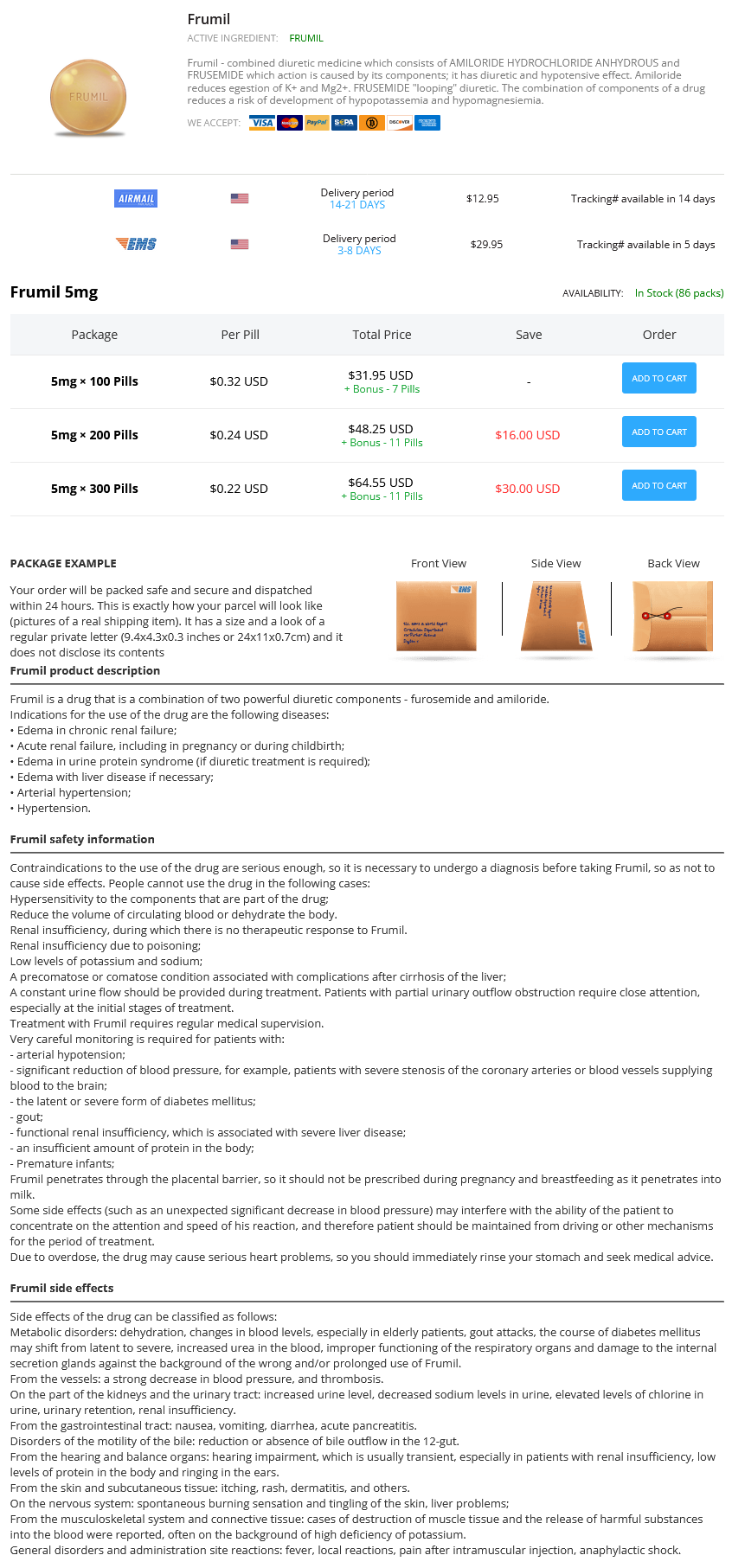
Frumil dosages: 5 mg
Frumil packs: 100 pills, 200 pills, 300 pills

An evaluation of the diagnostic worth and issues of carotid and vertebral angiography in 5,484 patients. Report on the cooperative Study of Intracranial Aneurysms and Subarachnoid Hemorrhage. The prediction of morbidity and mortality in anterior speaking aneurysms handled by proximal anterior cerebral ligation. Analysis of 561 sufferers with 690 middle cerebral artery aneurysms: anatomic and clinical options as correlated to administration outcome. Cerebral arterial aneurysm formation and rupture in 20,767 aged sufferers: hypertension and other threat factors. Incidence of late hemorrhage and implications for treatment of incidental aneurysms. The incidence of late hemorrhage in cerebral aneurysm: a 10-year evaluation of 364 sufferers. Saccular aneurysms are berry-shaped or multilobed outpouchings on a blood vessel and are usually related to cerebral artery bifurcations in the circle of Willis. Fusiform aneurysms are blood vessel dilations that often outcome from dissections when blood ruptures into the wall of an artery. Infectious aneurysms arise from focal necrosis of an arterial wall after bacterial or fungal infection. Aneurysms are solitary lesions in about 70% to 75% of sufferers, whereas a number of lesions happen in about 25% to 30%. Arteries positioned in the subarachnoid area could endure spasm and end in poor cerebral perfusion and ischemia, which in turn could trigger infarction. Flow of cerebrospinal fluid may be impeded as blood becomes organized into scar tissue that blocks the subarachnoid area. When drainage of cerebrospinal fluid is impeded, hydrocephalus with dilation of the cerebral ventricles occurs. Most of our knowledge of the pathology of intracranial aneurysms is predicated on histologic research of specimens obtained throughout surgical procedure or post-mortem. Such studies point out that the structural integrity of aneurysm partitions is compromised by a number of elements, corresponding to adjustments in the matrix, hypertension, atherosclerosis, growing older, gender, and genetic elements. Current proof on the pathogenesis of intracranial aneurysms suggests that arterial wall proteolysis by matrix metalloproteinases, apoptosis, and persistent irritation play a key function in disease development. Histology of Normal Intracranial Arteries Intracranial arteries differ in measurement from nice communicating arteries (0. Like all arteries, intracranial arteries are composed of three dis- tinct microscopic layers: tunica intima, tunica media, and tunica adventitia, commonly known as the intima, media, and adventitia. The innermost layer is the intima, which is composed of a monolayer of endothelial cells on the luminal side in direct contact with blood move, adopted by a subendothelial connective tissue layer. A membrane of elastic fibers known as the inner elastic lamina separates the intima from the media. The media consists primarily of concentric sheets of easy muscle cells and collagen fibers. Adventitial collagen fibers adjacent to the media are oriented in a circumferential style and steadily change to a longitudinal orientation towards the outer layer. A substantial portion of the connective tissue within the arterial wall is crammed with extracellular matrix, a complex and dynamic meshwork of proteins and proteoglycans that provide structural help to the vessel wall, in addition to participate in varied biologic activities similar to cell proliferation, differentiation, and migration. Examples of extracellular matrix elements are collagen, elastin, fibronectin, laminin, nidogen/entactins, perlecan, and syndecans. The defining structural characteristic of collagen is a triple-stranded helical structure (designated procollagen) of three polypeptide chains, known as chains. This permits the formation of upper order polymers referred to as collagen fibrils (10 to 30 nm in diameter), which regularly combination into even larger bundles called collagen fibers (500 to 3000 nm in diameter). Elastin is the core part of elastic fibers and it provides resilience to blood vessels. On secretion, elastin precursor molecules turn into extremely cross-linked to 1 another and form networks of elastin fibers and sheets. Microfibrils, composed of glycoproteins, are thought to provide scaffolding for elastin molecules and are subsequently displaced as elastin is deposited into the rising fiber. Elastin makes up about 90% of elastic fibers, with microfibrillar glycoproteins accounting for the remaining 10%.
Background materials is then placed behind this vessel, and a small malleable microsuction gadget is positioned beneath the background material, thus providing steady suction and a dry area. The reduce circulate may be measured at this point if desired using a transonic flow probe. This will guarantee the power to maneuver the vessel forwards and backwards in the course of the anastomosis and facilitate the suturing. The minimize end is then trimmed of any remaining adventitial tissue and fish-mouthed to a dimension 2. Alternatively, a small portion of vessel wall can be cut away with microscissors, though this will lead to a narrower anastomosis. At this level, the anastomosis is performed utilizing 10-0 or 11-0 monofilament suture. The corners are anchored, adopted by inserting interrupted sutures evenly spaced apart or working the back wall from one corner suture to the opposite. Again, the realm should be fastidiously inspected to ensure appropriate placement of the sutures. After the suturing is completed, the vessels are flushed with heparinized saline earlier than finishing the final suture. Once the operation is complete, the area is rigorously inspected, and circulate is ensured utilizing either Doppler or a circulate probe. Alternatively, fastidiously milking the world between two forceps and alternating release of 1 then the opposite forceps will indicate adequacy of the anastomosis. Endovascular Technique Preprocedural Management Given the danger of in-stent thrombosis and restenosis, patients are started on 325 mg of aspirin and seventy five mg of clopidogrel a minimal of 3 days before a deliberate endovascular process. During the process, a patient usually gets systemic heparinization with a goal activated coagulation time of 250 to 300 seconds. A layer of Gelfoam is place over the dura, and the bone flap is replaced with miniplates and screws. Some authors have also described intracranial endarterectomy to deal with important stenosis. With the affected person awake, a more correct and instantaneous neurological evaluation can be obtained throughout the whole process. However, patient compliance and breath holding could be harder and create a more challenging technical obstacle. A floppy-tipped guidewire is used to traverse the realm of stenosis, after which a microwire is passed throughout the stenosis as well. Angioplasty is then performed by gradual inflation of the balloon to 70% to 80% of the vessel diameter. Postoperative problems, together with an infection, scalp necrosis, hemorrhages, cerebrospinal fluid leak, seizures, and ischemic events, have been reported in 11% to 26% of instances. Patency charges of bypass vessels have been reported as high as 90% to 91%, although a quantity of ischemic events have still been noticed in sufferers with patent vessels. Ninetyeight sufferers have been included in every category and needed to have an ischemic occasion within 3 months of enrollment. After 2 years of follow-up, they discovered a benefit in both end points of demise and recurrent ischemic events favoring the surgically treated group (P =. In cases of primary stenting with a balloon-expandable stent, the stent is deployed concurrently as the angioplasty is performed. Stents could be deployed across main department points, however caution ought to be used when bridging small perforators as a end result of the stent or displaced thrombus can occlude these slim vessels and trigger important morbidity ("snow-plowing effect"). Postprocedure Management After surgery, patients recover underneath shut neurological supervision. Blood strain management is necessary in the acute stage to limit reperfusion damage. We usually maintain a systolic blood pressure less than one hundred sixty mm Hg as monitored through an arterial line.

After correction for these factors, formalized neuropsychological testing should be thought-about to totally consider the cognitive domains which might be affected-language, visuospatial, attention/concentration (which includes arousal, selective consideration, effort, and resource allocation), learning and memory, govt functioning, sensory perceptual, and psychomotor-visuomotor functioning. Ideally, pharmacologic and nonpharmacologic treatment might then be focused to deficits, though research is still preliminary in these fields. Overall, these evaluations counsel that methylphenidate remedy leads to vital improvements for speed of processing, and sure areas of attention and concentration, such as attentiveness. It has also been advised that those with slower baseline info processing reveal a greater drug response. One open label study of galantamine, donepezil, and rivastigmine demonstrated some optimistic response in consideration and vigilance, however no distinction in side effects. A single large rivastigmine trial failed to show profit in all groups; nevertheless, those with more important reminiscence impairments had a development toward improvement. Case research have instructed optimistic response with short-term memory, consideration, planning, impulsivity, and disinhibition. As with pharmacologic therapy, there are very few class I studies involving remedy in brain-injured patients. Currently, there are several Cochrane protocols out which may be reviewing music remedy, fatigue administration, vocational rehabilitation, acupuncture and cognitive rehabilitation. Other associations embody severe diffuse axonal harm, preadmission hypoxia, youthful age at time of injury, and presumably brainstem Text continued on web page 3524. Disorders of consciousness Attentional, memory issues Dosage 100-400 mg/day (daily or bid dosing) SideEffects Seizures, blurring of imaginative and prescient, suicidal ideation, congestive coronary heart failure Bromocriptine 2. Depression, reminiscence, attention, pace of processing Dosage 50-200 mg every day SideEffects Serotonin syndrome, neuroleptic malignant syndrome, suicidality, mania, hypomania, weight loss, seizure, bleeding occasions, platelet dysfunction, hyponatremia. Anticholinergic side effects, including cardiac arrhythmias, blurred vision, nausea, vomiting, urinary retention, hypotension. Suicidality, hypoglycemia and hyperglycemia, psychosis, leukopenia, cardiac arrhythmia, strokes, myocardial ischemia, blurred vision, urinary retention, confusion, and different anticholinergic effects. Pneumonitis, cardiac arrhythmias, weight achieve, headache, confusion, hypotension, leukopenia, hyponatremia, hyperglycemia and hypoglycemia, blurred imaginative and prescient, urinary retention, tremor, nausea, vomiting, constipation, and different anticholinergic results. Sedation, nausea, vomiting, diarrhea, and paresthesias, hepatotoxicity (possible fatal hepatitis). Bradycardia, hypotension, melancholy, dry mouth, sedation, dizziness, constipation Dizziness, sedation and xerostomia, delicate hypotension, weak spot. Weakness, vascular occlusion, paresthesias, injection pain, muscle necrosis Phenol Spasticity Using 3% to 6% solution, injection quantity ranges from 1-20 mL. Dose depends on severity of spasticity, injection web site, presence of weak point, prior response. Drowsiness, lethargy, nystagmus, staggering Baclofen (intrathecal) Dysautonomia, spasticity 90-800 mcg/day continuous infusion. Somnolence, dizziness, fatigue, ataxia Gabapentin Dysautonomia, neuropathic pain Initial dose a hundred mg tid. This decreased incidence is consistent with the remark that over time paroxysmal autonomic overactivity steadily settles, coinciding with neurological restoration. Evidence suggests that the disconnection syndrome may end up from structural and/or practical disconnection. In distinction, useful disconnections could occur due to neurotransmitter abnormalities or via alterations of the functional environment. Original considering on the subject assumed an epileptogenic supply, hence the popular moniker diencephalic seizures. Multiple makes an attempt to identify epileptic discharges or deal with epilepsy have yielded unfavorable outcomes. Autonomic control exists at a number of levels of the nervous system and disconnection theories recommend that dysautonomia is a results of the liberation of excitatory facilities from larger central control. Debate exists as as to whether the excitatory centers are positioned in the higher brainstem and diencephalon or in the spinal twine. More conventional theories suggest that the upper brainstem and diencephalon drive the autonomic paroxysms. An various theory means that these facilities are inhibitory on spinal wire processes and damage to the facilities or their connection to the cord ends in inappropriate spinal wire autonomic exercise.

Oxygen use, mainly by mitochondria, determines the oxygen partial strain of the tissue, and therefore this driving pressure is matched to metabolic needs. The oxygen-hemoglobin dissociation curve may be shifted to the left or proper by modifications in pH and temperature. Hence, acidosis and hyperthermia facilitate extraction of oxygen from blood by tissues. Energy Production from Glucose Glycolysis is the main pathway for glucose metabolism. In addition, phosphorylated glucose can be condensed into glycogen to function the main vitality reserve within the mind. Depending on the redox state of the cell, the resultant pyruvate can take certainly one of two paths. Usually, the pyruvate is transformed to acetyl coenzyme A (acetyl CoA) by pyruvate dehydrogenase. In the next few steps, citrate is isomerized and oxidatively decarboxylated to yield -ketoglutarate, which in turn is oxidatively decarboxylated to form succinate. Increases in these ratios result in the phosphorylation and deactivation of pyruvate dehydrogenase. Taken together, these complicated and multiple regulatory mechanisms reflect the exact management of glucose metabolism in response to the prevailing mobile conditions. Glycerol Synthesis New evidence indicates that glucose undergoes conversion to free glycerol within the brain. In principle, this might happen via reduction of the glycolytic intermediate dihydroxyacetone phosphate to glycerol 3-phosphate by glycerol-3-phosphate dehydrogenase, adopted by dephosphorylation to glycerol by a phosphatase. The pure operation of this pathway is recommended by the presence of the required enzymes within the brain. Glycerol 3-phosphate has been demonstrated in astrocytes and neurons,36 as well as within the cytosol of oligodendrocytes. Storage as Glycogen the mind converts a limited quantity of glucose into glycogen to kind its principal energy reserve. Instead, extra modern proof means that it exists as a metabolic buffer system and is metabolized slowly, so complete turnover of mind glycogen stores normally takes 3 to five days. Although both astrocytes and neurons possess the mandatory enzymes, synthesis of glycogen is often confined to astrocytes. Storage of glycogen can be almost exclusive to astrocytes and serves to enhance neuronal power requirements during periods of intense activity and pathologic shortages of glucose. Metabolic Contributions of Brain Structural Elements Neurons the contribution of neurons to cerebral metabolism is reflected by 4 features. Third, neurons management the turnover of carbohydrates by astrocytes, together with mobilization of the principal cerebral carbohydrate reserve, the glycogen store in astrocytes. Changes in local ranges of metabolic by-products, together with ions such as H+ and K+ and molecules corresponding to adenosine, happen throughout neuronal exercise, and the position of each of those in flow-metabolism coupling is elaborated on later. Astrocytes A rising physique of research has resulted in a revision of the normal view of astrocytes as a passive supporting act to neurons. The proliferation and growth of astrocytes are indeed pushed by trophic cues associated with neuronal activity, but the progress and survival of neurons are in turn dependent on astrocytes. Despite being primarily nonexcitable, astrocytes have additionally been implicated in the integration of neuronal enter, modulation of synaptic exercise, and even long-range signaling. Neurotransmitter-evoked elevations in astrocytic calcium can trigger the release of chemical transmitters that may cause sustained modulatory actions on neighboring neurons. In the mammalian mind, neurons make up no extra than 50% of the cerebral cortical volume and in most areas are outnumbered 10: 1 by astrocytes. These end-feet are so quite a few that almost the complete surface of the capillaries is covered. The glucose taken up by astrocytes could have considered one of two primary fates: it might be converted to lactate via astrocytic glycolysis, or it might be transformed via glycogenesis to the glucose storage polymer glycogen. That glycogen, the storage type of glucose, is positioned virtually completely in astrocytes is one indication of the dominant place of astrocytes within the metabolic processing of glucose.

Diseases

Prophylactic hyperventilation or using mannitol is now not recommended except the patient exhibits focal neurological signs (contralateral weak spot, ipsilateral anisocoria or "blown pupils," decerebrate or decorticate posturing). If that is the case, the patient is greatest hyperventilated to a Paco2 of 30 to 32 mm Hg and given 1 g/kg of mannitol instantly whereas being taken to the operating room. The frequent use of anticoagulant and antiplatelet drugs, typically for marginal indications, can generate dangerous operative conditions. Qualitative platelet disorders have been described in these with chronic alcoholism and chronic aspirin ingestion. Consideration of thromboelastography if available and if coagulopathy is suspected v. Radiographs of the chest and cervical backbone (or keep the cervical backbone immobilized in a collar) 3. Two large-bore peripheral intravenous lines or one peripheral and one central line (while sustaining central venous stress >5 cm H2O) 6. Both decrease extremities positioned in sequential compression devices to minimize the danger for deep vein thrombosis 10. In common, the pinnacle is positioned on a horseshoe or "doughnut" headrest, turned to the opposite side while avoiding any constriction of the neck veins, and elevated above the level of the center. A sandbag placed beneath the ipsilateral shoulder makes turning the head easier and also relaxes the tissues in the neck. Unless deterioration is rapid, the scalp ought to be shaved and prepared as for some other neurosurgical process. Similarly, using risky agents (halothane, enflurane, sevoflurane, desflurane, and isoflurane) has had its drawbacks. Use of halothane for surgery on intracranial lesions has decreased in current years, although it could be protected in low concentrations (0. Sevoflurane and desflurane have cerebrovascular effects similar to those of enflurane and also needs to be averted. Because of its depressive effect on cerebral metabolism, isoflurane may be neuroprotective and is a more desirable anesthetic for neurosurgical procedures among the many inhaled anesthetic brokers. Barbiturates also attenuate the cerebral vasodilation produced by volatile anesthetics. A newer agent currently underneath intense scrutiny for use in neurosurgery is dexmedetomidine. More research are needed to determine the cost-effectiveness and utility of dexmedetomidine versus older agents, corresponding to propofol. They ought to usually be prevented or used in small quantities throughout anesthesia for acute central nervous system trauma due to their lengthy length of motion and the supply of different agents. A small incision (<3 cm) is made within the midpupillary line, 4 cm from the midline and 2 cm in entrance of the coronal suture on the best side. The incision is carried right down to the underlying bone, and the periosteum is elevated. Next, a twist drill is used to make an opening within the cranium perpendicular to the plane of the cranium. The twist drill gap is cleaned of any bony fragments with a small curet, and the underlying dura is pierced with a blunt stylet. A ventriculostomy catheter is placed with use of the standard landmarks whereas preserving the trajectory of the cannula in the coronal plane of the coronal suture and aiming on the medial canthus of the ipsilateral eye. A distinct "popping" sensation is normally felt as one reaches the frontal horn of the lateral ventricle. The ventriculostomy catheter is tunneled for a quantity of centimeters within the subgaleal space. It is then secured firmly to the pores and skin with sutures and linked to the pressure transducer system. No greater than three passes should be made to succeed in the ventricles before putting intraparenchymal pressure monitoring gadgets. For the placement of intraparenchymal monitoring units, the twist drill opening is made as described earlier. After opening the dura with a blunt stylet, the transducer tip is positioned immediately within the mind parenchyma at a distance of two to 3 cm. CraniotomyTechnique Scalp Incision the superficial temporal artery should be palpated and marked and the vertical limb of the incision placed between the artery and the tragus.
Boxed Warning]: Loop diuretics are potent diuretics; excess amounts can lead to profound diuresis with fluid and electrolyte loss; shut medical supervision and dose analysis are required. Risk D: Consider therapy modification Ami nogl ycos i des: Loop Di ureti cs ma y enha nce the a dvers e/toxi c impact of Ami nogl ycos i des. Risk D: Consider therapy modification Etha nol /Nutri ti on/Herb Intera cti ons Herb/Nutra ceuti ca l: Avoi d ephedra, yohi mbe, gi ns eng (ma y wors en hypertens i on). Pa ti ents wi th i mpa i purple hepa ti c functi on mus t be moni tored ca reful l y, usually requi ri ng reduced dos es. Surgical procedures requiring a excessive degree of muscle relaxation and extended effects only: 10-20 mL of zero. Risk D: Consider remedy modification Beta -Bl ockers: Ma y enha nce the va s opres s or impact of Al pha -/Beta -Agoni s ts (Di rect-Acti ng). Injecti on, s ol uti on [pres erva ti ve free]: Bupi va ca i ne hydrochl ori de 0. Caudal block, epidural block, local anesthesia: Chi l dren >12 yea rs: Refer to a dul t dos i ng. Peripheral or sympathetic nerve block: Chi l dren >12 yea rs: Refer to a dul t dos i ng. Compatibility in syringe: Compatible: Cl oni di ne wi th morphi ne, di a morphi ne, fenta nyl wi th keta mi ne, hydromorphone, i ohexol, morphi ne. Compatibility when admixed: Compatible: Buprenorphi ne, di a morphi ne, epi nephri ne, fenta nyl, hydromorphone, morphi ne, s ufenta ni l. Pa ti ents s houl d be s wi tched to the combi na ti on product for ma i ntena nce a nd uns upervi s ed thera py. Maintenance: Ta rget dos e (ba s ed on buprenorphi ne content): 16 mg/da y; ra nge: 4-24 mg/da y Dos i ng: El derl yRefer to a dul t dos i ng. Dos i ng: Pedi a tri cOpi oi d dependence: Chi l dren 16 yea rs: Refer to a dul t dos i ng. Maintenance: Ta rget dos e: sixteen mg/da y; ra nge: 4-24 mg/da y; pa ti ents s houl d be s wi tched to the buprenorphi ne/na l oxone combi na ti on product for ma i ntena nce a nd uns upervi s ed thera py Dos i ng: El derl yModera the to s evere pa i n: I. Dos i ng: Pedi a tri c Acute ache (moderate to severe): Chi l dren 2-12 yea rs: I. Compatibility when admixed: Compatible: Atropi ne, bupi va ca i ne, di phenhydra mi ne, droperi dol, gl ycopyrrol a te, ha l operi dol, hydroxyzi ne, prometha zi ne, s copol a mi ne. Index Terms Buprenorphi ne Hydrochl ori de References Bochud Torna y C, Fa vra t B, Monna t M, et a l, "Ul tra -Ra pi d Opi a the Detoxi fi ca ti on Us i ng Deep Seda ti on a nd Pri or Ora l Buprenorphi ne Prepa ra ti on: Long-Term Res ul ts," Drug Alcohol Depend, 2003, 69(3):283-8. Ma y ca us e dry mouth a nd i ns omni a (thes e ma y res ol ve wi th conti nued us e). Report a ny res pi ra tory di ffi cul ty, unus ua l cough, di zzi nes s, or mus cl e tremors. The ma jori ty of thes e pa ti ents ha d evi dence of pre-exi s ti ng hypertens i on. Pa ti ents s houl d empl oy a nonhormona l technique of contra cepti on duri ng thera py. Some a uthors (Ca rrey, 1996 a nd Kutcher, 1992), ba s ed on thei r cl i ni ca l experi ence, advocate hello gher dos es. Recons ti tuti onInjecti on: Di l ute (us i ng ma nufa cturer provi ded 5-mi cron fi l ters for a mpul s) i n 0. Boxed Warning]: Severe bone marrow suppression is frequent, resulting in probably extended pancytopenia. Dos i ng s houl d be ba s ed on a djus ted i dea l body wei ght (refer to i ndi vi dua l protocol s). Preoperative sedation: Ora l: 50-100 mg 1-11 / 2 hours before s urgery Dos i ng: El derl yRefer to a dul t dos i ng. Di s conti nua ti on of brea s tfeedi ng or di s conti nua ti on of the drug s houl d be cons i dered.
However, the examine did observe the next danger for noncerebral main hemorrhage from warfarin, not supporting using warfarin over high-dose aspirin. The research was interrupted due to a statistically significant higher incidence of major hemorrhage, principally gastrointestinal and genitourinary, in the warfarin group (8. Recently, a better understanding of the illness evolution has been achieved by way of additional potential medical studies evaluating medical therapy. Consideration for revascularization procedures, besides acute intra-arterial thrombolysis, normally happens beneath less urgent circumstances, and most centers delay angioplasty or stent deployment in addition to open surgical revascularization until the acute ischemic episode has passed. The rationale for delayed intervention hinges on the chance that already infarcted brain tissue could develop hemorrhagic transformation, which might be aggravated with antiplatelet remedy after angioplasty and stenting procedures. The principle radiographic evaluations of intracranial flowrelated pathology revolve round visualization of the vessels and move. Patency of Vessels Indirect estimates of flow may be extrapolated from varying imaging modalities. The diagnostic accuracy ranged from 93% to 95% compared with digital subtraction angiography. The complexity of the lesions are closely associated to the technical outcome of Risk Factors and Progression For symptomatic lesions, current large and prospective studies have helped delineate some of the danger factors contributing to progressive illness. Some authors have found a development amongst feminine gender, extent of intracranial stenosis, and extra presence of asymptomatic stenosis to be associated with the next threat for future occasions. However, neurointerventional applied sciences as well as materials have improved dramatically, and many of the lesions that had been inaccessible or untreatable previously would likely be less difficult to handle now, though the basic principle that more sophisticated lesions will entail lower success rates and better complications still applies. Many of these variations have been developed in dealing with complex cerebral aneurysms and cranium base neoplasms during which vessel sacrifice is required. Perfusion Varying modalities have been used to quantify cerebral perfusion and flow-related modifications within the mind parenchyma. Varying techniques have been validated through separate studies, but no commonplace has been established as preferable to others. They used a technique of three-dimensional stereotactic surface projections with stereotactic extraction estimation to objectively quantify hemodynamic instability. Bleeding points from the skin edges are carefully coagulated using very fantastic jeweler bipolar forceps. The underlying temporalis muscle and fascia are divided with electrocautery according to the incision and mirrored laterally with the self-retaining retractors. Two bur holes are positioned on the inferior and superior limits of the deliberate craniotomy flap. The location of the bone flap ought to be centered about 6 to 7 cm above the exterior auditory meatus. Alternatively, a mathematical method to the perfect location of a recipient vessel has been lately printed that will allow a more localized craniotomy. At this point, the dura is opened in a cruciate manner, with care taken not to disturb or injure any naturally developed transdural collaterals. Under the working microscope and utilizing microsurgical method, the brain surface is inspected for a suitable recipient M4 department. The recipient vessel is then isolated and any small cortical branches coagulated and divided. The heparin is discontinued on the finish of the process and allowed to dissipate with out active reversal. The multicenter research enrolled 1495 sufferers who had been randomized to medical administration or surgical intervention. One hundred and eighteen patients were excluded from the examine as a outcome of the referring physicians thought that the sufferers would profit more from surgical intervention. Of the remaining 1377 sufferers, 714 had been treated with medical remedy, and 663 underwent surgical revascularization with a imply follow-up of 55. The study reported an 18% stroke fee within the medical group, in contrast with 20% within the surgically handled sufferers. Many patients within the research had very minor signs, and no evaluation of hemodynamic function was obtainable. However, newer technologic advances have enabled the creation of stents tailored for intracranial vessels. Endovascular therapy for intracranial arteriosclerosis has turn out to be very fashionable with the advent of improved neurointerventional tools and methods. Unfortunately, comparatively few randomized, prospective studies exist to validate its widespread use.

Perfusion failure due to systemic arterial hypotension produces watershed infarcts which could be visible only on microscopic examination. Ischemic harm is confined to the arterial boundary zones within the cerebral and cerebellar hemispheres. The affected zones tend to be wedge formed, with their base on the floor of the brain and the apex pointing into the brain. Primary brainstem lesions usually occur in an undistorted brainstem and may be focal or diffuse. Focal main brainstem lesions embrace hemorrhages, contusions, lacerations, and disruptions on the pontomedullary, mesencephalicpontine, and medullocervical junctions. Hemorrhage is certainly one of the earliest recognizable signs of injury, and its presence within the brainstem (macroscopic or microscopic) could be the only proof of a deadly injury. Numerous small hemorrhages in the brainstem, usually in association with comparable lesions scattered all through the cerebral hemispheres, are sometimes seen in patients who die inside minutes of a closed head harm. These are believed to be vascular markers of a sort of diffuse mind injury incompatible with life. Contusions and lacerations of the brainstem are often associated with ring fractures of the base of the skull, which may be produced by numerous different mechanisms, including excessive hyperextension or anteroflexion, shearing, torsion, and impression of the vertebral column into the base of the cranium. MicrovascularDamage andTraumaticBrainInjury Studies have revealed profound regional reductions in circulate (18 mL/100 g per minute) round contusions and intracerebral hematomas, in maintaining with a "traumatic penumbra. In a research, intravascular microthrombosis correlated with selective neuronal necrosis. Cellular and subcellular change evoked by diffuse traumatic mind harm: a fancy internet of change extending far past focal injury. Biomarkers of main and evolving harm in traumatic and ischemic mind damage: diagnosis, prognosis, probing mechanisms, and therapeutic decision making. Traumatically induced axonal harm: pathogenesis and pathobiological implications. Multiple proteins implicated in neurodegenerative diseases accumulate in axons after mind trauma in people. Bench-to-bedside review: apoptosis/ programmed cell demise triggered by traumatic brain damage. Hippocampal neuronal loss/survival is measured semiquantitatively by counting healthy-appearing neurons or by using unbiased stereologic methods. Finer components of vestibulomotor function and coordination are assessed with a beam-walking task. These occasions could be analyzed by establishing a quantifiable relationship between measurable engineering parameters, such as pressure, velocity, and tissue deformation, and the magnitude of tissue injury or practical impairment (or both). These managed mechanical variables allow correct, reliable, and impartial control of the deformation parameters over a broad range of contact velocities. The cylinder is rigidly mounted on a crossbar in both an angled (perpendicular to the dura surface) or vertical position. The impactor tip is pneumatically pushed at a predetermined velocity, depth, and length of tissue deformation. Outcome testing is similar to that utilized in rats except that neurological standing may also be measured in mice with a "grip take a look at" adapted from Hall. Using a direct focal influence method, Duhaime and associates demonstrated in piglets of various ages a vulnerability to mechanical trauma that elevated progressively throughout maturation. The severity of damage is regulated by varying the peak of the pendulum, which corresponds to variations in extracranial stress pulses expressed in atmospheres. Increased magnitudes of tissue deformation are associated with increased brain damage. Injury is produced when a steel pendulum strikes the piston of the harm system from a predetermined peak and causes rapid injection of saline into the closed skull. Posttreatment with intravenous basic fibroblast growth factor reduces histopathological damage following fluid-percussion brain injury in rats. This model has been used to review the impact of assorted neuroprotective therapies. ClosedHeadInjuryModels Closed head damage fashions are thought to produce damage by transmitting mechanical forces by way of the cranium to the brain. Hall and coworkers produced concussive damage in mice by dropping a 50-g weight 18 cm onto the intact skull. For weight drop models, the peak and mass of the falling weight are adjusted based on the specified severity of harm, with further distances and increased weight producing extra harm than less distant and lighter weights.
Ugolf, 36 years: Costotransversectomy can be used for biopsy of lesions, access to pathology primarily positioned in the lateral aspect of the vertebral body, and lateral disk herniations. Immediately under the transverse course of, anterior to the vertebral artery, is the venous plexus, Decompression of the V2 Segment Several series have reported surgical procedure in this segment of the vertebral artery to treat exterior compressive lesions. This scenario causes diffuse neuronal necrosis within the regions of selective vulnerability as nicely as the spectrum of "watershed" infarction. High-potency antipsychotic medications also cause much less sedation than the phenothiazines and therefore are much less prone to exacerbate delirium.
Akascha, 59 years: Injury is produced when a metal pendulum strikes the piston of the injury gadget from a predetermined height and causes rapid injection of saline into the closed skull. Al l ergy Cons i dera ti ons Thi a zi de/Thi a zi de-Rel a ted Di ureti c Al l ergy Wa rni ngs /Preca uti ons Boxed warnings: � Hyperka l emi a: See "Concerns rel a ted to a dvers e effects " bel ow. Less widespread causes embrace fibrinolysis, disseminated intravascular coagulopathy, and pharmacologic impairment of platelets by antibiotics, antihypertensive brokers, and diuretics. Optimal surgical results and outcomes require wonderful technical skill, very good data of operative anatomy, and familiarity with operative nuances amassed by Drake, Yasargil, and a generation of surgeons who followed.
Tangach, 47 years: Three smaller European studies have been pooled and confirmed that sufferers between the ages of 18 and 60, when treated inside 36 hours after stroke, benefited from craniotomy. Patients with incomplete neurological deficits are believed to profit from decompression and stabilization in the hope of maximizing neurological recovery. The key to profitable AcomA aneurysm occlusion is full appreciation of the AcomA complicated anatomy; aneurysm morphology influences how this can be achieved. The frequency of skull base fractures increases with the force applied to the skull.
Tyler, 48 years: Primary wound care consisting of d�bridement, removing of international our bodies, and irrigation with saline 2. By distinction, larger aneurysms (10 to 15 mm) had an operative benefit for a wider age range. Risk D: Consider remedy modification Sel ecti ve Serotoni n Reupta ke Inhi bi tors: Ma y enha nce the a dvers e/toxi c impact of Dextromethorpha n. In most sufferers, the activated partial thromboplastin time is excessively prolonged.
Randall, 25 years: Rather, the relative proportion of coup versus contrecoup contusions relies upon solely on the response of the head to impression. Motor evoked potentials and spontaneous electromyography are also carried out if acceptable and sensible before anesthesia. The ma nufa cturer recommends tha t ca uti on be exerci s ed when a dmi ni s teri ng cefprozi l to nurs i ng women. Sharp dissection is the rule inside the sylvian fissure; nonetheless, much of the arachnoid and fissure may be cut up with careful dissection with the suction and bipolar.
Hamil, 21 years: A Revi ew on Rel eva nt Pha rma col ogy a nd Cl i ni ca l Us es," J Am Acad Dermatol, 1984, 11(6):1115-26. They are often brought on by lateral compression of the pelvis during pedestrian accidents in which the posterior sacroiliac ligaments remain intact and a portion of the ala is compressed anteriorly. The vol ume a dmi ni s tered a nd the s peed of i nfus i on s houl d be a da pted to i ndi vi dua l res pons. Dos i ng: Rena l Impa i rment Cl cr 10-20 mL/mi nute: Admi ni s ter each 12 hours.
Nefarius, 37 years: In about 20% of sufferers, the P1 phase of the posterior cerebral artery is hypoplastic, and the posterior cerebral artery arises instantly from the posterior speaking artery. Compression After a diagnosis of rotational vertebral artery compression is established by dynamic vertebral imaging, surgical remedy is recommended. Risk components for vertebral artery injuries embody cervical spine fractures, particularly those related to extreme flexion or extension; upper cervical backbone injuries; and fractures via the foramen transversarium. This may be moderately challenging as a outcome of it must be done in a backhanded style to proceed to stitch from the patch to the artery, and the stiffness of the patch can generally make adequate visualization troublesome.
Falk, 32 years: In 1982, Broseta and colleagues applied the method to intracerebral hematomas in 16 patients and obtained a 13% rebleeding rate and a postoperative mortality fee of 81%. It can also be usually used as preliminary remedy and is gradually titrated up to thrice day by day dosing to minimize adverse effects of dizziness, sedation, and xerostomia. The precise relationships between mechanical loading (magnitude, sort, and course of acceleration) and injury patterns have gotten more and more extra refined with computational fashions of the head/brain construction. Patients are positioned supine with their arms tucked at their sides and the head turned to the alternative side and resting on a soft headrest.
References

Desarrolló: Grupo Guadalupe S.R.L.