
Michael G. Ison, M.D., M.S.
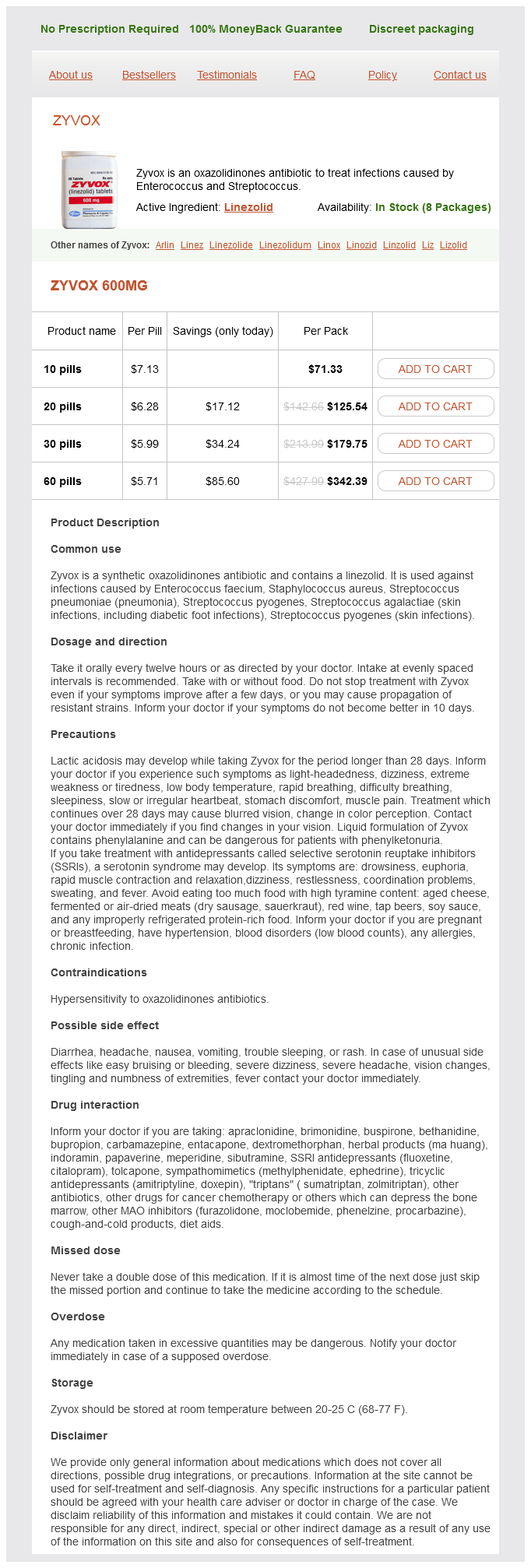
Zyvox dosages: 600 mg
Zyvox packs: 10 pills, 20 pills, 30 pills, 60 pills

The proximal cuff around the thigh is kept prepared to be instantly inflated if the proximal cuff fails during the procedure. Exsanguination of the extremity is performed by winding an elastic bandage tightly from the fingertips down onto the distal tourniquet cuff. Such studies have been guides to the willpower of the protected length of the appliance of an inflated tourniquet in scientific sufferers. However, their efficacy in emptying the limb of blood without damaging the skin must still be confirmed. Martin used their elastic rubber bandages as a method of applying diffuse strain on the entire lower extremity for the therapy of stasis ulcers and to prevent reoccurrence of effusion after aspiration of the knee joint. In comparability of various methods of exsanguination of the arm in volunteers, the Esmarch bandage reduces blood volume of the arm on average by 69% (25), whereas the discount was solely about 45% by elevation of the arm (Table 152). Chapter 15: Intravenous Regional Neural Blockade 375 was used as a tourniquet (11,28). Thus, the event of pneumatic tourniquets with pressure gauges connected had been of nice significance, perhaps extra so for the protected conductance of extremity surgical procedure. In precept, the least toxic native anesthetic must be chosen because the dose initially injected intravenously both in the upper or lower extremity is large sufficient to cause extreme systemic intoxication if the dose mistakenly enters the circulation directly. In international locations in which prilocaine has not been available, lidocaine has been the primary alternative. A few minutes may be won through the use of higher concentrations, however with the expense of inflicting poisonous harm to the endothelium of the veins (39). In an earlier study of adults, it was proven that 20 to 50 mL would suffice to fill the venous channels of an exsanguinated arm (40). Loss of sensation occurred at a similar fee as with lidocaine 5 mg/mL, but recovery after tourniquet cuff deflation was at least twice as long with levobupivacaine as with lidocaine. It has been proven that two metabolites of prilocaine, o-toluidine and nitrosotoluidine oxidize ferrous iron in the hemoglobin molecule to the ferric state (42). The interindividual variation in met-Hb concentrations after prilocaine anaesthesia are big (41,42). The maximum dose recommendation of 600 mg prilocaine in adults for the avoidance of clinically severe methemoglobinemia is more circumstantial than evidence-based (43). The prediction of the incidence of this side effect/complication is hampered additionally by the reality that exposure to several other medication and chemical substances. In some of the volunteers, articaine brought on an anaphylactoid-type response in the exposed arm, along the veins, suggesting a direct irritation of the endothelium by the acidic solution (57). In spite of the truth that articaine belongs to the amide-type local anesthetics, the breaking of an ester bond in the molecule in tissues and plasma inactivates the molecule (55). This formulation was quickly deserted due to the event of thrombophlebitis within the uncovered veins. More recently, forty mL of an additive-free 2-chloroprocaine 5 mg/mL solution has been discovered much less irritating to the veins, however otherwise quite related in impact as prilocaine 5 mg/mL (59,60). The quick breakdown of 2-chloroprocaine in plasma (half-life of approximately 22 seconds) is the premise for its low degree of systemic toxicity. In addition to drugs, the affect of alkalinization of the answer and hypothermia of the extremity was additionally included within the analysis. No evidence suggests any benefit to using the generally administered guanethidine, a sympatholytic drug earlier used for arterial hypertension (67). On the opposite, opposed effects, similar to extended arterial hypotension, may hamper this remedy. Comparison of lidocaine and prilocaine for intravenous regional anesthesia of the whole lower extremity. After a tourniquet time of 10 minutes, about 30% of the lidocaine dose is launched immediately within the first flush of blood muscle relaxation, tourniquet pain, and short length of postoperative analgesia. The longer the tourniquet time, the lower the arterial plasma concentrations of lidocaine at 1 minute after tourniquet cuff deflation in intravenous regional anesthesia. Open circles symbolize the imply of lidocaine concentrations after using a 1% solution; closed circles are individual values when a 0. Plasma concentrations of lidocaine in a topic following tourniquet cuff launch after intravenous regional anesthesia with lidocaine three mg/kg; tourniquet time was forty five minutes. The distinction in concentrations in pulmonary artery and peripheral artery indicates instant elimination of lidocaine into the lung tissue throughout its first pulmonary circulatory passage(s).
When linking the observed motor response to which wire is being stimulated, the mnemonic device "at the cords, the pinkie towards" is beneficial. The brachial plexus is situated by plotting some extent 2 cm medial from the lateral border of the coracoid course of and a pair of cm caudad. The cords of the brachial plexus reside lateral (cephalad), posterior, and medial (caudad) to the second a part of the axillary artery. The posterior wire is normally visualized posterior lateral to the artery, whereas the medial wire often resides in a triangular groove between the axillary artery and vein, however is the most variable in its relationship to the artery. Chapter 13: the Upper Extremity: Somatic Block 333 to deposit local anesthetic around the posterior cord and one of the other cords. The infraclavicular method is a superb alternative for continuous perineural catheter strategies (5,39,116). Operators could encounter technical problem maneuvering the catheter, which exits the needle tip at a right angle to journey along the trail of the brachial plexus. However, as quickly as this is accomplished, the catheter easily maintains its place throughout subsequent infusion. Hemidiaphragmatic paresis is extraordinarily rare utilizing the coracoid approach, most likely because native anesthetic spread with this approach is restricted to beneath the clavicle (127). However, the frequency of phrenic nerve involvement begins to increase as needle placement becomes extra medial, corresponding to with the vertical approach. The presence of the deep and noncompressible axillary artery argues in opposition to performing infraclavicular block in anticoagulated patients (110). Axillary Approach Indications the axillary strategy is the workhorse block for higher extremity regional anesthesia. It is appropriate for surgeries involving the hand and forearm, and is a reliable different for elbow surgical procedure (128). For ambulatory hand surgical procedure, axillary block provides short-term (<24 hours) advantages as compared to general anesthesia-earlier fast-track eligibility, less ache, and fewer opioid-related unwanted aspect effects (3). Single-stimulation infraclavicular and axillary blocks seem to be equally effective for hand surgical procedure (111). However, a four-stimulation axillary block has been shown to be more effective than a two-stimulation infraclavicular block, although comparison of unequal stimulation strategies is problematic (112). The disadvantages of this method are that it requires the arm be kidnapped ninety degrees at the shoulder, which may be problematic in some sufferers, and that the musculocutaneous nerve has often cut up away from the other terminal nerves and therefore requires a separate blocking process to guarantee adequate forearm anesthesia. Common to these strategies is that multiple injection/stimulation techniques lead to superior block quality, as in comparison with single- or double-injection techniques (82,85). Comparative studies are limited, however present information suggest that overall effectiveness and security of the various methods of axillary block are equivalent (14). Although these relationships can range among individual sufferers, the median and ulnar nerves are usually extra superficial, and are found superior and inferior to the axillary artery, respectively (when the arm is kidnapped 90 degrees on the shoul- der and flexed ninety levels at the elbow). The musculocutaneous nerve is superior to the artery, deeper, and often within the belly or fascia of the coracobrachialis muscle. Importantly, the median and ulnar nerves, and the triceps branches of the radial nerve all lie in a superficial compartment. Conversely, the principle department of the radial nerve lies in a deeper compartment that should be accessed if profitable radial anesthesia is to be ensured (18,85,129). Generally, five different strategies may be used for axillary brachial plexus block. All depend upon identification of the axillary artery as the first floor landmark. By barely pressing the fingertip into the pulsation, the operator features a sense of the side-to-side dimensions of the artery. The transarterial method relies on identification of the axillary artery and subsequent fractionation of 30 to forty mL of local anesthetic posterior and anterior to the artery (130�132). The perivascular approach relies on fanning small amounts of local anesthetic instantly inferior and superior to the axillary artery, injecting through a constantly moving needle. Successful blocks from the next two axillary strategies, which use both peripheral nerve stimulation (134) or paresthesia (135) to localize individual terminal nerves, are significantly amenable to a number of stimulations and injections. Determination of which nerve is most essential to anesthetize is somewhat depending on surgical necessities. Axillary catheter strategies have been described, but provide little advantage over catheter placement at more proximal approaches, and endure from a excessive frequency of catheter dislodgment.

Effects of thoracic epidural anesthesia on coronary arteries and arterioles in sufferers with coronary artery disease. Cardiac sympathetic nerve activity and progressive vasoconstriction distal to coronary stenosis: Feed-back aggravation of myocardial ischemia. The effects of cardiac sympathetic nerve stimulation on perfusion of stenotic coronary arteries in the dog. Thoracic epidural anesthesia improves world and regional left ventricular perform during stress-induced myocardial ischemia in patients with coronary artery illness. Long-term residence self-treatment with excessive thoracic epidural anesthesia in sufferers with severe coronary artery disease. Thoracic epidural anesthesia reduces myocardial infarct size after coronary artery occlusion in canine. Effect of acute sympathectomy by epidural anesthesia on the canine coronary circulation. A combination of intrathecal morphine and remifentanil anesthesia for fast-track cardiac anesthesia and surgery. Effect of subarachnoid morphine administration on extubation time after coronary artery bypass graft surgery. Fast-track cardiac anesthesia: A comparison of remifentanil plus intrathecal morphine with sufentanil in a desflurane-based anesthetic. Fast-track cardiac anesthesia: Use of remifentanil mixed with intrathecal morphine as an different choice to sufentanil during desflurane anesthesia. High spinal anesthesia in cardiac surgery: Effects on hemodynamics, perioperative stress response, and atrial -receptor function [Abstract]. A retrospective examination of regional plus basic anesthesia in kids present process open coronary heart surgery. Intrathecal morphine for coronary artery bypass graft process and early extubation revisited. Effects of intrathecal opioid on extubation time, analgesia, and intensive care unit keep following coronary artery bypass grafting. Anesthesia supplemented with subarachnoid bupivacaine and morphine for coronary artery bypass surgical procedure in a child with Kawasaki disease [Case report]. Anaesthesia for coronary artery bypass surgical procedure supplemented with subarachnoid bupivacaine and morphine: A report of 18 cases. Early extubation after cardiac surgery utilizing mixed intrathecal sufentanil and morphine. Intrathecal morphine within the administration of ache following cardiac surgical procedure, a comparison with morphine i. The role of intrathecal morphine within the anesthetic management of sufferers undergoing coronary artery bypass surgery. Comparison of intrathecal and intravenous morphine in post coronary bypass surgical procedure [Abstract]. Intrathecal sufentanil-morphine shortens the length of intubation and improves analgesia in fast-track cardiac surgery. High spinal anesthesia for cardiac surgery: Effects on -adrenergic receptor function, stress response, and hemodynamics. Factors contributing to success or failure in using a pump oxygenator for complete by-pass of the heart and lung, experimental and clinical. Systemic hypertension following myocardial revascularization, a way of therapy using epidural anesthesia. Continuous epidural infusion of morphine for pain relief after cardiac operations. A potential randomized examine of the potential benefits of thoracic epidural anesthesia and analgesia in sufferers present process coronary artery bypass grafting. High thoracic epidural anesthesia, however not clonidine, attenuates the perioperative stress response through sympatholysis and reduces the release of troponin T in sufferers undergoing coronary artery bypass grafting. Thoracic epidural anesthesia as an adjunct to basic anesthesia for cardiac surgical procedure: Effects on ventilationperfusion relationships. Effects of thoracic epidural analgesia on coronary hemodynamics and myocardial metabolism in coronary artery bypass surgical procedure. Thoracic epidural anesthesia throughout coronary artery bypass surgical procedure: Effects on cardiac sympathetic activity, myocardial blood move and metabolism, and central hemodynamics.

It divides into 4 branches: the exterior nasal, the internal nasal, the inferior palpebral, and the superior labial. The posterior superior alveolar branch arises from the trunk of the nerve simply before it enters the infraorbital groove. It enters the infratemporal floor of the maxilla communicating with the center superior alveolar branch, giving off branches to the liner membrane of the maxillary sinus and branches to the molar teeth. The center superior alveolar department arises from the nerve within the posterior part of the infraorbital canal and runs downward and forward in a canal alongside the lateral wall of the maxillary sinus. The anterior superior alveolar nerve branches off just as it exits the infraorbital foramen and descends in a canal within the anterior wall of the maxillary sinus. It communicates with the center superior alveolar department, which supplies the mucous membrane of the anterior a half of the inferior meatus and the floor of the nasal cavity, speaking with the branches from the sphenopalatine ganglia. The exterior nasal branches supply the pores and skin of the nostril and of the septum mobile nasi and joins with the terminal branches of the nasociliary nerve. The superior labial branches, the biggest, descend behind the quadratus labii superioris and are distributed to the pores and skin of the higher lip, the mucous membrane of the mouth, and the labial glands. They are joined, instantly under the orbit by filaments from the facial nerve, forming with them the infraorbital plexus (7). The supraorbital and supratrochlear branches of the primary division (ophthalmic) can be blocked as they emerge above the orbit. A single-needle insertion within the mid brow above the foundation of the nostril can anesthetize the forehead bilaterally by infiltrations on either aspect by way of the identical insertion. Note that this injection must be undertaken above the extent of the eyebrow to forestall periorbital hematoma. The infratrochlear nerve (and additionally anterior ethmoidal nerve) is blocked by inserting a needle 1 cm above the inside canthus and just lateral to the medial wall of the orbit. The mental nerve is anesthetized once more in the same vertical line because the pupil; to enter the psychological foramen, direct the needle medially as shown within the diagram. The mental foramen lies at a unique vertical stage within the mandible at completely different ages. Note that infiltration is superficial besides within the temporal area, where infiltration deep to deep fascia is beneficial to assist prevent motion of the temporalis muscle throughout surgery. Chapter 17: Somatic Blockade of the Head and Neck 409 septum and lateral wall of the nose obtain contributions from the anterior ethmoidal branch of the ophthalmic nerve. The complete onerous palate is provided by the maxillary nerve via the sphenopalatine ganglion. The recurrent laryngeal nerve also provides motor operate to all of the intrinsic muscle tissue of the larynx (except the cricothyroid muscle), and bilateral motor block produces lack of phonation and lack of ability to close the glottis. Palatine Nerve the palatine nerves are distributed to the roof of the mouth, taste bud, tonsil, and lining membrane of the nasal cavity. Most of their branches are derived from the sphenopalatine branches of the maxillary nerve. The anterior palatine nerve descends through the pterygopalatine canal and emerges within the onerous palate via the higher palatine foramen. The middle palatine nerve emerges via one of many minor palatine foramen and supplies the sensory supply to the uvula, tonsils, and the soft palate. The posterior palatine nerve descends through the pterygopalatine canal and emerges by way of a particular opening behind the higher palatine foramen. The middle and posterior palatine branches be a part of the tonsillar branch of the glossopharyngeal to form a plexus (cirrus tonsillaris) across the tonsils (7). Cervical Plexus the cervical plexus contributes to the supply of both the deep and the superficial buildings of the neck. The first cervical nerve, C1, is a motor nerve to the muscle tissue of the suboccipital triangle and has no sensory distribution to pores and skin. The skin of the neck is provided in a sequential dermatomal sample (like the trunk) by the cutaneous branches of C2�C4 by both anterior and posterior primary rami. The cervical plexus is formed by the ventral rami of the higher four cervical nerves. Their dorsal and ventral roots mix to form spinal nerves as they exit through the intervertebral foramen. The cervical plexus lies behind the clavicular head of the sternocleidomastoid, giving out both the superficial and deep branches. The superficial cervical plexus wraps across the belly of the clavicular head of the sternocleidomastoid to form 4 branches: (a) the lesser occipital, (b) the good auricular, (c) the transverse cervical, and (d) the supraclavicular nerves.

By recognizing the modifications in management which might be predicted by the impact of the physiologic adjustments of being pregnant, one can administer epidural anesthesia to gravid ladies with efficacy and security. The basic absorption and disposition characteristics of local anesthetics are mentioned intimately in Chapter 3. The potential for systemic toxicity must also be thought-about when choosing an area anesthetic agent for epidural use. The pharmacokinetic characteristics of the native anesthetics currently used for epidural analgesia and the implications for the time course of neural blockade and systemic toxicity have been reviewed intimately by Burm (133,134). Thus, a thorough data of the pharmacokinetics and toxicity of native anesthetics is a prerequisite to the protected use of epidural analgesia. To safely institute an epidural block, a knowledge of the physiology of epidural block is necessary, as properly as a revision of the pharmacokinetics of native anesthetics as related to their administration via the epidural route. The efficacy of epidural block is determined by this and on the scientific effects of the native anesthetics used (see Chapters 2�5). In considering the pharmacokinetics of native anesthetics, each the systemic absorption and systemic disposition are of significance. Systemic absorption of native anesthetics limits the period of nerve blocks and is of concern in view of systemic Local anesthetics might act on the periphery of the spinal wire, the spinal roots, the dorsal root ganglia, and the extradural nerves (87). However, the spinal nerve roots, on the location where they depart the subarachnoid space and enter the nerve root sheath, are suggested to be the primary sites of motion throughout spinal and epidural anaesthesia (87,135). This is substantiated by considerably higher tissue concentrations within the intradural spinal roots than in the spinal twine (136,137) and the shut proximity of the epidural area and the nerve roots (135). In addition, the diffusion floor is increased by the dispersion of the bundles into particular person fascicles (135). Despite lower tissue penetration of local anesthetics within the spinal cord (with concentration being highest within the lateral and posterior column and lowest within the grey matter) (137), involvement of the spinal cord in nerve blocking during epidural anesthesia has been demonstrated (143�145). Even lower tissue concentrations have been demonstrated in the dorsal root ganglia after epidural administration of local anesthetics (137). Nevertheless, this website has additionally been proposed as the primary site of motion (138). The latter expression is used to assess the development of tachyphylaxis (see later discussion). Somatosensory evoked potentials mirror the net outcomes of neuronal activities coming from peripheral nerves through the spinal wire to the brain. Somatosensory evoked potentials are generated by repetitive stimulation of peripheral nerves and may be monitored at a number of points alongside the sensory pathway, including over the spinal twine, subcortical structures, and cerebral cortex. This is presumably because of the flexibility of etidocaine to penetrate the white matter of the spinal wire more readily (144). Sympathetic block is assessed by measuring skin temperature with a telethermometer thermography, or temperature-sensitive papers. Skin conductance may be measured in the clinical setting by use of the psychogalvanic response; dependable measurements are far more tough than normally acknowledged. More precise, but of analysis software solely, are the use of varied sweat tests, similar to cobalt blue and starch iodine, or the response of pores and skin plethysmography to ice throughout venous occlusion plethysmography. A full dialogue of the clinical and laboratory tests of sympathetic block is given in Chapter 39. Motor block is usually assessed by use of the Bromage scale for motor blockade in the decrease limbs (87) (Table 11-5). This is as a end result of diffusion and vascular transport presumably influence the ultimate word unfold of analgesia (see Chapter 3). Longitudinal spread has shown to be more in a cephalad than caudad direction (146,147), and it depends largely on bulk flow throughout and after administration and on these constructions within the epidural area that resist circulate (148). The spread of analgesia may be modified by outflow of native anesthetics by way of the intervertebral foramina. Changes within the anatomy of the intervertebral foramina by disease or advancing age might alter the spread of analgesia by this mechanism (see Chapter 9). Yet there are nonetheless many main medical facilities throughout the world that maintain the belief that epidural blockade has a high failure price in contrast with subarachnoid blockade. This merely serves to underline the comparatively latest acquisition of related information on which to base the efficient use of epidural block. Assessment of Epidural Blockade In defining essential factors in efficient epidural block, the development of standardized methods of assessment of epidural block has been important. Sensory block is graphed by testing for loss and return of pin-prick sensation (partial sensory block) in every dermatome on both sides of the body.

Maca. Zyvox.
Source: http://www.rxlist.com/script/main/art.asp?articlekey=96554
Thoracic epidural anesthesia facilitates ambulation the same day of the surgical procedure, reduces the incidence of ileus and deep venous thrombosis, and permits early enteral feeding (67). Thoracic epidural anesthesia used through the postoperative course has been proven to lower the chance for anastomotic leakage (68). Shallow respiration improves to near regular levels and paradoxical chest wall actions are reduced. Patients on a thoracic epidural anesthesia routine are alert, able to cough adequately and comply with chest physiotherapy, and develop fewer problems (see Chapter 11). Thoracic epidural anesthesia might be technically demanding, particularly in sufferers distressed with ache. The neural blockade can mask intra-abdominal accidents and could additionally be associated with hypotension during the early phase of therapy, probably resulting in cardiovascular collapse and cardiac arrest within the inadequately resuscitated patient. Luchette and coworkers evaluated analgesia for 72 hours in 19 blunt trauma patients with unilateral rib fractures (66). Buggy and coworkers studied the effect of steady paravertebral anesthesia with levobupivacaine on the oxygen tension in the latissimus dorsi flap after mastectomy (70). The imply PtO2 over the 20-hour period was considerably higher in sufferers receiving paravertebral block (75 versus 44 mm Hg; p <0. Preincisional paravertebral anesthesia has been proven to cut back chronic pain after breast surgical procedure. At 1-month after surgery, patients who obtained paravertebral anesthesia within the perioperative period had a decrease intensity of motion-related ache. At 6 months, the prevalence of any type of ache continued to be lower, and at 12-month follow-up movement as properly as pain at relaxation were significantly decrease in the paravertebral group. Neuraxial blockade turned in style later as their security increased and applications for postoperative analgesia had been developed. More just lately got here the conclusion that regional anesthesia could influence a variety of the perioperative elements intrinsically tied with postoperative end result (see additionally Chapter 7). Major decreases in splanchnic blood flow occur throughout low cardiac output states, and if this persists, the gut mucosal barrier could additionally be disrupted, resulting in generation of inflammatory mediators which, along with ischemia�reperfusion harm, precipitate gastrointestinal organ dysfunction (72). The management of splanchnic blood flow is regulated via a fantastic balance involving sympathetic and parasympathetic methods. Other native and systemic elements also modulate the tone of the mesenteric vasculature. The ensuing decreased venous return and systemic hypotension might compromise gut mucosal integrity. Chapter 23: Neural Blockade for Abdominal and Thoracic (Non-vascular) Surgery 527 manipulation, circulating inflammatory mediators, or harm to the gut causes an increase in sympathetic exercise leading to ileus. Local anesthetic neuraxial blockade of the sympathetic fibers innervating the intestine (T4�L2) inhibits sympathetic hyperactivity and enhances vagal activity with restoration of gut motility (see Chapters 7 and 11). Endoscopic Surgery and Regional Anesthesia Endoscopic surgery, extensively used in gastrointestinal surgery, has been proven to attenuate the inflammatory response and the incidence of wound infections in contrast with typical open techniques. In addition, the small incisions trigger less postoperative ache and permit sufferers to be extra cell. However, the endoscopic strategy per se has not been shown to accelerate restoration of bowel function, most likely because of the lack of direct effect on anastomosis or the shortcoming to reverse postoperative ileus (86). Recently, native anesthetics, administered either intravenously or epidurally, have been shown to speed up bowel motility after laparoscopic colon surgical procedure (87�88) (see additionally Chapter 7). Surgical Considerations and Regional Anesthesia Preoperative Fasting Tradition dictates sufferers to be fasted the day and night before surgery. In addition, patients undergoing gastrointestinal surgery undergo chemical bowel preparation during the 18 to 24 hours prior to surgical procedure. Recent evidence paperwork the metabolic benefit of carbohydrate-rich clear liquids continued up till 2 hours preoperatively in reverting gluconeogenesis and attenuating perioperative insulin resistance (76). Clear fluids are rapidly eradicated from the abdomen with minimal threat of aspiration. Open Abdominal Surgery and Regional Anesthesia Spinal Spinal anesthesia for abdominal surgical procedure is a gorgeous proposition since it requires small quantities of local anesthetic and provides a reliable and prolonged sensory blockade with sufficient muscle relaxation. Adequate mesenteric blood move is particularly required for the viability of anastomosis.
Syndromes
The function of the vertebral venous system within the metastasis of most cancers to the spinal column. A technique of angiography of the azygos vein and the anterior inside venous plexus of the backbone. Comparison of intraosseous vertebral venography and Pantopaque myelography within the prognosis of surgical situations of the lumbar spine and nerve roots. The significance of venous return impairment in ischemic radiculopathy and myelopathy. Distribution in spinal fluid, blood, and lymph of epidurally injected morphine and inulin in dogs. The pure historical past of lumbar intervertebral disc extrusions handled nonoperatively. In the late nineteenth century, soon after the invention of the native anesthetic properties of cocaine, spinal anesthesia was launched into clinical follow. In the first experiments and scientific use, the native anesthetic used was cocaine (Table 10-1) (1). Therefore, the utilization of spinal anesthesia was limited to a few fanatics till safer native anesthetics-procaine (2) and later tetracaine (3)-caused a widespread curiosity in its use. The growth of contemporary basic anesthesia using muscle relaxants and an endotracheal tube, along with the concern of neurologic problems, decreased the curiosity in spinal anesthesia in Forties and Fifties (6). As operations turned extra radical, their duration and extensiveness were usually incompatible with spinal anesthesia. Dedicated lovers, however, continued to use the strategy and consider in its security (7), and, about 40 years in the past, spinal anesthesia started to regain its place in anesthesia care. Since the 1980s, trendy disposable needles and especially using bupivacaine has greatly increased the interest in spinal anesthesia in lots of international locations (8,9). The fact that general anesthesia also has its dangers and problems has made spinal anesthesia a useful possibility for surgical procedure of the lower stomach and extremities. It is used in brief ambulatory procedures as a restricted saddle block or as unilateral anesthesia to present a fast, restricted, short-lasting, and dependable anesthesia with good-quality postoperative pain relief (10). The spinal anesthesia approach and dose, and the properties of the local anesthetic can be tailored to acquire optimal unfold and duration of the anesthesia for the planned surgery. Specifically, spinal anesthesia is acceptable in sufferers who choose to remain conscious or whose medical condition re- quires consciousness through the surgical procedure, however who still need high-quality anesthesia. Patients with respiratory problems or tough airways might not need an endotracheal tube if spinal anaesthesia is employed. The threat of vomiting and aspiration is diminished (but not eliminated) during spinal anesthesia. Cholecystectomies and gastrectomies have efficiently been performed beneath spinal anesthesia. As a safety margin, the higher level must be nonetheless higher, and some unwanted reflexes could appear; thus, spinal anesthesia as a sole anesthetic approach for these operations. In cardiac surgery, using intrathecal narcotics allows sooner restoration (13). For renal transplant surgery, mixed spinal�epidural anesthesia has been as safe and as well tolerated as common anesthesia (15). An excessive example of using spinal anesthesia is a patient with severe lung disease who efficiently underwent a laparoscopic cholecystectomy beneath segmental subarachnoid (spinal) anaesthesia performed on the low thoracic stage (16). In lower extremity surgery, peripheral blocks are used with rising frequency for surgical anesthesia. The quantity and complexity of nerve blocks needed for good anesthesia for operations on the knees, thigh, and hip are so great that spinal anesthesia is usually the popular method. There are sev- eral indications for which spinal anesthesia would be a higher option than common anesthesia, however hardly ever is general anesthesia completely contraindicated and, in these circumstances, the affected person normally understands the need for regional anesthesia and accepts the choice. No needle ought to move via an contaminated area before entering into the subarachnoid space. Since spinal anesthesia causes sympathetic block and vasodilatation, the hypotension in a hypovolemic patient may cause extreme issues. This is extremely uncommon, and often one other choice of local anesthetic is out there. Relative contraindications include: case stories on the secure use of spinal anesthesia in sufferers with postpolio syndrome or a quantity of sclerosis (19,20). These can sometimes be aggravated by spinal anesthesia; however, if enough data is offered and agreement in regards to the procedure is obtained from the patient, spinal anesthesia can be safely used.

Povidone iodine and chlorhexidine gluconate (with or without the addition of isopropyl alcohol) have been most extensively studied (109,110). In nearly all scientific investigations, the bactericidal effect of chlorhexidine was extra fast and more effective (extending its effect hours following its application) than povidone iodine. Although common anesthesia was administered to 59 sufferers, the remaining 110 sufferers obtained spinal or epidural strategies. The authors concluded that neuraxial block was protected in circumstances of secondary infection. Additional investigations help these suggestions, although the entire number of patients studied is just too restricted to make a definitive assessment (93,94). In addition, since the danger of neurologic complications in sufferers undergoing neuraxial block in the presence of main an infection stays unknown, a conservative strategy is beneficial. It should be noted that chlorhexidine-alcohol labeling accommodates a warning in opposition to use as a skin preparation previous to lumbar puncture. Therefore, because of its superior impact, alcohol-based chlorhexidine solutions are thought of the antiseptic of choice for skin preparation earlier than any regional anesthetic process (100). Anesthetic Management of the Infected or Febrile Patient In summary, a number of medical and laboratory research have advised an affiliation between dural puncture throughout bacteremia and meningitis. Patients with evidence of systemic infection might safely bear spinal anesthesia, if antibiotic therapy is initiated previous to dural puncture and the affected person has demonstrated a response to therapy, similar to a decrease in fever. Placement of an indwelling epidural (or intrathecal) catheter on this group of patients stays controversial; sufferers should be carefully chosen and monitored for evidence of epidural an infection. Spinal anesthesia could additionally be safely performed in sufferers at risk for low-grade transient bacteremia after dural puncture. Once again, little data exists regarding the risk of epidural anesthesia in sufferers suspected of developing an intraoperative transient bacteremia (such as throughout a urologic procedure). Likewise, the vary of microorganisms inflicting invasive infection in the immunocompromised host is far broader than that affecting the general inhabitants and consists of atypical and opportunistic pathogens. Consultation with an infectious disease specialist is suggested to facilitate initiation of early and efficient remedy (91). Meticulous aseptic method, together with hand-washing with chlorhexidine, carrying of masks and sterile gloves by the proceduralist, pores and skin asepsis with chlorhexidine, and antibiotic pretreatment for the position of everlasting gadgets, is critical to the prevention of infectious complications related to regional anesthesia (100). A delay in diagnosis and treatment of even a couple of hours considerably worsens neurologic outcome. Meningitis presents most often with fever, severe headache, altered level of consciousness, and meningis- mus. The scientific course of epidural abscess progresses from spinal ache and root pain, to weak point (including bowel and bladder symptoms), and finally paralysis. The initial back ache and radicular symptoms may remain steady for hours to weeks. However, the onset of weak point often progresses to complete paralysis inside 24 hours. A combination of antibiotics and surgical drainage stays the treatment of selection. As with spinal hematoma, neurologic restoration is dependent on the period of the deficit and the severity of neurologic impairment before remedy. The cause of postoperative deficits is difficult to consider, because neural harm may occur as a outcome of surgical trauma, tourniquet stress, prolonged labor, improper patient positioning, or anesthetic technique. Progressive neurologic ailments similar to a quantity of sclerosis could coincidentally worsen perioperatively, independent of the anesthetic technique. The most conservative authorized strategy is to keep away from regional anesthesia in these sufferers. However, high-risk sufferers, together with these with important cardiopulmonary illness, may benefit medically from regional anesthesia and analgesia. The decision to proceed with a regional anesthesia in these sufferers must be made on a case-by-case basis. The presence of preexisting deficits, signifying persistent neural compromise, theoretically places these sufferers at increased risk for further neurologic harm. The presumed mechanism is a "double crush" of the nerve at two locations, resulting in a nerve injury of clinical significance. The double-crush idea suggests that nerve damage caused by traumatic needle placement/local anesthetic toxicity in the course of the efficiency of a regional anesthetic might worsen neurologic consequence within the presence of an extra patient factor or surgical damage. Progressive neurologic diseases may coincidentally worsen perioperatively, independent of the anesthetic technique.
The lateral approach to the sciatic nerve on the popliteal fossa: One or two injections A comparison of the posterior versus lateral apzc proaches to the block of the sciatic nerve in the popliteal fossa. Lateral popliteal sciatic nerve block: A single injection concentrating on the tibial branch of the sciatic nerve is as efficient as a double-injection method. The results of three different approaches on the onset time of sciatic nerve blocks with zero. The location of the terminal branching of the posterior tibial nerve and its effect on administering a posterior tibial nerve block. Dilute lidocaine ankle blocks within the analysis of sympathetically maintained pain. Local anesthesia for postoperative ache relief after foot surgical procedure: A prospective clinical trial. Lateral popliteal sciatic nerve block in contrast with subcutaneous infiltration for analgesia following foot surgery. Intra-articular bupivacaine (Marcaine) after arthroscopic meniscectomy: A randomized double-blind controlled examine. Pain reduction after arthroscopic surgery of the knee: A potential, randomized, and blinded assessment of bupivacaine and bupivacaine with adrenaline. Intra-articular morphine for pain relief after knee arthroscopy carried out underneath regional anaesthesia. Comparison of postoperative analgesic effects of intra-articular bupivacaine and morphine following arthroscopic knee surgery. Intra-articular morphine, bupivacaine, and morphine/bupivacaine for ache management after knee video arthroscopy. A comparative examine of analgesia after knee surgical procedure with intra-articular bupivacaine, intra-articular morphine and lumbar plexus block. The pharmacokinetics of bupivacaine when injected intra-articularly after knee arthroscopy. Influence of minimum current for peripheral nerve stimulation on the latency and success fee of sciatic blockade. Effectiveness of bupivacaine administered through femoral nerve catheter for pain control after anterior cruciate ligament restore. Comparison of the parasacral approach and the posterior method, with single- and double-injection 151. Ultrasound steering for lateral midfemoral sciatic nerve block: A potential randomized study. An ultrasonographic and histological research of intraneuronal injection and electrical stimulation in pigs. Effects of epinephrine in native anesthetics on the central and peripheral nervous systems: Neurotoxicity and neural blood circulate. Small-dose clonidine prolongs postoperative analgesia after sciatic-femoral nerve block with 0. Adding clonidine to the induction bolus and postoperative infusion during steady femoral nerve block delays recovery of motor perform after total knee arthroplasty. Combined lumbar-plexus and sciatic-nerve blocks: An evaluation of plasma ropivacaine concentrations. Plasma concentrations after excessive doses of mepivacaine with epinephrine within the combined psoas compartment/sciatic nerve block. Steady state bupivacaine plasma concentrations and safety of a femoral "3-in-1" nerve block with bupivacaine in patients over eighty years of age. In the last 10 years there has been little or no change in this anesthetic technique itself (1�3); as a substitute, lately, clinical analysis has centered on pharmacokinetics, toxicity, and advantages of components within the native anesthetic solutions used. The technique initially consisted of exsanguination of the arm by winding an Esmarch bandage from the fingers to above the elbow, application of two pneumatic tourniquets on the arm, one above the elbow and the other on the antebrachium, and then performing a surgical cutdown beneath native anesthesia in the cubital or antebrachial area to locate a superficial vein. A slit was made in the vein and a cannula was inserted within the peripheral path and secured with a tie. A slower growing sensory block was noted in the region distal to the peripheral tourniquet. Harvey Cushing introduced the pneumatic tourniquet, an adaptation of the original sphygmomanometer, in 1904.
Dimitar, 21 years: The needle is then fastened and a volume of 25 to 30 mL of local anesthetic is injected. Thus, through the pivotal instant postoperative interval after cardiac surgical procedure, sufficient analgesia (coupled with stress response attenuation) might doubtlessly lower morbidity and enhance health-related high quality of life (27,28). Hydrophobic adsorption accounts for a lot of the membrane binding of native anesthetics.
Armon, 50 years: Composite figure exhibiting the relationships between some physicochemical properties (lipophilicity given by octanol log P, and ionizability given by pKa) of n-N-alkyl homolog members of the mepivacaine family and some pharmacokinetic properties in models of spinal anesthesia. Nonsurgical Applications Paravertebral thoracic somatic nerve block could additionally be used to cut back the chance of continual ache after breast surgery (58). The effect of adjusting the metabolic setting from an in a single day fasted to a fed state earlier than surgical trauma on the event of the catabolic response has only lately been tested in humans.
Hurit, 31 years: Minor surgeries, such chest and stomach wall procedures, are often performed on an outpatient foundation. Cochlear implantation in patients with neurofibromatosis sort 2 and bilateral vestibular schwannoma. Moreover, a bolus injection of bupivacaine has been shown to displace lidocaine from binding sites in rabbit lung (469), with attainable implications for transient toxicity.
Candela, 47 years: Prospective randomized research of a new method of offering postoperative pain reduction following femoropopliteal bypass. This technique could additionally be related to an increased incidence of infection, as the presence of the ultrasound probe itself and the elevated complexity of the process can intervene with aseptic technique. It is about 1 cm in diameter, with cervical and lumbosacral expansions within the lateral dimension to accommodate the larger grey matter for the limbs at these levels.
Kliff, 60 years: Neonatal regional anesthesia: Alternative to general anesthesia for urologic surgery. For patients with small tumors and mild or no signs, the controversy is particularly pointed. Analytical separation of local anesthetic (and many other) pairs of enantiomers for pharmacokinetic and different functions is based on their different affinities for chiral macromolecular stationary phases, sometimes 1 -acid glycoprotein (also generally identified as orosomucoid), or cyclodextrin, packed right into a chromatographic column (40�42).
References

Desarrolló: Grupo Guadalupe S.R.L.