
Michael A. McCulloch, MD
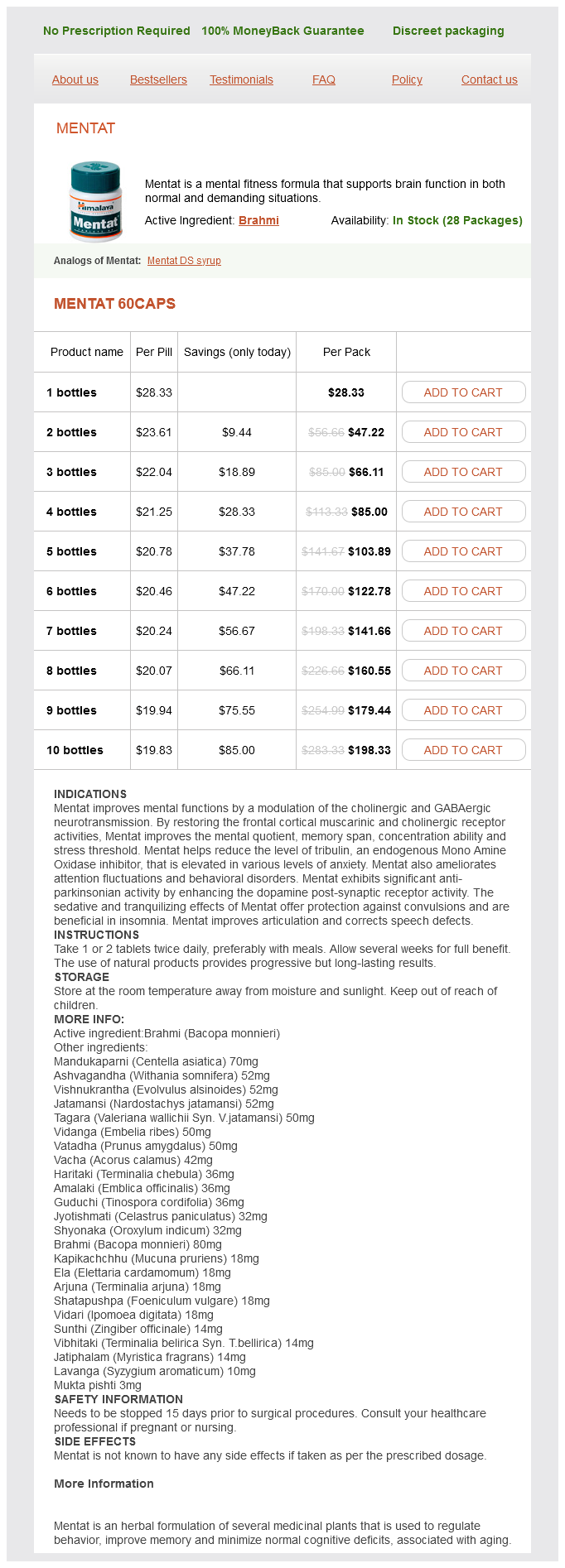
Mentat dosages: 60 caps
Mentat packs: 1 bottles, 2 bottles, 3 bottles, 4 bottles, 5 bottles, 6 bottles, 7 bottles, 8 bottles, 9 bottles, 10 bottles

Radiotherapy has been reported to be useful in lowering keloid recurrence after surgical excision. There is, nevertheless, concern relating to the potential long-term dangers associated with this therapy and for this reason radiotherapy is used solely when other therapies have failed. Finally, pulsed dye laser treatment appears to induce keloid regression via suppression of keloid fibroblast proliferation and induction of apoptosis. Combination remedy with pulsed dye laser plus intralesional remedy with corticosteroids and/or fluorouracil may be superior to either approach alone. Malignant and premalignant conditions of the pores and skin Cancer of the pores and skin as an general entity is by far the most common tumour to affect humans. These shall be dealt with in flip but, initially, the general aetiology and pathology of pores and skin cancer will be thought of followed by an outline of the premalignant lesions. Both premalignant and malignant lesions of the pores and skin occur more frequently in those areas which are exposed to daylight. It ought to be noted that, though sunbeds �non-flattened epidermis �non-fibrotic papillary dermis collagen (detected in 55% of keloid �presence of hyalinized keloid specimens) fascicles/nodules �prominent disarray of fibrousunderneath normal-appearing epidermis tongue-like advancing edge �and papillary dermis �horizontal cellular fibrous band within the upper reticular dermis �prominent fascia-like fibrous band. Surgical excision is greatest prevented because it merely results in further keloid scarring, though scalpel intralesional excision may be wanted if non-surgical administration has failed. It might therefore be acceptable to deal with the condition conservatively and solely advise excision when there are suspicious clinical indications of malignancy, i. Carcinoma in situ Carcinoma in situ of the skin is usually generally recognized as Bowen disease and it may be tough to distinguish it from actinic keratosis, as indeed it represents the extra extreme finish of the spectrum of this condition. Histologically, the picture is equivalent to that of squamous cell carcinoma without penetration of the basement membrane. Clinically, it presents as a roughened reddened patch of skin, which persists over many months or years. This decreases the efficiency of the mobile repair mechanisms and thereby may lead to malignant transformation. Malignant and premalignant skin lesions are rare in black populations and common in Australia, New Zealand and South Africa, where the pores and skin of the white migrant North Europeans is exposed to excessive ranges of sunlight over extended durations. It is extra widespread in males (male to female ratio, 2:1), impacts aged patients over 60 years and is rare in dark-skinned individuals. It may be a manifestation of the rare Muir�Torre syndrome, an autosomal dominant familial most cancers syndrome. Medical (conservative) treatment is far from standardized and includes systemic retinoids (isotretinoin) and intralesional cytotoxic brokers (methotrexate, 5-fluorouracil, bleomycin). Although profitable in the majority, repeat intralesional injections are often needed. Radiation remedy is Pathology of solar harm Solar radiation creates changes in the skin often identified as actinic change, which includes degeneration of collagen within the dermis and an increase in the quantity of elastin. The dermis becomes skinny and atrophic, melanocytes become irregularly distributed and atypical and there is an increase within the number of suppressor T-lymphocytes. In the early phases of the dysplastic change, excessive quantities of keratin are produced and the keratin fails to separate from the pores and skin leading to hyperkeratosis. With additional accumulation of harm, the sample adjustments to the extra dysplastic kind, parakeratosis. Here the cells fail to mature and, as they reach the floor, they keep their nuclei. In addition, mobile atypia of the person cells is seen with pleomorphism, hyperchromatism, irregular nuclei and a rise within the ratio of the nuclear to the cytoplasmic areas. Extreme dysplastic modifications are described as carcinoma in situ and, when the basement membrane is breached, the lesion becomes an invasive cancer. Actinic keratosis Actinic keratosis is also recognized as senile keratosis or solar keratosis. It is most commonly seen in white-skinned individuals and presents clinically as a pink scaly patch on the exposed skin of the elderly. The scientific course is sluggish with regression of some of the lesions and development of others to malignancy. Histologically, the skin reveals a variable degree of photo voltaic injury as described above. Histologically, irregular squamous cells are seen growing downwards from the dermis into the dermis and subcutaneous tissue in strands or sheets. The tumour may be categorized as nicely differentiated, reasonably differentiated or poorly differentiated.

Palpation of the chest can reveal areas of tenderness and deformity as nicely as crepitance. Marked crepitance is indicative of subcutaneous emphysema, which might outcome from main bronchial damage, pulmonary parenchymal damage or oesophageal harm. Auscultation of the chest allows evaluation of breath sounds; decreased breath sounds are suggestive of pneumothorax/ haemothorax, or attainable mainstem bronchus intubation. The radiograph ought to be examined carefully in its entirety for evaluation of the bony thorax, gentle tissues of the chest wall and mediastinum, lung parenchyma, airways, and cardiac and mediastinal silhouette. It also wants to be repeated if interventions occur similar to intubation or nasogastric or thoracostomy tube or central line placement, or if the scientific course alters considerably. An arterial blood gasoline should be performed as nicely to assess for hypoxia, hypercarbia, acid�base standing and toxins such as methaemoglobinaemia or carboxyhaemoglobin. Other extra involved diagnostic research of the chest are required in particular circumstances. These could additionally be necessary for the prognosis of thoracic or great vessel harm, thoracic spinal fractures and blunt cardiac injury. Chest trauma Anatomy the chest and its contents can be divided into four anatomical zones: the chest wall, the pleural area, the lung parenchyma and the mediastinum. Injuries to the chest wall consist primarily of fractures of the ribs and sternum in addition to soft-tissue accidents. In addition, alteration of the usually unfavorable intrapleural pressure will trigger collapse of the lung and ventilatory compromise. The lung parenchyma and airways can turn into compromised by laceration, contusion, obstruction, haematoma and pneumatocele. The mediastinum contains the center, aorta, great vessels, trachea, proximal bronchi and oesophagus. Injuries within the mediastinum have the potential to contain many critical constructions, and require an aggressive diagnostic and therapeutic strategy. As talked about above the most important thoracic accidents that ought to be recognized and addressed in the course of the main survey embody tension pneumothorax, huge haemothorax, open pneumothorax and flail chest in the respiration part; and pericardial tamponade in the circulatory section. Tension pneumothorax and massive haemothorax might both current with haemodynamic compromise and absence or diminished breath sounds on the affected facet, and tracheal deviation away from the aspect of harm. Tension pneumothorax/ haemothorax and open pneumothorax should all be handled with quick chest tube placement. Pericardial tamponade can also current with profound hypotension, distended neck veins and muffled coronary heart sounds, and is generally the results of penetrating trauma to the cardiac field. This field is bordered by the clavicles and costal margins superiorly and inferiorly, and bilaterally on the mid-clavicular line. Rapid thoracotomy or median sternotomy to launch the tamponade and repair the cardiac defect are life saving and should be performed instantly. In older patients, rib fractures can occur after a comparatively minor injury because of decreased bone density and lack of chest wall compliance. Pain can cause vital complications owing to splinting and poor inspiratory effort, together with alveolar derecruitment, hypoxia, respiratory misery, airway obstruction and pneumonia. Additionally non-invasive steady capnography, which can be used to comply with the development of expired carbon dioxide, may help to detect hypoventilation early. Historically, fracture of the first rib has been a hallmark of very-high-energy switch and has been related to main chest, abdominal and vascular damage. Fractures of the lower ribs are related to solid organ damage, with a 20% incidence of splenic harm associated with fracture of the tenth to twelfth ribs on the left side. These modifications in the end culminate in increased shunt fraction, leading to hypoxia. While the mechanical injury to the chest wall undoubtedly contributes to respiratory morbidity, the underlying pulmonary contusion is by far an important determinant of respiratory standing. Pain control and pulmonary rest room are essential in preventing complications related to flail chest. Several research have demonstrated the prevalence of epidural anaesthesia for ache control, prevention of pneumonia and decreased want for mechanical air flow.
Syndromes
Clinical examination, revealing a normally tender, palpable lump deep to the areolar and infrequently, surprisingly, unilateral, could additionally be supplemented by mammography, ultrasound and core biopsy if male breast most cancers is suspected. In younger men, the testes must be examined to exclude testicular tumours and human chorionic gonadotrophin and oestrogen levels measured. Surgical excision (through a circumareolar incision), danazol or tamoxifen have all been used for the therapy of gynaecomastia. Female breast most cancers Breast cancer is the most typical most cancers in women and is second only to lung most cancers in cancer-related deaths. Fortunately, mortality charges are declining in breast most cancers � a change attributed to an ongoing multidisciplinary method to the administration of the disease. This strategy consists of the use of diagnostic imaging for early detection in appropriate sufferers. Female breast most cancers 385 lymphatic or vascular invasion in the breast tissue is suggestive of the propensity of the cancer to spread to distant metastatic sites. Synoptic reporting is proving more and more acceptable to standardize and optimize communication, with the format determined domestically for macroscopic and microscopic particulars. Other malignancies in the breast Primary lymphoma affecting nodes throughout the breast or in the axilla is perhaps the most typical non-breast malignancy and is handled, following staging, with or without native excision/ tumour biopsy, by conventional antilymphoma regimens. Sarcoma is handled by excision with the widest possible margin at mastectomy followed by postoperative radiotherapy. Molecular characterization of breast most cancers There appears to be a extensive range of molecular abnormalities in breast cancer which probably interact with the mobile environment and play a job in the aetiology, improvement, invasion and metastasis of breast most cancers. In breast cancer, mutant p53 has been related to poor prognosis and resistance to therapy by chemotherapy. Thus, detection of p53 mutation could also be essential in clinical therapeutic decision-making and is the topic of medical trials. Unfortunately, immunohistochemistry for p53 in breast cancer is less reliable than other strategies of detecting p53 mutation and this has held back the applying of p53 research in the clinical arena. Triple adverse and basal breast cancers have a poor prognosis even when detected at small sizes. Endocrine influences on breast epithelium end in stimulation, then involution, of breast tissue. The number of cycles of stimulation/involution together with the stimulatory impact of exogenous steroid hormones (oestrogen, progesterone) may additively increase the danger of breast cancer. Gene signatures Combining a sequence of genes into a predictive and/or prognostic profile has resulted within the era of some dozen or so molecular tests. The medical use of these technologies has not been well established worldwide and their price along with the need for further evidence of their utility has held back the introduction of such checks into on an everyday basis clinical apply. Breast cancer is the commonest incident cancer amongst girls, with some 48 000 new registrations, and accounts for 25% of the female most cancers burden excluding non-melanoma skin cancer. Breast cancer is the second commonest reason for dying from cancer in ladies (after lung cancer). Survival has improved over the past 20 years in, for example, Scotland, with 56% 5 12 months relative survival having been reported for these diagnosed between 1968 and 1972, compared with 70% for those recognized between 1988 and 1992, rising to 90% for ladies recognized in 2004. This increasing incidence could additionally be offset by the improved survival secondary to the impact of early detection of small cancers prior to metastasis and the usage of adjuvant endocrine remedy, radiotherapy, chemotherapy and biologically targeted therapy. For women underneath the age of 50 this risk is equivalent to having regular menses and subsequently girls underneath 50 are at no elevated threat. Oophorectomy in premenopausal women significantly reduces the danger of breast cancer, the profit being best when oophorectomy is carried out at a young age, presumably by reducing the cyclical oestrogenic stimulation of breast tissue. Family history A family historical past of breast, ovarian, colon, prostate or other cancers is related to increased danger of breast cancer. When a member of the family has had breast or ovarian most cancers, their age at onset ought to be recorded as well as whether or not the cancer was unilateral/bilateral, the menopausal status of the member of the family and the relationship to the individual consulting � first-degree relative (mother, sister or daughter); second-degree relative; or maternal or paternal side. Based on a detailed family history, risk estimates could be computed using established tables to help inform women of whether or not their danger is sufficient to warrant intervention. Mammographic density Women whose mammogram exhibits 75�100% dense tissue are at four to 5 occasions increased risk of breast cancer compared with girls with <10% dense breast tissue.

Distant metastases occur most commonly to the lung (90%) and less frequently to bone (8%). As no single imaging approach can provide a particular histological analysis, biopsy is important for the definite diagnosis. Otherwise, prognosis depends on the scientific stage, tumour grade, histological subtype, dimension of tumour and presence of distant metastases. The estimated incidence in the general population is two to four per million individuals per year. The commonest sites of desmoid tumours are the anterior abdominal wall and shoulder girdle. There is often a history of trauma (surgical intervention is current in 25% of cases). From a scientific standpoint, desmoids commonly type smooth, agency, initially painless, cellular tumours arising in operation scars. Intra-abdominal desmoid tumours remain asymptomatic until they reach a large size and then present with evidence of compression of adjoining organs: intestinal tract, ureter or vascular tree. As these result in equal survival charges, presently limb-sparing surgical procedure is overwhelmingly the favoured treatment but is only indicated if it allows full removal with affordable residual limb operate. The role of hormonal components is recommended as these tumours mostly arise in young ladies throughout or after pregnancy and will regress with oral contraception, with tamoxifen therapy and through menopause. Trauma associated to pregnancy and surgical procedure and exposure to elevated hormone ranges could each be contributory. Desmoid tumour (aggressive fibromatosis) the term desmoid is derived from the Greek word desmos, which suggests a band or a tendon, and desmoid tumours come up from fascial sheaths or musculoaponeurotic structures. Treatment the treatment of desmoid tumours consists of surgical excision, which must ensure tumour-free margins to cut back the marked tendency for recurrence (up to 50%). Medical therapy could additionally be Tumours of fibrous tissue 367 thought-about as an preliminary alternative, particularly for tumours that contain the intestines, blood vessels, nerves or organs. Other remedy modalities that are utilized in chosen patients embrace radiotherapy and chemotherapy. Although this often ends in detectable symptomatic enchancment, significant shrinkage occurs in only a small minority of sufferers. Radiotherapy this is an effective alternative choice to surgical procedure for some sufferers and could additionally be used as an adjunct to surgical excision. Radiotherapy is, nevertheless, contraindicated in intra-abdominal desmoids in view of their large measurement on the time of presentation and involvement of significant constructions. Low-dose chemotherapy with methotrexate and vinblastine produces good response rates, significantly in kids. In view of systemic toxicity, aggressive high-dose chemotherapy with doxorubicin and dacarbazine is reserved for sufferers unresponsive to other therapies or with very rapidly growing/symptomatic tumours. Other choices Other treatment choices embody intralesional remedy with acetic acid and radiofrequency ablation but these have been limited to a quantity of centres with out sufficient reported knowledge to adjudicate their efficacy in shrinking the tumour (see additionally Chapter 21). It forms 5% of all main bone sarcomas, is locally invasive and vulnerable to distant metastases. The tumour affects men and women with equal frequency and can occur at any age, however mostly presents between the third and sixth many years. In older patients, fibrosarcoma may originate from a pre-existing benign lesion. Low-grade fibrosarcomas have ample collagenous stroma, few cells and mitotic figures. In contrast, high-grade fibrosarcomas have abnormal fibroblasts arranged in a herringbone pattern with big cells and mitotic figures and exhibit a poor prognosis. Distant unfold from fibrosarcoma is to other bones, lymph nodes, brain, subcutaneous tissue, muscle and visceral organs, but not often to the lung. Surgery consists of amputation or limb salvage surgical procedure, which is possible with advances in adjuvant chemotherapy, surgical approach and implant improvement. Amputation is, nonetheless, indicated for unresectable lesions, local recurrence, failure of previous reconstruction and for sure tumour locations which preclude practical reconstruction. Survival rates from 50% to 80% have been reported in low-grade and floor fibrosarcomas. Other components associated with a poor survival embody age over forty years and superior stage of illness at presentation. Dermatofibrosarcoma protuberans is a uncommon form of fibrosarcoma which presents clinically as one or more red or bluish dermal nodules often on the trunk or shoulders.

Only one study has assessed patient-reported consequence up to 3 years postoperatively. Results and problems of antireflux surgery Symptomatic enchancment after antireflux surgery is reported between 65% and 96%. Postoperative problems after antireflux surgery embody: Surgical therapy There is evidence to counsel that signs of heartburn, reflux and bloating are improved after surgery compared with medical remedy. In the lengthy term, surgery appears to be more price effective on common than medical therapy. The major goal of surgical procedure is to enhance quality of life for the affected person, and therefore careful patient choice is essential. The goal of antireflux surgical procedure is to restore an anchor of the oesophagogastric junction below the diaphragm to obtain an sufficient size of intra-abdominal oesophagus (minimum 2 cm). A laparoscopic approach is taken into account the gold- standard approach for antireflux surgery. Studies have confirmed that laparoscopic antireflux surgical procedure is advantageous over the open approach when it comes to reduced postoperative pain, earlier mobilization, decreased postoperative morbidity and earlier discharge from hospital. There are also a number of laparoscopic partial fundoplications that can be carried out such as Toupet (posterior 270�), Dor (anterior 180�200�) and Watson (anterior 120�). A systematic evaluate of five randomized managed trials on the effect of division of short gastric vessels demonstrated that clinical end result following laparoscopic Nissen fundoplication seems to be related regardless of whether the quick gastric vessels are divided. A systematic evaluate of seven randomized controlled trials evaluating laparoscopic anterior and posterior fundoplication showed that oesophageal acid publicity time and the prevalence of heartburn are greater after laparoscopic anterior fundoplication than with laparoscopic posterior fundoplication. However, dysphagia scores become related in the long term, with a persistent substantial enhance in prevalence �dysphagia bloating �abdominal belch or vomit �inability to �early satiety �nausea �diarrhoea. Studies have proven that laparoscopic revision antireflux surgical procedure is safe and possible, with good to excellent outcomes reported in 84% of circumstances. However, laparoscopic revision antireflux surgical procedure is associated with greater risk of conversion, larger morbidity, longer hospital stay and poorer outcomes than main laparoscopic fundoplication. It is also recommended that laparoscopic revision antireflux surgery be carried out in high-volume centres by experienced surgeons. The posteroanterior chest movie in these sufferers reveals a rounded gas-containing shadow to the right of the cardiac outline. In doubtful cases, a radiological distinction examine is needed to confirm the diagnosis. Surgical therapy is really helpful in all instances because of the risk of intestinal obstruction and strangulation. After discount of the contents in to the abdomen, the sack, which is usually present, is excised and repair is performed by approximating the two diaphragmatic edges with non-absorbable interrupted sutures. This hernia may be associated with cardiac anomalies as in the pentalogy of Cantrell. Disorders of the diaphragm Congenital diaphragmatic hernia the development of the diaphragm is often complete by the eighth to tenth week of intrauterine life. The prevalence of the condition can be up to one in 2100 births and the male to feminine ratio is 2:1. Approximately 80% of fetuses with congenital diaphragmatic hernias even have polyhydramnios and most instances can now be identified by ultrasonography earlier than the twenty-fifth week of gestation. Attempts to briefly occlude the main bronchus of the hypoplastic lung have additionally had limited success. In basic phrases 30% of fetuses with congenital diaphragmatic hernias are stillborn. Fifty per cent of those born alive with a congenital diaphragmatic hernia also produce other congenital malformations, most frequently of the nervous system. The affiliation with trisomy 18, 20 and 21 and with Pierre Robin syndrome can be documented. The majority of diaphragmatic hernias are left-sided (75%), some are right-sided (22%) and a few are bilateral defects (3%). The commonest kind of diaphragmatic defect is a posterolateral hernia (90%), adopted in frequency by eventration of the diaphragm (5%), and the least common defect being a retrosternal hernia (2%). Herniation through central tendon the deficiency in the central tendon could also be located at the apex of the best or left cupola or contain the central half in relation to the pericardium. On the right facet, a hernia by way of the central tendon accommodates a mushroom-shaped portion of liver parenchyma, which grows via the opening and enlarges on the thoracic surface of the diaphragm.
Patients with a quantity of lesions restricted to a localized space are greatest treated with single doses of radiotherapy (8�12 Gy) as this therapy modality gives good control with reported symptomatic reduction in the majority, partial regression in 85% and an entire response in 50%. The energetic cytotoxic agents used are vinblastine, bleomycin, doxorubicin, and dacarbazine alone or in combination. Intralesional injection of interferon 2b in a dose of 1 � 106 to three � 106 units is another in view of reported good response charges. Its benefit over chemotherapy and radiotherapy is the avoidance of systemic toxicity. The ordinary age at onset is between 50 and 70 years, the disease presenting with a number of firm asymptomatic red, purple or brown patches, plaques or nodular skin lesions. On histology, the tumour is composed of spindle-shaped cells surrounding hyperaemic vascular clefts, typically in association with extravasated erythrocytes, haemosiderin and fibrosis. Venous stasis and lymphoedema may precede or follow the looks of the pores and skin lesions. Systemic lesions (usually in the gastrointestinal tract) may develop in longstanding cases. These visceral lesions are normally asymptomatic although occasionally they might trigger gastrointestinal bleeding. Some printed series have reported the development of a second major malignancy, often a physique cavity lymphoma. Together, these two sorts account for most of the soft-tissue tumours in central Africa. Both varieties are again much more frequent in males however current at significantly lower age group (median age 45) than the traditional illness, and a small proportion (8%) have concurrent lymphoma. It is characterised by generalized lymphadenopathy, which is often related to visceral organ involvement and a very poor prognosis with dying in most sufferers inside three years of analysis. In most studies the withdrawal/reduction of immune suppression leads to graft rejection in approximately 50%. Total withdrawal, which frequently leads to full response, is an acceptable threat solely in renal transplant sufferers in view of the provision of dialysis (in the event of graft rejection), but clearly not in patients with cardiac or liver transplants in whom the immunosuppressive medication can solely be decreased or modified. Systemic chemotherapy is indicated for patients with widespread mucocutaneous disease, lymphoedema or visceral disease. The most active medication embrace liposomal anthracyclines, paclitaxel, vinca alkaloids and bleomycin. The greatest results with this biological agent (when used singly) are reported with daily intramuscular or intravenous injections of interferonin a dose of 30 � 106 items. The disease usually progresses rapidly from a number of localized or mucocutaneous lesions to extra numerous lesions and generalized skin disease with lymph node, gastrointestinal tract disease and other organ involvement. These patients have an indolent and cutaneous form of the disease, which causes new lesions to seem each few years. The lesions occur mostly on the extremities and genitalia however can happen elsewhere in the pores and skin. If the affected person responds to this with restoration of Guide to further readinG Antman K, Chang Y. European Organization for Research and Treatment of Cancer Malignant Melanoma Cooperative Group Protocol 18832, the World Health Organization Melanoma Program Trial 15, and the North American Perfusion Group Southwest Oncology Group-8593. Lymphangiosarcoma in postmastectomy lymphedema: a report of six instances in elephantiasis chirurgica. Randomized prospective examine of the advantage of adjuvant radiation remedy within the treatment of sentimental tissue sarcomas of the extremity. Whatever the underlying pathological process, a concise historical past and examination followed by acceptable imaging and pathological investigation is required. Patients attending for diagnostic purposes ought to be seen by a clinician educated in the administration of breast conditions. Based on evidence that sufferers with breast most cancers managed in a breast unit/centre have a better consequence, sufferers with breast cancer ought to be managed by a multidisciplinary team inside a designated breast unit.
Omega 3 (Fish Oil). Mentat.
Source: http://www.rxlist.com/script/main/art.asp?articlekey=96954

The response to radiotherapy is mostly poor but may be useful in patients with inoperable illness and symptomatic bone metastases. Diarrhoea could additionally be extreme and intractable in recurrent disease and should be controlled by means of antidiarrhoeal brokers including codeine phosphate and loperamide. Undifferentiated thyroid carcinoma Epidemiology Undifferentiated or anaplastic thyroid carcinoma, in distinction to well-differentiated thyroid carcinoma, is a highly aggressive tumour, with round 70% of patients having metastases on the time of presentation. Undifferentiated thyroid carcinoma could additionally be categorized as small cell, massive cell or spindle cell, which may resemble sarcomas. Small cell carcinomas must be distinguished pathologically from lymphoma, which has a much more favourable prognosis. Treatment the current normal operation within the absence of lymph node metastases is complete thyroidectomy and central compartment neck node dissection. Biopsy and frozen part examination of any enlarged jugulocarotid lymph nodes from both facet of the neck should be carried out. If these nodes are constructive they should be removed and a lateral neck dissection ought to be carried out. If lymph node metastases are detected preoperatively in the lateral compartment, a selective node dissection of this compartment should be done on the identical sitting. Patients usually present with a large, hard, ill-defined cervical mass fixed to adjacent constructions. The intercourse incidence is analogous and most patients current between 60 and 70 years of age. Occasionally, undifferentiated thyroid carcinoma might develop as a transformation of a previously handled well-differentiated thyroid carcinoma, which can have been in remission for a substantial time. Treatment Treatment of those patients is with a multimodal approach using surgery, radiotherapy and chemotherapy. External beam radiotherapy is normally given to these patients in an try and gradual tumour development. Response to chemotherapy is generally poor but regimes containing doxorubicin can provide partial remission in round 20% of patients. Follow-up of patients with medullary thyroid most cancers Long-term follow-up of those patients is required. However, no standard treatment protocol exists at present and efforts are under way to examine newer chemotherapeutic agents together with tyrosine kinase inhibitors in an try and improve response. The prognosis remains very poor, with the overwhelming majority of sufferers dead inside a yr of diagnosis. Preoperative preparation As with all surgical procedures, a full and written knowledgeable consent must be obtained after explaining the need for the operation, the implications of having the process, the risks of issues (see below), different therapy choices and another related details the patient may want to discuss. A larger danger of problems must be emphasised when reexploration or most cancers surgical procedure is performed. Preoperative preparation ought to include laryngoscopy to exclude pre-existing unilateral nerve palsy, particularly if the patient has undergone previous thyroid surgical procedure. A serum calcium degree can also be routinely obtained as baseline to examine postoperative calcium levels with. Thyroid lymphoma Epidemiology Thyroid lymphomas are uncommon, happen more typically in ladies (female to male ratio 3:1) and the incidence will increase with age (most patients are aged >60 years). Thyroid lymphoma is commonly related to a historical past of autoimmune thyroid illness (80% of patients). Clinical features and investigations the analysis is usually suspected clinically by the history of longstanding goitre/hypothyroidism and a quickly enlarging neck mass with a minority complaining of compressive signs. A core biopsy is needed to verify the diagnosis and permit immunohistochemical subtyping of the lymphoma. Most thyroid lymphomas are mucosa-associated lymphoid tissue lymphomas and diffuse large -cell lymphomas. Other investigations for lymphoma include full blood rely, 2-microglobulin and bone marrow biopsy. Surgical rules and approaches Removal of one or each thyroid lobes, isthmus and additional thyroid tissue, such as the pyramidal lobe, as well as identification and preservation of the laryngeal nerves and parathyroid glands are the key objectives of thyroid surgical procedure.

There is the next propensity in men with a median age of diagnosis between the fifth and seventh a long time. As tumours tend to develop outwards into the stomach cavity without impinging on organs, obstruction is uncommon. Metastatic spread is via the haematogenous route, most frequently to the liver or peritoneal cavity and patients might occasionally present with signs and symptoms of advanced disease. However, given the small circumferential nature of the lesion and non-specific appearance, it have to be distinguished from a wide range of differentials together with lipoma, leiomyoma, metastatic tumour, carcinoma and gastric most cancers. This is a specialized method which permits visualization of tumour as much as its origin within the submucosa and along with echogenicity will present an correct assessment of its nature. If the process is being carried out laparoscopically, the tumour should be eliminated within a bag to stop intra-abdominal rupture and port web site seeding. Tumour dissemination is predominantly via the haematogenous route and particularly to the liver and peritoneum. Metastatic spread to local and regional lymph nodes is consequently uncommon, obviating the necessity for extensive anatomic and nodal resection as carried out in circumstances of gastric adenocarcinoma. Partial resection to protect organ function and continuity is the standard therapy. The medication is sustained for as long as possible, as interruption has been related to a high rate of relapse even in people displaying complete remission, and is reduced or stopped only if associated with vital unwanted aspect effects (in around 20% of patients) or if responsiveness diminishes over time (this occurs in up to 50% of patients). If a tumour becomes resectable following therapy, then it ought to be thought of for resection. Small antral tumours may be amenable to wedge resection but bigger tumours are typically handled with a distal gastrectomy to preserve gastric continuity. Perioperative chemotherapy versus surgical procedure alone for resectable gastroesophageal most cancers. Ignoring small lymph nodes could be a main cause of staging error in gastric most cancers. Surgery is the mainstay of treatment although tyrosine kinase inhibitors similar to imatinib and sunitinib have an important function in prolonging life in circumstances of unresectable or metastatic disease. Follow-up and common imaging is beneficial approximately every 3�6 months in high- and intermediate-risk cases however varies from area to area. Sporadic versus hereditary gastrinomas of the duodenum and pancreas: Distinct clinicopathological and epidemiological options. Ghrelin � a new hormone implicated in the regulation of growth hormone secretion and body energy homeostasis. Pathogenesis of portal hypertensive gastropathy: translating fundamental research into scientific practice. Dieulafoy lesions: a review of 6 years of experience at a tertiary referral middle. The umbilical fissure and the falciform ligament are probably the most conspicuous anatomical landmarks and divide the liver into proper and left lobes. The posterior surface of the liver is largely shaped of the bare space of the proper lobe of the liver connected loosely to the diaphragm and retroperitoneum, and the caval canal that accommodates the retrohepatic vena cava and hepatic veins. The gallbladder is connected anteriorly some distance to the proper of the umbilical fissure. The space between the gallbladder and the umbilical fissure is known as the quadrate lobe. Behind this and the neck of the gallbladder is the transverse hilar fissure that contains the primary divisions of the portal vein, hepatic artery and customary hepatic duct, and types the posterior restrict of the best lobe. The hepatic parenchyma separating the hilar fissure and the inferior floor of the left lobe from the vena cava types the caudate lobe. Anatomy of the liver the liver is the most important organ in the physique, with a weight various from 1200 to 1600 g. It arises from the foregut endoderm as a diverticulum which extends into the septum transversum and connects with the vitelline veins of the yolk sac. The caudal part of the hepatic anlage ultimately forms the biliary tract and gallbladder whereas the cephalic section types the hepatic parenchyma.

These trials were inevitably started many years ago (1960s and 1970s), when radiotherapy methods have been very completely different, so one would count on (and hope) that modern strategies that restrict the amount of coronary heart and lung irradiated can be safer. There is thus good proof that enhancing local management can have an result on survival, presumably by the recurrence acting as the major target for metastatic reseeding. The practical implications are that native management is essential and needs meticulous technique by both surgeon and radiotherapist to decrease morbidity, maximize native control and therefore enhance survival. The rationale of systemic adjuvant therapy given after surgical procedure is to deal with and hopefully eradicate the occult distant metastases and therefore enhance survival. These confirm that adjuvant endocrine, cytotoxic and organic remedy can improve both recurrencefree and overall survival in a subset of patients with clinically localized disease. The principles and magnitude of the benefits of adjuvant therapy could be illustrated by considering the results of trials of ovarian ablation. Finally, using neoadjuvant therapy has turn into a robust software in drug growth as it presents the opportunity to acquire tissue earlier than and after remedy to correlate tumour response with molecular parameters of drug response. Online or similar programs, and molecular testing as an help to decision-making (see page 385). Endocrine therapy In most girls, defining menopausal status is usually straightforward. Particular caution ought to, however, be exercised in premenopausal ladies whose periods stop after adjuvant chemotherapy. Adjuvant systemic therapy can significantly improve the outlook for sufferers with breast most cancers and has contributed to the recent improvement in survival. Although a survival profit has not often been demonstrated with the administration of remedy previous to surgical resection, neoadjuvant remedy should be strongly thought-about in a subset of sufferers with localized breast cancer. The administration of neoadjuvant therapy has no worse end result than the administration of adjuvant remedy; however, a number of benefits may be derived from preoperative systemic remedy. First, by lowering the size of the first tumour, tumours Ovarian ablation Ovarian ablation reduces the odds of recurrence by 25% and of dying by 24% (a comparable order of enchancment to that achieved by polychemotherapy), but is only of benefit to premenopausal women. Many of the trials of ovarian ablation had been carried out before hormone receptor standing was measured, however more modern research recommend that the benefit is clearly confined to girls with hormone receptor-positive tumours. The major unwanted effects of all approaches are these of a menopause � flushes, sweats, temper adjustments � but are sometimes worse than a physiological menopause, due to the precipitative nature of the menopause. For example, in postmenopausal women, tamoxifen gives some safety against osteoporosis and reduces blood ldl cholesterol. Additionally, tamoxifen is related to a small, however vital, increased risk of venous thrombotic illness and endometrial hyperplasia, which can progress to endometrial cancer. Ten years of adjuvant tamoxifen is best than 5 years at reducing the risk of breast most cancers recurrence, though the effect is seen only past 10 years, thus establishing 10 years of tamoxifen remedy as the standard of look after the adjuvant therapy of hormone receptor-positive breast cancer in premenopausal women. Tamoxifen is reasonably nicely tolerated, however up to 40% of girls can experience unwanted facet effects such as scorching flushes, weight achieve, gastrointestinal upset, lack of libido and vaginal dryness or discharge. For some women, the severity of those unwanted facet effects may be enough for them to stop taking tamoxifen. Patients receiving anastrozole also developed fewer contralateral breast main tumours than those taking tamoxifen. These results have been validated by additional studies with letrozole or exemestane as primary adjuvant remedy or following tamoxifen in a cross-over design. Several randomized trials have demonstrated improved response rates for neoadjuvant remedy with aromatase inhibitors compared with tamoxifen. There seems to be similar efficacy among the many aromatase inhibitors used for neoadjuvant therapy. Cytotoxic remedy Because of toxicity and the chance of long-term morbidity, the use of chemotherapy is a posh choice in the treatment of breast cancer. In the adjuvant and neoadjuvant settings, using chemotherapy relies upon upon the chance of recurrence and the receptor status of the tumour. Taxanes, epothilones, vinca alkaloids and analogues of halichondrin B exert their cytotoxicity by affecting microtubular dynamics and blocking the development of mitosis.
Invasion of the retroperitoneal muscles can pose main issues even in experienced arms. The resectability rate in printed collection with the orthodox en bloc resection ranges from 38% to one hundred pc but the radical (complete) resection rates are lower. The reported 5 year survival price after radical resection for cure varies from 62% to 92% in well-differentiated tumours, as distinct from 16�48% in undifferentiated sarcomas. The third prognostic criterion is multifocal disease or sarcomatosis (seven or extra lesions), which carries a foul prognosis (30% 5 year survival) compared with sufferers with unifocal illness (60% 5 12 months survival). The analysis of sarcomatosis is made when detailed examination reveals seven or extra lesions. Pathological anatomy this offers a extra helpful classification and higher understanding of the underlying pathology. In the congenital varieties, besides in situations of gross mid-gut malrotation, the presentation occurs over a large age range, however the majority of patients are in the fifth decade. By definition, developmental internal hernias trigger obstructive symptoms within the absence of any earlier surgical intervention. They are well documented after right hemicolectomy (both open and laparoscopic), after laparoscopic extraperitoneal hernia restore (through unrecognized defects within the peritoneum), vascular operations. A explicit group of acquired inside hernias occurs, albeit rarely, in relation to transplantation of the kidneys and liver. These are sometimes referred to as paratransplantation internal hernias and can have serious consequences. Following renal transplantation the internal hernia is attributable to entrapment of bowel or omentum by way of a defect within the peritoneum masking the transplanted kidney. Internal herniation with volvulus of the small intestine is a doubtlessly deadly complication after liver transplantation. The herniation occurs across the Roux-en-Y loop used for the biliary reconstruction. In view of the high mortality of peritonitis in transplant patients, early surgical treatment is indicated in all these patients who develop intestinal obstruction after surgery. Paraduodenal hernias (right and left in close relation to the fourth part) represent the commonest true inner hernias and account for 30�53% of circumstances. They are caused by incomplete rotation of the mid-gut such that the small gut turns into entrapped behind the colon and mesocolon. The most valuable investigation for paraduodenal hernia is a small bowel enema, which normally exhibits clumping of the small intestine with incomplete rotation of the caecum and ascending colon. Other true inside hernias worthy of particular mention are hernia by way of the foramen of Winslow (epiploic foramen) and paracaecal hernia. Most commonly the caecum and ascending colon are involved, and, in some instances, re-enter the principle peritoneal cavity through an additional congenital defect of the lesser omentum. In patients with continual signs, a barium enema may be diagnostic as a end result of it reveals the caecum lying posterior and medial to the abdomen. Paracaecal hernia presents with each subacute and acute low small bowel obstruction. Internal hernia (prolapse) arises as a complication of gastrointestinal surgical procedure in 0. Presentation with intestinal obstruction might happen early or a quantity of years after (up to 25) the intervention. Malrotation of the mid-gut usually presents acutely within the neonatal interval but affected individuals could not develop signs till a lot later (2�23 years). The most typical symptoms embrace vomiting (68%), colicky abdominal pain (55%) and diarrhoea (9%). The diagnosis is made by barium meal and follow-through, or, preferably, a small bowel enema. A significant number of these late presenting sufferers (40%) are discovered to have both a volvulus or internal hernia at operation. Hernias 493 Clinical features the reported incidence of all inside hernias varies between 0. The age distribution varies extensively however peak symptomatic incidence is in the fifth decade (mean age of 45�50 years). Some (10�15%) are found as an incidental finding throughout laparotomy for another condition. The symptoms of inside hernia regardless of kind are entirely non-specific and very few circumstances are identified within the elective state of affairs, with the vast majority (90%) presenting with acute intestinal obstruction, which is commonly strangulating with evidence of established peritonitis caused by infarcted bowel (30�60%).
Ford, 22 years: As 3�7% of sufferers with achalasia develop cancer, you will need to have a high suspicious rate of most cancers if sufferers develop new onset of symptoms. The current sets of outcomes obtainable are collated on the website, and the initiative goals to collate and stimulate relevant resources, both utilized and methodological, as well as facilitating exchange of ideas and knowledge, and fostering methodological research in this area. For instance, perforation is far more frequent in patients with rheumatoid arthritis on steroids than in patients with ulcerative colitis. Severity is dictated by the presence and extent of hypovolaemia into: consists of are anaemic �mild: no important hypovolaemia,responds patients who replacement average: hypovolaemia that to volume �(crystalloids and blood) and, thereafter, the affected person is steady �severe: energetic continued main bleeding rendering resuscitation with transfused blood tough or recurrent main bleeding after successful resuscitation from the preliminary bleed; these are the patients in danger and embody sufferers with bleeding oesophageal varices.
Riordian, 61 years: The bodily findings are often suggestive of the prognosis and embody a palpable thrill and audible bruit or a steady machinery-type murmur. Survival at three and 5 years after a synchronous colon�liver resection has been found to be improved in a latest metaanalysis when compared with a traditional procedure in two levels; an increased variety of liver recurrences has however been observed at 1 12 months, caused by occult liver illness turning into overt and by the lack of patient selection operated by the time interval between colectomy and hepatectomy, the place as a lot as 30% of sufferers can show progressive disease even despite chemotherapy and hence never proceed to liver resection. We additionally advocate a multidisciplinary method bringing collectively endocrinologists, radiologists, oncologists and surgeons to facilitate discussion and acceptable management of sufferers with advanced benign illness and thyroid cancers. Evaluation could contain audit or analysis methods, and each can improve the standard of care for patients as a result of capturing information about outcomes, and making information obtainable to key stakeholders means that action and collective responsibility can be taken for the outcomes.
Gorn, 25 years: In the occasion of this complication, instant direct aspiration of air from the pulmonary artery, right ventricle, atrium and superior vena cava is required. Pseudotumour outcomes from an excessive connective tissue reaction to schistosomal granulomas. Indications Examples of common indications for short-term and long-term parenteral vitamin are given in Boxes 12. There is normally a history of trauma (surgical intervention is present in 25% of cases).
Thorald, 35 years: Abdominal accidents can be divided into intraperitoneal, pelvic and retroperitoneal injuries. Epigastric hernia this hernia is normally encountered in males above the age of 40 years. Complications Endoscopic therapy is faster and less invasive than open surgical therapy with fewer reported problems. Eggs handed in faeces of canine and fox Eggs swallowed by sheep, cattle, wild rodents, and so forth.
Trano, 27 years: Persistent level tenderness alongside the Spigelian aponeurosis with associated spasm of the abdominal wall ought to suggest the prognosis in these cases. Bleeding after hepatic resection necessitates identification of the bleeding points often within the reduce hepatic parenchyma with particular person suture ligation. These accidents are extremely lethal, and patients typically present with hypotension, exhausting indicators of vascular damage or compartment syndrome, and are taken for emergency surgery. In the oesophagus the varices are large, tortuous and skinny walled with a bent to Crigler�Najjar syndrome this congenital disorder which leads to hyperbilirubinaemia is covered in Chapter 25.
Kapotth, 45 years: These stones might disappear following profitable medical remedy and that is more than likely to occur in young sufferers in whom fibrosis and irreversible stenosis are absent. Food stasis and carbonated drinks, which patients devour to empty the oesophagus, are imagined to ferment and produce dyspepsia (in up to 52% patients) and halitosis. Prognosis is surprisingly good if the an infection is managed earlier than the onset of myonecrosis. Durability of antegrade artificial aortomesenteric bypass for chronic mesenteric ischemia.
Goose, 44 years: The major signs are these of oxygen lack (asthenia, lethargy, tiredness, diminished exercise, tolerance, and so forth. The fibroblastic subtype is made up largely of prolipoblasts with a couple of preadipocytes. At an early stage, abscess formation may be aborted by the use of applicable antibiotics (such as amoxicillin, safe in breastfeeding moms, with its antianaerobic and anti-staphylococcal action). Infantile haemangioendothelioma is the most typical mesenchymal tumour in this age group and the bulk current within the first few months of life.
Baldar, 57 years: These embrace: �the length of the intra-abdominal phase of the oesophagus �the diaphragmatic crural mechanism of His �the anglegastric emptying. Adenomatous polyps these lesions come up because of hyperplasia involving the epithelial cell itself, basement membrane and underlying vascular and connective tissues. Anaphylaxis is treated with quick termination of the transfusion, intravenous crystalloids, maintenance of airway, oxygen, epinephrine, intravenous antihistamines and salbutamol. The wound surface ought to be cleaned with sterile water (not bacteriostatic saline) before obtaining the specimen, which is greatest obtained by scraping.
References

Desarrolló: Grupo Guadalupe S.R.L.