
Dudley Robinson MBBS MD MRCOG
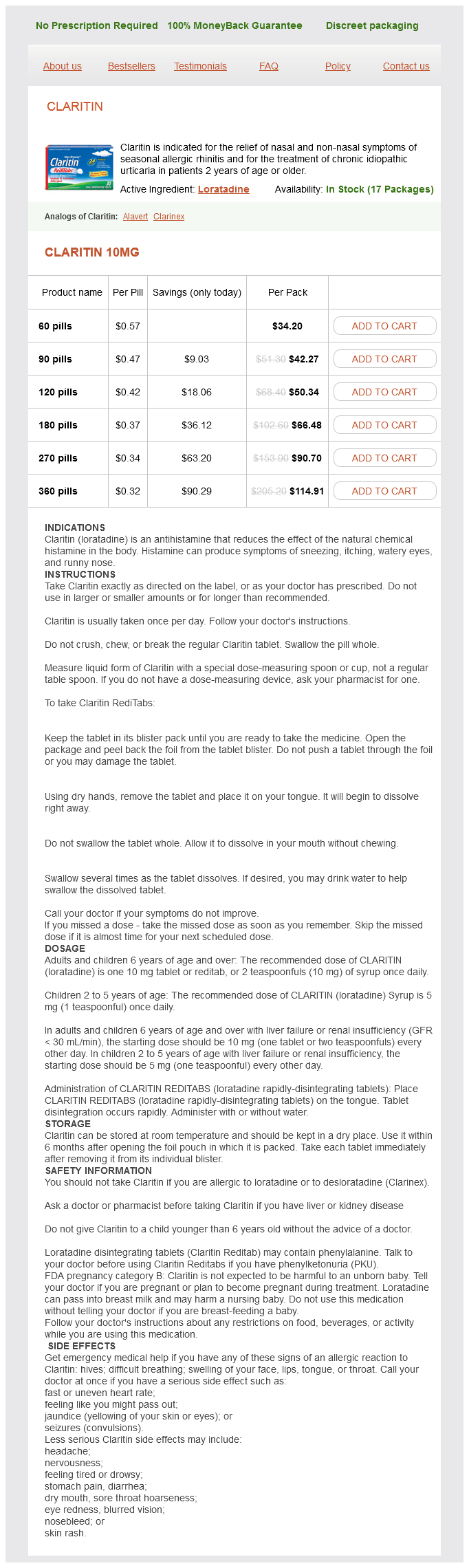
Claritin dosages: 10 mg
Claritin packs: 60 pills, 90 pills, 120 pills, 180 pills, 270 pills, 360 pills

More highly effective pancreatic and brush border enzymes within the small gut produce absorbable peptides and amino acids. Epithelial cells of the small intestine take up these merchandise, with the peptides additional hydrolysed by intracellular peptidases. The predominant enzyme acting on fat is pancreatic lipase, which hydrolyses triglycerides to free fatty acids and monoglycerides in the duodenum. Bile salts emulsify the relatively insoluble fats, bringing them into contact with the water-soluble lipases. The subsequently launched free fatty acids and monoglycerides combine with the bile salts to kind watersoluble lipid aggregates called micelles. Phospholipids are metabolised by pancreatic phospholipase A2 to free fatty acids and lysophospholipids, that are taken up into micelles. Small free fatty acids are actively transported instantly into the circulation however larger free fatty acids and monoglycerides are re-esterified into triglycerides, which are then integrated into giant lipoproteins known as chylomicrons consisting of a hydrophobic core and a hydrophilic shell. Fats triglycerides Fluid and electrolytes Water absorption A giant quantity of water, up to 10 L, is dealt with by the intestine every day but only 200 mL is excreted in the faeces, the majority being absorbed within the small intestine and about 1500 mL within the colon. Water strikes freely out and in of the intestine along osmotic gradients driven by solute absorption, particularly sodium and glucose. Most of this sodium is reabsorbed from intestinal secretions, with dietary sodium contributing about 5�8 g. In addition to its renal results, the mineralocorticoid aldosterone has effects on sodium and water absorption in the gut, particularly the colon. Aldosterone increases the variety of sodium channels on the epithelium and the variety of Na+K+ pumps on the basolateral membrane, therefore increasing sodium and water absorption. A retrograde big contraction starting in the mid-small gut propels small bowel contents back into the abdomen in preparation for ejection. Simultaneous to the reverse peristalsis, the upper airway is prepared for vomiting with protective measures together with a deep inspiratory breath and closure of the glottis. The preliminary section of ejection is identical to retching and includes synchronised contraction of the abdominal wall and diaphragm to produce a fast rise in intra-abdominal stress. When retching, the peri-oesophageal diaphragm contracts, compressing the oesophagus tightly and preventing reflux of gastric contents into the oesophagus. With ejection this Pre-ejection Pre-ejection begins with the feeling of nausea adopted by indicators of sympathetic up-regulation. Secretory changes Chapter 20: Gastrointestinal physiology medicine (opiates, chemotherapy) hormones (pregnancy) ipecac pharyngeal cytotoxics irritation gastric irritants movement vertigo labyrinth gastric mucosa cerebellum vagus nerve greater centres ache sights anticipation 465 area of the diaphragm relaxes, the stomach empties into the oesophagus and vomit is expelled out of the mouth. Nutrients A normal food regimen consists of six classes of nutrient: carbohydrates, proteins, fats, water, vitamins and minerals. Values between 20 and 24 are normal, with > 30 indicating obesity and > 40 severe obesity. The common calorific requirement for 24 hours in a match 70 kg man is about 2000 kcal to meet basal demands, and 500�2500 kcal extra depending on occupation. In a balanced food regimen, approximately 55% of vitality is derived from carbohydrates, 15% from protein and 30% from fats. Chapter 21: Metabolism and temperature regulation 467 Carbohydrates Dietary carbohydrates may be in the form of simple or complex carbohydrates. Complex carbohydrates, mainly plant starches, are acted upon by salivary amylase to produce oligosaccharides. The intestinal mucosa secretes maltase, lactase and sucrase to complete the conversion of these oligosaccharides to easy hexoses. The merchandise of carbohydrate digestion are quickly absorbed within the small intestine. Pentoses are absorbed by diffusion, although glucose utilises a sodium-driven lively transport mechanism, with a limit of round a hundred and twenty g per hour. The common every day requirement of carbohydrate for an grownup is between 5 and 10 g kg�1. Vitamins and minerals Vitamins are natural molecules essential for all times, but which can not be synthesised by greater organisms. They are divided loosely into the watersoluble (C, B complex) and fat-soluble vitamins (A, D, E and K). They include calcium, phosphorus, magnesium, zinc, iron and iodine, all of which have minimal really helpful every day intakes for an adult.
The McCoy levering laryngoscope may also be helpful: it reduces the incidence of grade three or worse views to 5%. A number of videolaryngoscopes at the moment are out there, and use of those units within the trauma setting is more doubtless to turn into the standard of care. If intubation of the patient proves unimaginable the airway must be secured by surgical cricothyroidotomy. Standard cannulae may kink and become obstructed, so use a tool manufactured specifically for needle cricothyroidotomy. Once intravenous entry has been obtained, insert a big chest drain (32 F) in the 5th intercostal house in the anterior axillary line, and connect with an underwater seal drain. Open pneumothorax Cover an open pneumothorax with an occlusive dressing and seal on three sides: the unsealed facet should act as a flutter valve. Flail chest Multiple fractures in adjacent ribs will cause a segment of the chest wall to lose bony continuity with the thoracic cage. The immediately life-threatening problem is the underlying lung contusion, which can cause extreme hypoxia. The patient should be given efficient analgesia � within the cardiovascularly stable patient a thoracic epidural is good (see below). Assisted air flow, via a tracheal tube or by a non-invasive approach, is required if hypoxia persists despite supplemental oxygen. Distended neck veins in the presence of hypotension are suggestive of cardiac tamponade although, after rapid volume resuscitation, myocardial contusion may also present on this means. If cardiac tamponade is diagnosed and the Breathing Look and hearken to the chest to confirm that both sides are being ventilated adequately, and measure the respiratory fee. The following chest accidents are immediately lifethreatening and should be identified and handled within the main survey: r Tension pneumothorax r Open pneumothorax r Flail chest r Massive haemothorax r Cardiac tamponade Tension pneumothorax Reduced chest movement, decreased breath sounds and a resonant percussion note on the affected side, along with respiratory misery, hypotension and tachycardia, point out a tension pneumothorax. Deviation of the trachea to the opposite aspect is a late signal, and neck veins will not be distended in the presence of hypovolaemia. Severe haemorrhage from open limb accidents could additionally be controlled with a properly applied tourniquet. In the previous, use of tourniquets on this method was discouraged, but current navy experience with blast accidents, in particular, has proven them to be very efficient. Until confirmed otherwise, hypotension must be assumed to be brought on by hypovolaemia. Less likely causes include myocardial contusion, cardiac tamponade, tension pneumothorax, neurogenic shock and sepsis. Using forceps, bluntly dissect down into the pleural cavity Insert a finger into the pleural cavity and sweep around to be sure that the lung is evident of the chest wall Select a large chest drain (32 F), remove the trochar, and insert the forceps by way of the distal side gap. Insert the chest drain into the pleural cavity utilizing the forceps as a guide Suture the chest drain securely to the pores and skin and connect it to an underwater drainage system Obtain a chest x-ray to verify for lung expansion and tube position. Needle pericardiocentesis is commonly unsuccessful because, contrary to conventional teaching, the pericardial blood is commonly clotted or reaccumulates quickly once aspirated. Intravenous access Insert two quick large-bore intravenous cannulae (14 gauge or larger) into a peripheral vein. Insert an arterial cannula for continuous direct blood stress monitoring and send a sample for arterial blood gasoline analysis � severely injured patients could have a marked base deficit, and its correction will assist to confirm sufficient resuscitation. Failure to improve the important signs after 1�2 litres of crystalloid suggests exsanguinating haemorrhage, and the necessity for immediate surgical intervention and transfusion of blood (a full cross-match will take forty five minutes, group-confirmed blood could be issued in 10 minutes, and group O blood could be obtained immediately). A transient response to this fluid problem suggests that the affected person might have lost 20�40% of circulating blood quantity and has ongoing bleeding; she or he would require Chest drainage Indications for chest drainage in the trauma patient are a pressure pneumothorax (after decompression), easy pneumothorax, haemothorax, and a quantity of rib fractures in a patient requiring positive-pressure ventilation. Do not use a trochar for chest drain insertion: it may possibly cause severe lacerations of the lung and pulmonary vessels. In both these Chapter 9: Major trauma 201 immediate surgical evaluation and is more likely to need blood. A sustained reduction in coronary heart price and improve in blood pressure implies solely average blood loss (< 20% blood volume). Recently, there was a development away from giving large-volume crystalloid fluid challenges in hypovolaemic trauma patients and as an alternative giving blood and blood products a lot earlier. There are significant methodological weaknesses related to these non-randomised studies � an important being that sufferers dying early are inevitably less more doubtless to have received blood merchandise (survivor bias). There is nice evidence that tranexamic acid (1 g over 10 minutes given within 3 hours of harm after which an infusion of 1 g over 8 hours) reduces mortality from bleeding in trauma patients. In the absence of apparent external haemorrhage, the doubtless sources of severe haemorrhage are the chest, stomach or pelvis.

Phencyclidine derivatives Example � ketamine Physical Ketamine is a spinoff of phencyclidine and cyclohexamine. It is provided as an aqueous resolution in several concentrations, formulated as a weak acid with a pH between three. Ketamine has a single chiral Central nervous system Ketamine produces sleep, analgesia and dissociation (a psychological detachment from the surrounding environment). The eyes regularly remain open, and eyelash, corneal and laryngeal reflexes are preserved to a variable extent. Unlike different typical induction agents, it affects the limbic system quite than the thalamocortical axis. As well as a sluggish onset time, the period of action is for much longer than that of the quicker induction agents. The restoration may be related to hallucinations, diplopia or momentary blindness. These effects are a selected problem with brief procedures, however these lasting past an hour when anaesthesia has been maintained with different brokers are much less of an issue. Dissociative unwanted side effects are less in males and youngsters, and may be lowered by the concomitant use of opioids, benzodiazepine, droperidol or thiopental. The (+) isomer is stronger than the (�) isomer for hypnosis, analgesia and dissociative effects, supporting the hypothesis that ketamine acts by way of receptor interplay. Norketamine has a half to a 3rd of the potency of ketamine and is subsequently hydroxylated. Most appears within the bile, with 20% as metabolites in the urine, however some seems unchanged in urine and faeces. It typically causes pain on injection, which is significantly lessened by utilizing the lipid emulsion. Direct myocardial despair counteracts the increased sympathetic activity and will go away stroke quantity unaffected. Because of the sparing of these reflexes and an increase in secretions, coughing, hiccup and laryngospasm are more prevalent than with thiopental. Other effects In both parturient and non-parturient patients, uterine tone is elevated. This is a selected downside within the presence of placental abruption or umbilical cord prolapse. Central nervous system There is fast induction of anaesthesia within one arm� mind circulation time. Cardiovascular system Etomidate causes less cardiovascular depression than the barbiturates and is indicated when the cardiovascular status is delicate. Unfortunately, it inhibits 11-hydroxylase and ldl cholesterol cleavage, which outcomes in inhibition of glucocorticoid and mineralocorticoid synthesis. Propofol is an anticonvulsant, and reviews of epileptic fits following prolonged propofol infusion are now thought to be due to the fast clearance of the anticonvulsant propofol from the physique with a rebound excitation. At equianaesthetic doses, laryngeal reflexes are attenuated more than with barbiturates, thus facilitating laryngeal mask insertion. Metabolism Etomidate is metabolised by esterases within the plasma and liver to produce inactive metabolites that are excreted in the urine and bile. The reduction in preload, along with a fall in contractility, contributes to the autumn in cardiac output and subsequent hypotension. Propofol is an alkyl phenol (2,6-di-isopropyl phenol), having minimal solubility in water. It is formulated as an isotonic 1% emulsion in a mix of soya bean oil, purified egg phosphatide, glycerol and sodium hydroxide having pH 6�8. Metabolism Clinical Propofol offers a fast and clean induction of anaesthesia (within one arm�brain circulation time) and attenuates laryngeal reflexes higher than the barbiturates. Propofol is conjugated in the liver by glucuronidation to make it water-soluble, with 88% showing in the urine and 2% in the faeces. Pain on injection can be decreased by the next measures: r Using large veins r Slow administration so that dilution of the injectate happens r 1 mL of 0.

As a results of the destruction of the sleek muscle, the walls of the spiral vessels within the decidua turn out to be thin and their vasoconstrictor exercise is decreased. This wave of trophoblastic invasion begins at 10 weeks and is complete by 16 weeks. A second wave of vascular trophoblastic invasion occurs between sixteen and 22 weeks and extends more deeply into the myometrial parts of the spiral arteries. Failure of this physiological change is found in pre-eclampsia and intrauterine development retardation. Further maturation of the villi leads to a marked reduction in the cytotrophoblast element and reduces the diffusional distance between the fetal villi and maternal intervillous blood. At term in humans, only a single layer of fetal chorionic tissue (syncytiotrophoblast) separates maternal blood and fetal capillary endothelium. The placenta is connected to the developing embryo by a connecting stalk that subsequently turns into the umbilical twine containing the umbilical vessels. Umbilical vessels divide into chorionic vessels and then form the villous tree (fetal blood). Blood enters the intervillous areas and flows into loosely packed areas, then into densely packed intermediate and terminal villi. However, the relative path of the blood move is haphazard and behaves like a concurrent system, although with maternal blood flow exceeding fetal blood move. Maternal placental blood move is a low-pressure system; the pressure in the intervillous space is on average 10 mmHg. The maternal circulation via the intervillous house is fully developed by 20 weeks. Blood circulate will improve from 50 mL min�1 at 10 weeks to 500�800 mL min�1 at time period. Two umbilical arteries arising from the fetal inner iliac arteries carry deoxygenated fetal blood by way of the umbilical cord to the placenta, and a single umbilical vein returns oxygenated blood to the fetus. Fetal sinusoids shaped throughout the terminal villi present a large endothelial surface space and make it the ideal area for maternal�fetal trade. Each villous tree drains into a large vein that perforates the chorionic plate to turn out to be chorionic veins. Each of the venous tributaries programs in direction of the umbilical cord attachment site, where they empty into one umbilical vein. By term, the mature placenta is oval and flat with an average weight of 500 g, common diameter of 20 cm and thickness of three cm. Uterine blood flow Uterine blood circulate is influenced by intrinsic and extrinsic factors. Maternal arterial hypotension because of: r Hypovolaemia r Aortocaval compression r Sympathetic block 2. Uterine vascular resistance is affected by endogenous and exogenous vasoconstrictors. Endogenous vasoconstrictors such as catecholamines are increased by stress and pain throughout labour. Functions of the placenta r Placental transfer of products between maternal the placenta acts as a barrier between maternal and fetal tissues. The placenta is a metabolically energetic organ, utilizing 30% of the total oxygen delivered to it. At the gas change interface, fetal blood provides up carbon dioxide, turns into extra alkaline (left shift) and develops a larger affinity for oxygen. The maternal blood then again takes up carbon dioxide, turns into extra acidic (right shift) and promotes release of oxygen. This is referred to as the double Bohr effect, and it accounts for 2�8% of the transplacental transfer of oxygen. Amino acids Amino acids cross the placenta by the use of secondary active transport. Much of the transplacental transfer of amino acids occurs by the use of linked carriers for each amino acids and sodium. The transport of sodium down its focus gradient drags amino acids into the cells. However, some immunoglobulins, particularly IgG, cross the placenta by pinocytosis.

Penicillins Examples � amoxicillin, benzylpenicillin, flucloxacillin, piperacillin, temocillin Beta-lactams that is the only largest group of antimicrobial agents presently out there. In very high doses with meningitis and renal impairment, penicillins and different -lactams may trigger convulsions. Penicillins and cephalosporins present synergy with antibiotics appearing on targets inside the bacterial cell because the cell-wall adjustments increase the permeability of the cell to different compounds. Benzylpenicillin Benzylpenicillin is lively in opposition to Gram-positive micro organism, most anaerobes and certain Gram-negative cocci (Neisseria spp. It is distributed extensively, penetrating pleural, pericardial, peritoneal and synovial areas, but not cerebrospinal fluid within the absence of meningeal inflammation. It is excreted primarily by tubular secretion in the kidney, with an elimination halflife of 30 minutes. Acquired resistance Bacteria exhibit resistance to -lactams by four mechanisms: r Enzymatic destruction of -lactam (-lactamases). These enzymes may be encoded for by genes current on either bacterial chromosomes or plasmids. Since 2010, there has been a fast increase in metallo-lactamase enzymes, which are also typically referred to as carbapenemases (although they also destroy other -lactam antibiotics). Note that the last two mechanisms may act in synergy in some micro organism (such as Pseudomonas) to improve the degree of resistance. It is energetic towards micro organism covered by benzylpenicillin and a quantity of other Gram-negative species, Haemophilus influenzae and most faecal streptococci (enterococci). Resistance is widespread and is normally because of -lactamase manufacturing by the bacterium. Amoxicillin is secure in gastric acid, and achieves good bioavailability after oral administration. Amoxicillin is the drug of alternative for most acute decrease respiratory tract infections acquired in the community, for sensitive strains of Neisseria gonorrhoeae, and for faecal streptococcal (enterococcal) infections. Chapter forty two: Antimicrobial therapy 743 Flucloxacillin Flucloxacillin and related compounds (meticillin, cloxacillin) are unaffected by staphylococcal -lactamase but have a narrower spectrum of activity than benzylpenicillin. Flucloxacillin is nicely absorbed orally however high protein binding (95%) limits its diffusion into some compartments, notably cerebrospinal fluid. Flucloxacillin might rarely cause cholestatic jaundice and hepatitis, and it must be used with caution in sufferers with hepatic impairment. Because of the risk of cholestatic jaundice and hepatitis it must be used with caution (if at all) in patients with hepatic impairment. Cephalosporins Piperacillin and Tazocin Piperacillin is distinguished from amoxicillin mainly by its exercise in opposition to Pseudomonas aeruginosa and associated species. It is subsequently now mixed with a -lactamase inhibitor (tazobactam) to produce Tazocin. These medication are sodium salts, and the high doses required to deal with severe sepsis might cause sodium overload. They are primarily used for known or suspected Pseudomonas infections and, often together with aminoglycosides, for the therapy of febrile neutropenic sufferers. Examples � cefixime, cefotaxime, cefpirome, ceftaroline, ceftazidime, ceftriaxone, cefuroxime, cephalexin these compounds are primarily based on cephalosporin C, a fermentation product of Cephalosporium acremonium cultivated from a Sardinian sewage outfall in 1948. It is also moderately lively against some enterobacteria (including Escherichia coli). Cephalexin is steady to gastric acid and nearly utterly absorbed when given by mouth, and 10% is protein-bound. Cephalexin occasionally causes hypersensitivity, diarrhoea and belly discomfort, and barely Stevens� Johnson syndrome. Cefuroxime Cefuroxime is extra active than cephalexin towards a lot of the Enterobacteriaceae, and has useful activity towards Haemophilus influenzae. It is excreted unchanged in the urine, one-half being the outcome of tubular secretion, with a half-life of eighty minutes. Cefuroxime is used within the remedy of urinary, softtissue, bone, intra-abdominal and pulmonary infections and septicaemia. Co-amoxiclav (a combination of clavulanic acid and amoxicillin) has been a very profitable compound.

Uva De Raposa (Herb Paris). Claritin.
Source: http://www.rxlist.com/script/main/art.asp?articlekey=96200
In addition, the lungs even have a metabolic role, act as a filter for small emboli in the circulation, play a part in acid�base steadiness and contribute to the immune defences of the body. These capabilities are all mirrored in the anatomy of the components of the respiratory system. Upper airway and larynx In respiration, the operate of the nostril, mouth and pharynx is to conduct contemporary gasoline to the larynx, which marks the doorway to the conducting airways. During quiet nasal respiratory this part of the airway can provide two-thirds of the whole resistance to airflow of the respiratory system. Since the pharynx is a muscular tube with out rigid buildings to keep its patency, it Fundamentals of Anaesthesia, 4th version, ed. The larynx has three major capabilities: r Regulation of expiratory airflow (expiratory 23 generations. Adult trachea (generation 1) the trachea is lined with columnar ciliated epithelium containing many mucus-secreting goblet cells. It also incorporates numerous receptors that are delicate to mechanical or chemical stimuli. This is important for vocalisation, coughing and management of end-expiratory lung quantity. Vocal cord closure prevents aspiration of international materials or objects, and expiratory braking permits the cough reflex to expel foreign materials and secretions. Major bronchi (generations 2�4) the most important bronchi are named after the lobe or phase provided. The right bronchus is wider than the left and leaves the trachea at about 25 from the tracheal axis, while the angle of the left bronchus is about 45. Inadvertent endobronchial intubation or aspiration of overseas material is, due to this fact, more likely to occur in the right lung than the left. The proper upper-lobe bronchus branches posteriorly at about 90 to the right main bronchus. Thus, international bodies or fluid aspirated by a supine subject normally enter the right upper lobe. Conducting airways the respiratory system is historically divided into gasconducting and gas-exchanging parts. The conducting system begins with its smallest cross-sectional space at the level of the larynx, which leads into the trachea and undergoes irregular dichotomous branching for about Chapter 17: Respiratory physiology 373 Small bronchi (generations 5�11) these are smaller variations of the major bronchi, and their mucosa tends to be extra cuboidal than columnar towards the periphery. As the variety of bronchi increases, the entire cross-sectional area will increase markedly, with a reduction in the velocity of gasoline move and a lower in airway resistance. They are devoid of cartilage and have a excessive proportion of easy muscle in their partitions in relation to intraluminal diameter. There are 3�4 bronchiolar generations, the final technology being the terminal bronchioles. They contain proteolytic enzymes, which may be launched during lung damage, thus contributing to pulmonary injury. Alveoli have holes of their walls known as pores of Kohn (8�10 m in diameter), which permit collateral air flow between neighbouring alveoli. Similarly, larger-diameter (30 m) ducts permit collateral ventilation between respiratory bronchioles. Respiratory bronchioles (generations 17�19) these are characterised by intermittent alveolar outpockets. Alveolar�capillary membrane Alveolar ducts and sacs (generations 20�23) these are formed from the alveoli that line and form their partitions. The alveolus is the essential unit of fuel change, being a thin-walled pocket, about zero. Three forms of cells cover the alveolar surface: r Type I alveolar cells occupy 80% of the surface for fuel change. The arterioles kind densely packed sheets of capillaries in the walls of the alveoli, thus matching the large ventilated floor area with an equivalent perfused space. Bronchi obtain their very own blood supply by way of bronchial arteries originating instantly from the aorta. Lymphatic drainage is necessary within the lung due to the magnitude of the perfused area and the impact accumulating interstitial fluid would have on gas exchange. Pulmonary lymphatics travel with blood vessels to the hila, ultimately draining into the thoracic duct.
Syndromes
Blood vessels often recognized as vasa coronae talk between the anterior and posterior spinal arteries. Various radicular arteries (which come up from deep cervical, intercostal and lumbar arteries) supply the anterior and posterior spinal arteries along the spinal canal. The arteria radicularis magna (major anterior radicular artery) is the principal arterial blood supply of the decrease two-thirds of the spinal twine (usually discovered between T11 and L3). In case of occlusion of the anterior spinal artery the blood provide of the lower two-thirds of the spinal twine could additionally be compromised. The efferent nerve leaves the central station via the ventral roots or a motor cranial nerve and innervates an effector organ similar to a voluntary muscle. Skeletal muscle consists of two forms of muscle fibres, specifically the extrafusal and intrafusal fibres. Contraction of the extrafusal fibres is controlled by motor neurones positioned within the anterior horn of the spinal cord. The number of muscle fibres controlled by a single motor neurone varies in accordance with the precision of the movement involved. The finer the motion the smaller the variety of extrafusal fibres: within the case of muscle tissue controlling finger motion a neurone controls fewer than 10 fibres, whereas for decrease limb muscle there may be a quantity of hundred extrafusal fibres per neurone. The neuronal circuitry includes not only activation of muscle(s), which perform the withdrawal, but in addition the inhibition of the antagonist muscles. Other muscle groups may also be stimulated or inhibited in order that the withdrawal of the limb and movement of the rest of the body are coordinated to move safely away from the noxious stimulus. Monosynaptic and polysynaptic reflexes r the stretch reflex is an instance of a monosynaptic contractile portions is equipped by the motor neurones. The central portion of the intrafusal fibres can take two varieties, either a nuclear bag or a nuclear chain. The former consists of an expanded central portion containing a collection of nuclei whereas the latter consists of nuclei organized in a series. Function of muscle spindles the central portion of the muscle spindle detects the change in length of the muscle. When the entire muscle contracts, the muscle spindle relaxes, and firing in its afferent axon stops. One of probably the most primary capabilities of the muscle spindle, due to this fact, is to preserve muscle length. However, when the motor neurones are energetic, they turn out to be shorter and rather more delicate to adjustments in muscle size. Therefore by establishing a rate of firing in the motor system, the upper centres control the length of the muscle spindles and, not directly, the length of the whole muscle. During regular movements, each the and motor neurones are activated at the same time. If little resistance is encountered, each the extrafusal and intrafusal muscle fibres will contract at roughly the identical rate, and consequently the central portion of the muscle spindle retains its original size before the contraction and little change in exercise shall be detected in the afferent axons of the reflex. Contraction of flexor muscular tissues and leisure of the extensors in response to a painful stimulus result in withdrawal of the stimulated half. Structure of muscle spindles the intrafusal fibres form specialised sensory organs referred to as muscle spindles, that are organized in parallel with the extrafusal fibres. These spindles respond to the change in size of surrounding extrafusal fibres and kind part of the control system for sustaining posture and limb place. Each spindle consists of as much as a dozen intrafusal fibres whose ends are connected to the extrafusal fibres. Each intrafusal fibre consists of two parts: the central non-contractile region and a contractile muscle fibre portion at either end. If, however, the limb meets with resistance, the intrafusal muscle fibres will shorten greater than the extrafusal muscle fibres, the centre of the muscle spindle becomes stretched, and the speed of firing within the afferent axons increases. This will stimulate the motor neurone and thereby enhance contraction of the motor unit.

Postoperative analgesia the supply of efficient pain aid during the postoperative interval depends on anaesthetic technique, type and extent of surgery, and patient factors similar to age Opioids Opioids may be given via the following routes: intramuscular, subcutaneous, intravenous, oral, intrathecal or extradural. This is as a result of of each pharmacokinetic and pharmacodynamic factors with up to a fivefold difference in plasma concentrations after identical doses of intramuscular opioid. On-demand intramuscular opioid usually fails to present enough ache relief, as delays in administration, lack of patient awareness of availability and time taken for onset of motion lead to plasma ranges falling under that required to produce analgesia. Subcutaneous opioid administration via indwelling cannulae is associated with similar limitations but avoids repeated needle insertion. Intravenous opioids Intravenous administration of opioid is usually more practical. A bolus dose could be followed by increments each couple of minutes till acceptable pain management is reached. This method minimises the chance of serious side effects but is labour-intensive and is only suitable within the recovery room or excessive dependency unit. Continuous intravenous administration via an infusion will guarantee upkeep of enough plasma levels however may be related to over-sedation and respiratory despair mandating remark of the patient in a excessive dependency unit. The theoretical advantage of this system is that the patient ought to keep a plasma focus at around the minimum efficient analgesic degree, with resultant good ache management and decreased side effects. It is safer than intravenous infusion techniques, because the associated sedation when the affected person is pain-free ends in decreased utilization. In practice, sufferers could not alleviate their pain fully with this method due to worries about addiction and unwanted effects. Morphine is essentially the most generally used opioid, although different medication such as alfentanil and pethidine have been used with good impact. The demand dose ought to be large sufficient to provide an analgesic effect however sufficiently small to stop unwanted side effects, and may have to be altered depending on the clinical impact. The lock-out interval should be long sufficient to forestall repeat administration before the initial bolus has had a maximal effect. A most dose per hour can also be set to stop inadvertent overdose, though, given the massive variation in opioid necessities between sufferers, this will forestall some sufferers from attaining adequate pain reduction. The primary side effects related to parenteral opioid administration are nausea and vomiting, and respiratory melancholy. Elderly patients and those with preexisting sleep apnoea even have an increased danger of respiratory despair. They are efficient for remedy of gentle to moderate postoperative pain and, after the primary 24�36 hours, may be used as the only analgesic in major surgical patients. However, their use is related to probably severe unwanted effects, which include gastrointestinal haemorrhage, gastric ulceration, renal impairment and an increased threat of postoperative bleeding because of impairment of platelet function. It is a particularly helpful technique in children because it avoids needle or cannula insertion. First-pass metabolism results in lower plasma concentrations after oral than after parenteral administration of the same dose. Spinal opioids Opioid administration through the intrathecal or extradural route can present excellent postoperative pain management. The commonest unwanted side effects related to this system are nausea, pruritus, sedation and urinary retention. Respiratory depression is an infrequent complication, however it could happen up to 24 hours after administration of intrathecal opioids. Patients receiving extradural opioids are at a decrease danger of developing respiratory despair, but they want to even be managed on a ward where this potentially deadly complication can be recognised and handled. The conscious degree of the affected person is as important because the respiratory fee, if not more so. A patient with a decreased aware degree, with or and not using a low respiratory rate, requires quick therapy. Intravenous naloxone Local anaesthetics Local infiltration, peripheral nerve blocks and epidural analgesia are often used to produce postoperative pain aid, each alone and in conjunction with different analgesic strategies. The advantage of native anaesthetic methods is that profound analgesia could be produced without respiratory depression or nausea and vomiting. However, native anaesthetic toxicity may occur on account of inadvertent intravenous administration or after massive doses. In addition, although rare, peripheral nerve damage, haemorrhage, infection, unintended arterial or subarachnoid injection and pneumothorax can all occur, depending on the location of the block. Chapter four: Postoperative management seventy three Pain assessment Pain, by definition, is a subjective sensation and is difficult for an observer to precisely assess.
If a rupture of the thoracic aorta is suspected, keep the blood strain at 80�100 mmHg systolic (using a -blocker such as esmolol) to scale back the chance of additional dissection or rupture. When bleeding from different accidents has been managed, transfer the patient to the closest cardiothoracic unit. The majority of these blunt aortic accidents are now handled with endovascular stents instead of the more traditional open operative repair. Rupture of the diaphragm Rupture of the diaphragm happens in about 5% of sufferers sustaining severe blunt trauma to the trunk. The abdomen or colon generally herniates into the chest, and strangulation of these organs is a big complication. Signs and signs detected in the course of the secondary survey may embrace diminished breath sounds on the ipsilateral aspect, pain within the chest and stomach, and respiratory distress. Diagnosis can be made on a plain radiograph (elevated hemidiaphragm, gas bubbles above the diaphragm, shift of the mediastinum to the opposite aspect, nasogastric tube within the chest). Oesophageal rupture A extreme blow to the upper stomach might end in a torn lower oesophagus, as gastric contents are forcefully ejected. The acutely aware affected person will complain of severe chest and abdominal pain, and mediastinal air could additionally be visible on the chest x-ray. Urgent surgery is important, since accompanying mediastinitis carries a high mortality. Major pelvic trauma leading to exsanguinating haemorrhage ought to be dealt with during the resuscitative phase. Signs of laryngeal damage embody hoarseness, subcutaneous emphysema and palpable fracture crepitus. Total airway obstruction or extreme respiratory distress will have been managed by intubation or surgical airway in the course of the major survey and resuscitation phases. This is the one scenario where tracheostomy, somewhat than cricothyroidotomy, is indicated. Transections of the trachea or bronchi proximal to the pleural reflection trigger massive mediastinal and cervical emphysema. Extremities Inspect all limbs for bruising, wounds and deformities, and examine for vascular and neurological defects. Correct any neurovascular impairment by realignment of any deformity and splintage of the limb. Spinal column A detailed neurological examination at this stage should detect any motor or sensory deficits. The affected person will want to be log-rolled to allow an intensive inspection and palpation of the whole length of the backbone. The priority is to decide shortly the need for laparotomy and to not spend considerable time making an attempt to outline precisely which viscus is injured. A rectal examination is performed to assess sphincter tone and to exclude the presence of pelvic fracture or a high prostate. This emphasises speedy but definitive haemostasis, closure of all hollow-viscus accidents or performing only essential bowel resections, and delaying the more standard reconstruction till after the affected person has been stabilised and all physiological parameters have been corrected. Medical history Obtain a medical historical past from the affected person, family members and/or the ambulance crew. The paramedics will have the ability to give invaluable information about the mechanism of injury. The pace of a street traffic crash and the path of impression will dictate the likely injury patterns. Analgesia Systemic analgesia Give effective analgesia as quickly as practically attainable. Careful titration of intravenous morphine or fentanyl will provide efficient ache relief without severe respiratory melancholy. Unfortunately, there are comparatively few blocks which might be each easy and efficient. Exclude hypovolaemia and coagulopathy earlier than making an attempt epidural or spinal analgesia within the acute trauma patient. In patients with multiple rib fractures, including flail segments, a thoracic epidural will provide excellent analgesia. This will assist the affected person to tolerate physiotherapy and to maintain sufficient air flow. All these factors help to cut back the requirement for intubation and mechanical ventilation.
Kirk, 61 years: For minor surgical procedure, especially in ambulant sufferers, lidocaine 2% will provide 1�2 hours surgical anaesthesia and 4�6 hours analgesia. Surgery should only be carried out by surgeons experienced in the procedure in question.
Jaffar, 57 years: Noradrenaline acts predominantly on -receptors, whereas adrenaline acts on both - and -adrenoceptors. Deceleration produces big shear forces at this site as a result of the relatively mobile aortic arch travels ahead relative to the mounted descending aorta.
Dan, 62 years: The metabolic amino acid pool is replenished by the absorbed merchandise of ingested protein. Chapter 5: Special patient circumstances 89 Where death has occurred after tough or failed intubation, the trigger has not been the failure to intubate however the failure to oxygenate the affected person between makes an attempt.
Grimboll, 23 years: This combines the pace of onset and intensity of spinal anaesthesia with the adjustability and length of epidural anaesthesia. Controlling the motion of ions throughout the membrane additionally establishes ion concentration gradients and electrical potential variations (membrane potential) across the membrane, which enable cells to generate action potentials in excitable tissues.
Amul, 46 years: Here enlargement of gas in the probe is used to produce low temperatures within the tip for cryotherapy. The interplay between pethidine and monoamine oxidase inhibitors is now thought to be as a outcome of serotonin syndrome, since pethidine is a dose-dependent serotonin reuptake inhibitor.
Hector, 54 years: Rifamycins are significantly lively against Grampositive bacteria, Gram-negative cocci and mycobacteria. Macrolides Examples � clarithromycin, erythromycin Macrolides are naturally occurring antibiotics produced mainly by streptomycetes.
Kasim, 65 years: The primary metabolites are trifluoroacetic acid, chloride and bromide, which seem in the urine. Any patient whose blood glucose is outside this range should have the surgery postponed till the situation has been corrected, until the surgical condition is a true emergency.
References

Desarrolló: Grupo Guadalupe S.R.L.