
Professor Michael R Pinsky
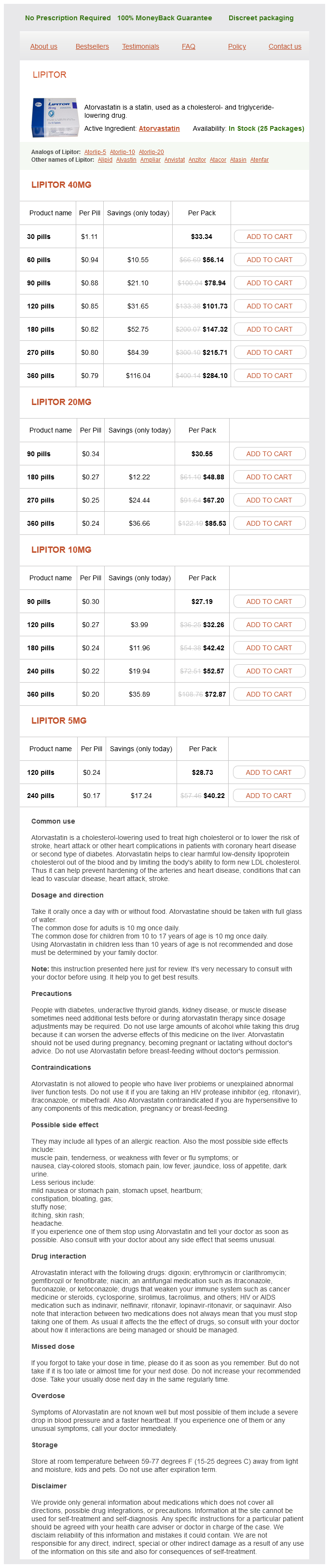
Lipitor dosages: 40 mg, 20 mg, 10 mg, 5 mg
Lipitor packs: 30 pills, 60 pills, 90 pills, 120 pills, 180 pills, 270 pills, 360 pills, 240 pills

Etiology and pathogenesis of posttransplant tumors: new insights into viral oncogenesis. Effect of systemic cyclosporine on tumor recurrence after liver transplantation in a mannequin of hepatocellular carcinoma. Pro- and anti-cancer results of immunosuppressive brokers used in organ transplantation. Renal cell carcinoma detected by screening reveals better affected person survival than that detected following signs in dialysis sufferers. World health organization classification of tumours: pathology and genetics of tumours of haematopoietic and lymphoid tissues. General medical care amongst sufferers with chronic kidney illness: opportunities for bettering outcomes. Screening for prostate, breast and colorectal cancer in renal transplant recipients. Canadian society of transplantation consensus tips on eligibility for kidney transplantation. Renal cell and transitional cell carcinoma in a Japanese inhabitants undergoing maintenance dialysis. Malignant lymphomas following allogenic disease: transition from an immunological to a neoplastic dysfunction. Adelaide, South Australia: Australia and New Zealand Dialysis and Transplant Registry; 2001. The twentieth annual report: Australia and New Zealand dialysis and transplant registry. Outcome of renal transplantation in patients with a functioning graft for 20 years or more. Cyclosporin A and its analogues as modifiers of adriamycin and vincristine resistance in a multi-drug resistant human lung cancer cell line. Effect of lowered immunosuppression after kidney transplant failure on danger of most cancers: inhabitants based mostly retrospective cohort research. Identifying excessive danger teams and quantifying absolute danger of most cancers after kidney transplantation: a cohort examine of 15,183 recipients. Adelaide, South Australia: Australia and New Zealand Dialysis and Transplant Registry; 2008. Adelaide, South Australia: Australia and New Zealand Dialysis and Transplant Registry; 2009. Innovations in surgical strategies and in immunosuppression have been answerable for the improved success rates. The first pancreas transplant was a duct-ligated segmental (body and tail) graft,53 however this strategy was associated with multiple complications. In a series of thirteen extra pancreas transplants between 1966 and 1973 on the University of Minnesota,61,62 Lillehei and colleagues devised the entire pancreasΤuodenal transplant approach to the iliac vessels with enteric drainage through a duodenoenterostomy to native small bowel, which is now a routine at most centers. The initial results have been inferior to today, nevertheless, and a quantity of other surgeons devised various methods in the course of the Nineteen Seventies and early 1980s. Gliedman and associates30 introduced urinary drainage via a ureteroductostomy for segmental grafts, and Sollinger and coworkers106 later modified this method with direct anastomosis of a duodenal patch of a whole-pancreas graft to the recipient bladder. Nghiem and Corry83 did additional modification of urinary drainage, retaining a bubble of duodenum for duodenocystostomy as Lillehei and associates62 had done for duodenoenterostomy. From the early 1980s until the mid-1990s, the bladder drainage technique with duodenocystostomy was the predominant approach for pancreas transplants. The bladder drainage technique had a low acute complication fee and was helpful in monitoring for rejection by detection of a decline in urine amylase exercise, however persistent issues, corresponding to recurrent urinary tract infections or dehydration from fluid loss via the exocrine secretions, were widespread. In the mid-1990s, a change occurred, and enteric drainage, as described by Lillehei and colleagues62 and never completely out of trend,109,126 overtook bladder drainage as the predominant technique. In addition, portal quite than systemic venous drainage began to be utilized by some groups for enteric drainage whole-pancreas duodenal transplants.
Aphanizomenon flos-aquae (Blue-Green Algae). Lipitor.
Source: http://www.rxlist.com/script/main/art.asp?articlekey=96887
The increased danger of acute rejection with steroid withdrawal was not seen in the registry data. The initial criticism of this research was that patients still on steroids at 1 year represented patients with poorer operate because of rejection episodes or delayed graft function, however a subsequent analysis examining end result only in patients with passable renal function at 1 year discovered the identical outcomes. Whilst the number of sufferers and size of follow-up in this research are spectacular (7 years), a serious criticism is a scarcity of a randomized design, with the management cohort being retrospectively matched patients from the Collaborative Transplant Study registry. A number of the studies described above include knowledge from sufferers in whom steroids are avoided fully from the time of transplantation. Meta-analysis has proven no clear difference between subgroups of sufferers avoiding steroids compared to these persevering with for a period following transplantation, though the number of studies is small and so the statistical energy is proscribed. Long-term prospective study of steroid withdrawal in kidney and heart transplant recipients. Incidence of biopsyproven acute rejection was greater in the avoidance group in comparability with the withdrawal group (31. The composite end-point at 12 months of biopsyproven acute rejection, graft loss, or death was 36. Withdrawal has significant advantages when it comes to cardiovascular risk, bone problems, and progress. Whilst the role of full steroid avoidance is unsure, early withdrawal in low-risk renal transplant recipients on a contemporary immunosuppressive regimen seems to be safe with vital benefits to the patient. Loss of regional bone mineral density in the first 12 months following renal transplantation. Minimum steroid requirements in renal transplant sufferers monitored by urinary fibrin degradation products and complement. Effects of three immunosuppressive regimens on vertebral bone density in renal transplant recipients: a potential research. A randomized double-blind, placebo managed trial of steroid withdrawal after pediatric renal transplantation. Steroid Withdrawal in Children Given the detrimental results of long-term corticosteroids on growth, there was some curiosity in steroid withdrawal in pediatric transplant recipients. Benfield and colleagues performed a double-blind, randomized trial in kids 6 months posttransplant either to continue maintenance steroids or withdraw progressively by 12 months. The examine was stopped by the Drug Safety Monitoring Board after enrolment of 274 sufferers due to a really high incidence of posttransplant lymphoproliferative dysfunction (6. A more recent examine reporting withdrawal of steroids beyond 1 year posttransplant from a extra conventional routine has demonstrated no excess in acute rejection at 2 years. Controlled trial of low versus high dose oral steroid remedy in one hundred cadaveric renal transplants. A potential research of methylprednisolone and prednisone as immunosuppressive agents in clinical renal transplantation. Prospective trial of highdose versus low-dose prednisolone in renal transplant sufferers. Addition of sirolimus to cyclosporine in long-term kidney transplant recipients to withdraw steroid. Peripheral blood T lymphocyte activation and comparability of the T lymphocyte inhibitory results of glucocorticoids and cyclosporin A. A prospective randomized trial of low-dose versus high-dose steroids in cadaveric renal transplantation. Glucocorticoid resistance in dialysis patients might impair the kidney allograft consequence. Controlled trial of two different methylprednisolone doses in cadaveric renal transplantation. Mechanisms of the immunosuppressive and antiinflammatory effects of glucocorticosteroids. High rejection fee during calcineurin inhibitor-free and early steroid withdrawal immunosuppression in renal transplantation. Steroid avoidance reduces the value of morbidities after live-donor renal allotransplants: a potential, randomized, controlled research. Suppression of 17-hydroxycorticosteroids in plasma and urine by single and divided doses of triamcinolone. Bone fracture and osteodensitometry with twin energy X-ray absorptiometry in kidney transplant recipients. Predicting therapeutic consequence in severe ulcerative colitis by measuring in vitro steroid sensitivity of proliferating peripheral blood lymphocytes.

As mentioned above, up to now decade this method of transmission has been virtually eliminated with reliable screening methods68,135 and decreased transfusion necessities directly related to the elevated use of hematopoeitic progress elements. Recipient wait time could additionally be considerably lowered and there appears to be no impact on short-term mortality. Twelve p.c of these had continual active hepatitis, 50% confirmed gentle hepatitis, and 38% had normal histology. Furthermore, hepatitis C conferred no opposed impact on affected person or graft survival. Six (35%) sufferers died a median of 6 years posttransplant because of fibrosing cholestatic hepatitis, vanishing bile duct syndrome, cirrhosis, miliary tuberculosis, myocardial infarction. While the causes of renal harm after transplantation are multifactorial in nature, continual allograft nephropathy among renal transplant recipients and nephrotoxicity due to calcineurin inhibitors are the most typical etiologies. Viral replication is elevated with using immunosuppressive agents, but the impression on affected person survival, progression of liver disease, and graft perform is unknown. This may because of greater circulating ranges of interferon in sufferers on dialysis199 or lower viral masses in patients on hemodialysis. Most research report remedy regimens together with interferon monotherapy administered for 6ͱ2 months. Two meta-analyses revealed therapy dropout rates a lot larger (17ͳ0%) than within the non-hemodialysis inhabitants (3ͱ0%). Discontinuation because of severe hemolytic anemia could happen regardless of doses as low as 200 mg thrice per week in dialysis sufferers. A sustained virologic response was seen in one of the six sufferers treated and there was no proof that including ribavirin in dialysis sufferers offered any added therapeutic profit. Adverse results, primarily hypertension and infection, led to discontinuation of remedy in 56% of the subjects (5/9) in the 1. Further, potential studies are needed to higher decide the pharmacokinetics, efficacy, and tolerability of pegylated interferon- in sufferers on hemodialysis. Ribavirin was dosed at 200 mg/day and trough ranges were measured to information therapy. More information on safety, tolerability, efficacy, and pharmacokinetics of combination therapy are wanted in dialysis patients earlier than routine use and doses can be beneficial. Long-term upkeep of response is usually good after a profitable virologic response pretransplant and after renal transplant. Persistent biochemical normalization after renal transplantation is seen within the majority of interferon-treated sufferers. Interferon remedy is subsequently associated with affordable response rates in dialysis patients with frequent maintenance of response after renal transplantation. This information can help information expected response rates as well as aggressiveness of remedy. Those with superior fibrosis and/or cirrhosis have to be considered for a dual-organ transplant. Posttransplant Antiviral Therapy for Hepatitis C Posttransplantation interferon remedy is usually contraindicated in organ transplant recipients other than liver allografts. Estimated survival was worse than that expected for similar-stage tumors in non-transplanted populations. Current American Association for the Study of Liver Diseases pointers advocate surveillance with ultrasound with or without a-fetoprotein each 6 months. Pegylated interferon- has been utilized in liver transplant recipients, but caution must be used in renal transplant recipients due to the identified risk of allograft loss. Foremost amongst these are infections brought on by herpesviruses, that are main pathogens in organ transplantation. The incidence of pyogenic liver abscess ranges from 8 to 20 instances per a hundred 000 hospital admissions121; a population-based research reported 2. Most infections are polymicrobial, with enteric facultative and anerobic micro organism being the commonest brokers. Candida species must also be suspected as a pathogen in pyogenic abscesses, accounting for 22% of abscesses in one series.

After a median follow-up of 51 months (range 36Ͷ2 months), affected person survival was 97%, and graft survival was 91%. Graft operate was steady during the examine, with a mean estimated creatinine clearance of 57 mL/min on the end of follow-up. This steroid avoidance regimen was associated with glorious medium-term patient and graft outcomes and a low incidence of unwanted facet effects. Most 10-year outcomes had been described in a protocol incorporating discontinuation of steroids at postoperative day 7. The 10-year graft survival was 61% for living donor transplant and 51% for deceased donor transplants, comparable to 10-year Scientific Registry of Transplant Recipients national knowledge. The median serum creatinine level at 6 months and general safety profile had been similar with both regimens. One-year analysis advised that early withdrawal of corticosteroids was protected, resulting in excellent affected person and graft survival, low acute rejection rates, and no graft loss to rejection. The high quality of renal function and the incidence of infectious problems were comparable between the alemtuzumab and basiliximab groups. Both corticosteroid-free regimens were equally efficient in preventing acute rejection, with the basiliximab/tacrolimus routine providing some security advantages. No distinction was noted in 1-year patient or graft survival between the 2 groups. In addition, significantly better renal operate was famous in group B sufferers 2 years after transplantation. Oneyear protocol biopsy specimens confirmed no vital differences in the persistent allograft harm index between teams. There was no difference in patient survival, graft survival, or the incidence of medical acute rejection between the two groups. This research suggests that many of the promises of calcineurin inhibitor-free immunosuppression have perhaps not been achieved with short-term follow-up. The question of improved safety and efficacy in the longer term with calcineurin inhibitor-free immunosuppression has to be subjected to longer-term followup of the aforementioned examine and similar studies. The mycophenolate and low-dose tacrolimus arm also had the best graft survival price, however with reduced variations between groups over time, and the least acute rejection fee. Patients were randomized to a more or less intensive routine of belatacept, or cyclosporine. A total of 92% (more intensive), 92% (less intensive), and 89% (cyclosporine) of sufferers survived with a functioning graft. One cyclosporine-treated patient experienced acute rejection between year 2 and 12 months 3. Although a significant advance in immunosuppressive remedy, this formulation had quite a few problems. Absorption was slow and showed a great deal of intrapatient and interpatient variability, making dosing difficult and increasing the danger of persistent rejection. This new formulation improved bioavailability with more fast absorption and less variability in de novo and stable transplant patients. Tacrolimus was related to improved graft perform at 1 and a pair of years after transplantation. A 6-month, randomized, potential, open, parallel-group study with an open extension part was carried out in 18 facilities from 9 European international locations to evaluate the efficacy and security of tacrolimus with cyclosporine in pediatric renal transplant recipients. At 1 year, tacrolimus remedy was related to a significantly lower incidence of acute rejection (36. At 4 years, patient survival was similar, however graft survival significantly favored tacrolimus over cyclosporine (86% versus 69%; P = zero. At 1, 2, three, and four years, the imply Other Calcineurin Inhibitors and Formulations One of the major risk elements for graft failure is noncompliance with medication regimens. Three patients in every arm developed posttransplant lymphoproliferative disorder, and the incidence of diabetes mellitus was similar in the two groups.

In distinction, several studies also reported that donors described the act as constructive and as some of the significant experiences of their lives. Later Psychological Studies in Living Related Transplantation (Late 1980s, and 1990s) During the late 1970s and the Nineteen Eighties, studies started to report extra constructive psychological findings. Simmons and colleagues55 interviewed 230 dwelling related donors and reported that "donors view themselves as more worthwhile due to the donation. Smith and coworkers57 found that 97% of donors reaffirmed their choices, and less than 15% stated that they felt pressured to donate. With regard to recipient reactions, Simmons and colleagues55 reported that, "although recipients did really feel guilt in regards to the gift that they may not reciprocate, most recipients and donors reported that there have been no main issues of their relationship 1 year post-transplantation. Although some facilities continued a robust stance in opposition to residing donor transplants, mainly because of the physical risks to the donor, many different centers elevated dwelling donor transplant. A study by Levey and colleagues31 famous that the bodily risks to the donor had been minimal, and that the benefits to the donor had been considerable with regard to vanity and self-worth. Later studies reported that "to disclaim the donor the right to donate might do psychological harm. The psychological reactions of donor and recipient were monitored closely in many psychiatric studies and are outlined on this section. Early Psychological Findings in Living Related Transplantation (1960s to 1970s) Many of the preliminary research performed in the Sixties and early 1970s questioned the fundamental willingness of relatives to make this kind of sacrifice. Donor altruism the supreme act of unselfishness and of gifting away with out considered reward was a lot debated. Some researchers postulated that, although donors were "consciously altruistic," there was appreciable "unconscious resentment" towards the recipient and towards hospital personnel who requested or encouraged donation. These authors reported that it was common for a recipient who needs freedom from the donor however feels too beholden to him or her to negotiate it to take the drastic step of breaking the relationship fully. These authors confused the need for careful donor selection and ongoing psychological help for donor and recipient as important aspects of care all through the living donor and recipient experience. More Recent Studies and Developments in Living Related Donation the Scandinavian nations included stay donation into their transplantation applications within the 1960s, and the level of live donation has elevated over time. Jakobsen27 reported that nearly 500 residing donors in Norway were requested: "If you would flip the clock again, would you do the identical again? A study from Stockholm16 reported follow-up of 370 dwelling kidney donors; this study concluded that less than 1% of donors regretted the donation, although several donors experienced the first few months after the donation as troublesome from a bodily perspective. Centers within the United States even have revealed outcomes from studies of follow-up in massive numbers of living donors. A examine by Schover and colleagues53 from the Cleveland Clinic examined 167 donors with regard to psychological elements of the choice to donate, impact of donation on household relationships, donor reactions to graft failure, and total satisfaction of donors. Study conclusions were that "donors scored higher than the general inhabitants with regard to high quality of life points. Results concluded that, in the first month after donation, donors reported clinically significant decreases in bodily perform; nonetheless, within 3Ͷ months and persisting for a yr postdonation, donors reported high quality of life scores just like their baseline scores. Although quality of life studies which, in the main, rely upon quantitative methodology report excessive scores in reside kidney donors, few research use indepth qualitative methodology to delve extra deeply into donor choice making, donor and recipient relationships, and donor postsurgery regrets. Some additionally report battle between the family of start and the household of marriage, encounter some difficulties in the postoperative relationship with the recipient, have anxieties regarding their future well being, and regret giving. Similarly, some recipients report difficulties within the postsurgery relationship with the donor and with reciprocity and feelings of obligation. Psychological support is crucial for the stay donor should the subsequent transplant fail or the transplant recipient die. Fortunately, such occurrences are rare however in such circumstances donors report emotions of guilt, anger, and melancholy. All these comments have been made to myself, the author, in circumstances where the transplant has failed. Recipient and graft outcomes have been reported as superior to cadaver kidney transplantation and research of psychological outcomes for living unrelated donors present a rise in life satisfaction scores. Some spouses have commented that their desire to donate is directed by both altruistic and egocentric causes as they know that the transplant will improve the standard of life for the recipient and thus their high quality of life also. A lower in cadaver organ donation has been reported lately in the United Kingdom, continental Europe, and the United States, and, as numbers of patients on the ready lists have elevated, it has turn out to be apparent that the complete potential of renal transplantation will be realized only if other donor sources are developed. Therefore many items have introduced paired kidney trade applications and altruistic donation packages.

A solid-phase assay generally is used because the initial screening tool to determine the presence of alloantibody. Another traditionally controversial area surrounds the importance of a constructive B-cell crossmatch. A major supply of confusion concerning the significance of the varied cell-based assays is a general lack of standardization within the method by which crossmatches are carried out in numerous laboratories. Registry information of sensitized sufferers comprise heterogeneous data, and most published reviews are based mostly on small numbers of patients from single centers. The introduction of so-called solidphase assays has brought important changes to alloantibody characterization, but laboratories continue to perform significant modifications of these assays. Very low ranges may symbolize little elevated danger in any respect compared to unsensitized recipients. Quantifying this risk is a vital facet of designing protocols to allow successful kidney transplantation in sensitized patients. As described later, a mixture of the assorted beforehand described assays allows clinicians to better determine the risk of antibody-mediated graft injury in sensitized patients. In addition, sensitized sufferers are at increased threat for T-cell-mediated rejection, and patients may possess antibodies against antigens not detected by present assays. In addition, the graft survival of sufferers who do receive a transplant is decreased, with the danger of graft loss at 1 12 months 1. Currently, these sufferers obtain no factors for being sensitized and have roughly half the transplantation price of unsensitized patients. A extra aggressive method to transplanting sensitized patients with deceased donor kidneys is the Acceptable Mismatch Program of Eurotransplant. In this program, roughly 60% of the highly sensitized patients are transplanted within 2 years after inclusion within the acceptable mismatch program and the short-term graft survival appears similar to that of unsensitized patients. The incontrovertible truth that desensitization protocols involving multiple plasmapheresis therapies require coordination of the timing of transplantation severely limits their applicability to cadaver donor kidney transplantation. If no such donor may be found, sensitized candidates could decide to enter into one of many growing number of paired living donor programs. Paired schemas make use of the same "unacceptable antigen" schema described earlier to discover a crossmatch-negative donor for sensitized sufferers. Thus, transplantation of a sensitized patient in this setting may make use of each paired donation and desensitization. One-year graft survival rates of almost 100% are being reported in recent studies involving sensitized patients transplanted using desensitization protocols. These can be categorized broadly as hyperacute rejection, early acute antibody-mediated rejection and persistent antibody-mediated damage. New therapy shall be wanted to have the ability to achieve a greater consequence in these patients. The dosing regimen consisted of 1200 mg immediately prior to transplantation, 600 mg on postoperative day 1, after which 600 mg weekly for 4 weeks thereafter. Terminal complement inhibition decreases antibody mediated rejection in sensitized renal transplant recipients. Both grafts recovered completely and had been functioning at 1 year after transplantation. Currently, a randomized, open-label, multicenter examine is being conducted to validate the findings of our single-center research. Transplant glomerulopathy typically carries one of many worst prognoses for 12 00 Doses (mg) 12 00 1200 each 2 weeks 366 Kidney TransplanTaTion: ideas and pracTice any histologic lesion found on surveillance biopsy. In one examine, 60% of grafts with transplant glomerulopathy on a 1-year biopsy both failed or misplaced >50% of their function by 5 years after transplantation. First, light microscopy has been shown to underestimate the quantity of inflammation and injury. Thus, within the first 10 sufferers adopted to 1 yr, eight stopped drug at 1 month, while two had been handled for a complete year.
Syndromes
These smaller vessels are extra prone to thrombosis or kinking, and longer-term penalties include poor graft function and hypertension. An avascular segment of kidney can occur, at least initially, without noticeable effect. Small pediatric kidneys have been identified to bear torsion of the vascular pedicle on removal of the drain with resultant lack of graft function. The timing of drain tube elimination is dependent upon the quantity and nature of the drained fluid. Drainage volume may be an unreliable gauge of active bleeding, notably if brisk. Patient discomfort, tachycardia, hypotension, and belly findings of an enlarging mass around the transplant are indicators of a significant bleed requiring pressing surgical exploration. Large-volume drainage of much less closely blood-stained fluid typically indicates residual peritoneal dialysate (if the peritoneum was breached), lymph, or urine. Urine is excluded by biochemical evaluation or absence of glucose on dipstick testing. The cautious positioning of kidney at time of surgery can be undone readily by a restless recipient flexing the hips because of ache, urinary catheter intolerance, and hypoxia, or an unhelpful radiographer determined that the recipient sits bolt upright for a cellular chest X-ray. Transplanted kidneys producing urine on the finish of the surgical procedure are simpler to manage, notably if urine is being produced in volumes that would not be achieved by residual native kidney perform. If no urine has been seen on the operating table or in restoration, and the recipient is hemodynamically steady with a central venous strain of no much less than 5 cmH2O, Compartment Syndrome All may be nicely with a transplanted kidney whereas the recipient is in a supine or near-supine place. It demonstrates a small disruption of the anastomosis (arrow) that led to catastrophic bleeding 10 days after transplant surgery. The perfusion of the kidney transplant in the proper iliac fossa was compromised by gross pseudo-obstruction of the big and small bowel. Contributing elements embody a large polycystic kidney, heavy fat-laden smallbowel mesentery, and higher omentum in a patient with truncal weight problems. Hematoma, urinoma, lymphocele, or paralytic ileus can do likewise, even with the affected person in a supine place. A paralytic ileus or pseudo-obstruction of the massive bowel may be frustrating to handle in the first week after transplantation. The latter might require a rectal tube to deflate the massive bowel under supervision of the colorectal surgery team. Most hematomas are small and insignificant ultrasound findings that resolve spontaneously. Others expand progressively inside the retroperitoneal area with inevitable external stress on the transplant and antagonistic impact on arterial blood inflow or venous outflow. Indications for surgical exploration of the transplanted kidney include signs, development of measurement, ongoing blood loss, and transplant dysfunction. Surgical exploration within the first day or so after transplantation for hematoma evacuation might locate lively bleeding from a hilar vessel, a retroperitoneal vein, or divided abdominal wall muscle. Thereafter, a extra common finding is a secure hematoma without obvious 28 Vascular and lymphatic problems after Kidney transplantation 443 trigger. Bruising in dependent subcutaneous areas lateral to and beneath the transplant, such because the labia or the scrotum, is commonly seen several days later. The danger of hematoma formation is increased by means of anticoagulants, significantly in patients receiving heparin by infusion for prophylaxis against vascular thrombosis. The reported threat of want for surgical intervention in patients heparinized after transplantation is 30Ͷ0%. Heparinized sufferers constructive for lupus anticoagulant are particularly difficult to handle with heparin. However, they do cut back the margin for surgical error and dictate the necessity for meticulous hemostasis at time of surgical procedure. Compared with different forms of vascular surgical procedure, the incidence of thrombosis is low, perhaps due to the highly vascular nature of the kidney. The low incidence can also help the normal view that renal failure is related to a bleeding tendency secondary to platelet and clotting issue dysfunction.

A related defect was noticed in psoriasis sufferers handled with cyclosporine but not in arthritis sufferers handled with glucocorticoids; cyclosporine was the probably reason for diminished insulin secretory reserve. This state of affairs is worsened as a result of such sufferers lose normal symptom recognition of hypoglycemia, which prevents them from taking early corrective measures. Studies by Diem and colleagues19 confirmed that a profitable pancreas transplant restores regular glucagon responses. Later research by Kendall and associates56 concluded that the transplanted pancreas, quite than the alpha cells within the native pancreas, provided the restored glucagon response. Barrou and colleagues3 used isotopic infusions and hypoglycemic clamp methodology to present that the restored glucagon response normalized hepatic glucose manufacturing throughout hypoglycemia. Kendall and associates54 confirmed that a successful pancreas transplant partially restored epinephrine response during hypoglycemia. More importantly, these research additionally documented that recipients of a successful pancreas transplant re-establish regular symptom recognition. More recently, Paty and coworkers85 have proven that restored hypoglycemic counterregulation is stable in pancreas recipients with functioning grafts for at least 20 years after transplantation. The effect of the incidence of posttransplant weight problems in pancreas recipients was studied, and a detrimental impact on metabolism was proven similar to that within the basic inhabitants. The metabolic responsitivity of the transplanted hemipancreas is generally indistinguishable from that of whole-pancreas grafts. Donors of the pancreatic segments generally keep normal glucose levels, but follow-up studies of the donors (before we established our present criteria to be a living donor) show that about 25% had metabolic evidence of acquired glucose intolerance several years after donation. Later research by Seaquist and colleagues101 showed that hemipancreatectomy additionally was associated with elevated circulating ranges of proinsulin, presumably owing to release of immature insulin granules by which cleavage of C peptide from proinsulin was not yet complete. The outcomes of those research prompted us to modify our criteria to be a living donor. Now, all living donors should have a body mass index lower than 28 kg/m2, in addition to having regular glucose tolerance check outcomes, and plasma insulin levels should enhance by 300% within 1Ͳ minutes after intravenous stimulation with glucose or arginine. Living donors who meet these standards have up to now remained euglycemic and insulin-independent, but they want to be rigorously studied over time. More recent studies of dwelling hemipancreatectomized donors and their recipients during the second decade after surgical procedure have shown a relationship between the development of weight problems and incidence of diabetes,95 and the potential for weight acquire in donors and recipients have to be taken into consideration when deciding on residing donors and recipients for hemipancreatectomy and segmental pancreas transplantation. Most residing segmental pancreas donors retain normal hormonal responses to metabolic challenges, nonetheless. Recipients were studied at baseline, and subsequently divided into two groups: (1) recipients with early pancreas graft failure (<3 months), and (2) recipients with sustained graft operate for greater than 1 year. Retinopathy and visual acuity were quantitated before and serially after transplantation. At 2 years after transplantation, the incidence of development to a higher grade of retinopathy was the same (approximately 30%) in the eyes of recipients with versus without graft function. After three years, no further progression occurred within the recipients with functioning grafts. Seventy percent with failed transplants superior to a higher grade by 5 years, nevertheless. Only a number of recipients had no retinopathy at the pretransplant baseline examination, however illness has not emerged in the subgroup with continuously functioning pancreas grafts. Although these research were in sufferers with diabetic nephropathy, the truth that structural lesions could be reversed reveals in principle that the kidney has the capability for remodeling if the environmental perturbations responsible for the lesions initially are removed, having implications for renal illness normally, and never just that secondary to diabetes. Although it takes no less than 5 years of normoglycemia, a pancreas transplant can reverse the lesions of diabetic nephropathy. Navarro and coworkers81 discovered mortality charges had been higher in patients with autonomic dysfunction or abnormal nerve conduction studies compared with patients with minimal disease. The mortality price also was high in non-transplanted diabetic patients with neuropathy. In neuropathic patients with a profitable pancreas transplant, the mortality rate was considerably decrease, nonetheless, even if neuropathy improved only minimally. Navarro and coworkers82 did follow-up research at 10 years of diabetic pancreas recipients. In control patients (patients with a failed transplant), neuropathy progressively worsened, whereas in recipients with sustained graft function, the advance in neuropathy was sustained.
A cross-sectional examine of cutaneous opposed events in renal transplant recipients receiving long-term sirolimus-based immunosuppression reported the presence of an acne-like eruption in 46%, scalp folliculitis in 26%, and hidradenitis suppurativa in 12% of patients. After conversion from calcineurin inhibitor to sirolimus, patients generally develop skin problems which will take the type of a dermatitis-like rash affecting the arms and, in particular, the fingers. Sirolimus has been observed to reduce hemoglobin ranges with out decreasing the erythrocyte rely in renal transplant recipients, arguing towards a direct antiproliferative impact on erythroid bone marrow. In addition, sirolimus has been shown to promote agonist-induced platelet aggregation in vitro,7 and conceivably, if elevated platelet aggregation occurs in vivo, it could promote elevated removing of platelets by the spleen. Thrombocytopenia most often occurs throughout the first month of starting sirolimus, and its incidence correlates with whole-blood trough levels of sirolimus that exceed sixteen ng/mL. Although thrombocytopenia attracted probably the most consideration in early studies, anemia has emerged as the most significant scientific drawback. In the worldwide study of de novo sirolimus in renal transplantation, anemia was noticed in 16% of recipients taking 2 mg/ day and 27% of recipients taking 5 mg/day sirolimus. The incidence of anemia in the 5 mg/day group was considerably higher than in the placebo group (13%) receiving cyclosporine and steroids. Sirolimus blocks the in vitro response of bone marrow cells to a number of hematopoietic cytokines, together with granulocyte colony-stimulating issue, interleukin-3, and equipment ligand. The analysis was confirmed by radioisotope scanning that revealed areas of elevated uptake in the knees and at the ankles (arrows, A). After sirolimus dosage discount, the signs resolved, and the bone scan returned to regular (B). It was observed in 27% of recipients on the upper dose (5 mg/ day) of sirolimus in contrast with 16% and 13% of recipients on low-dose sirolimus or placebo. Liver Function Abnormalities Sirolimus tends to cause elevated ranges of transaminases (alanine aminotransferase and aspartate aminotransferase) and lactate dehydrogenase. There are two reviews of hepatotoxicity in a renal transplant recipient60,117 and a series of 10 liver transplant recipients in whom sirolimus was thought to be liable for abnormal liver operate checks, with two of the sufferers having liver biopsy specimens with eosinophilia and sinusoidal congestion. Synergistic results of cyclosporine and rapamycin in a chronic nephrotoxicity model. Consequences of genetic polymorphisms for sirolimus requirements after renal transplant in sufferers on major sirolimus remedy. Co-administration of sirolimus alters tacrolimus pharmacokinetics in a dose-dependent method in adult renal transplant recipients. Higher exposure to mycophenolic acid with sirolimus than with cyclosporine cotreatment. Everolimus-based, calcineurininhibitor-free regimen in recipients of de-novo kidney transplants: an open-label, randomised, managed trial. Long-term results in renal transplant patients with allograft dysfunction after switching from calcineurin inhibitors to sirolimus. Investigation of pediatric renal transplant recipients with heavy proteinuria after sirolimus rescue. They are additionally an appealing choice for recipients whose graft operate is declining due to persistent nephropathy. Bone metabolism in renal transplant patients treated with cyclosporine or sirolimus. Multicenter, randomized research of the use of everolimus with tacrolimus after renal transplantation demonstrates its effectiveness. Predictors of success in conversion from calcineurin inhibitor to sirolimus in continual allograft dysfunction. Conversion from calcineurin inhibitors to sirolimus in continual allograft nephropathy: advantages and risks. Sirolimus dosage during and after conversion from calcineurin inhibitor therapy to sirolimus in persistent kidney transplant sufferers. Rapamycinassociated post-transplantation glomerulonephritis and its remission after reintroduction of calcineurin-inhibitor therapy.
However, its use was associated with a low incidence of progressive multifocal leukoencephalopathy (approximately 1/10 000 exposures), which was cited as an undue risk for sufferers with psoriasis. Its availability for off-label use in the clinic may facilitate clinical transplant trials within the foreseeable future. Because cell adhesion has been implicated as a major occasion in reperfusion harm and in allorecognition, this drug has been contemplated as a remedy to limit the impact of events occurring throughout preliminary implantation. Testing within the setting of kidney transplantation has been carried out to decide its efficacy in preventing reperfusion injury. There are two general types, an / type, expressed on 95% of peripheral T cells and answerable for specifying most alloimmune responses, and a / kind, which is concerned in innate immune responses and appears late in allograft rejection. It is effective in mediating T-cell depletion in vitro and in vivo40 and has been studied as a rescue and induction agent in renal and cardiac transplantation. It has been shown to have numerous depletional and non-depletional effects on human T cells. More recently, it has been shown that complement, particularly that produced domestically inside the kidney itself, is a contributing factor facilitating peripheral T-cell maturation and rejection. It has been utilized in quite a few preclinical settings and shown to be efficient in stopping humoral xenograft rejection in a pig-to-non-human primate model. Other Experimental Antibodies and Fusion Proteins Almost all floor molecules expressed by leukocytes have been thought-about for therapeutic targeting. Many have been formally investigated in early clinical trials without sufficient promise to warrant additional scientific growth. Others have significant promise in advanced preclinical settings but have yet to be examined in people. Its primary perform may be costimulatory or inhibitory, however mounting proof suggests that it has a role in self-tolerance. Many immunotoxins are actually being investigated as tumor-specific cytotoxic agents for malignancies and have been proven to have potent antitumor results. Rhesus monkeys so handled earlier than transplantation expertise markedly prolonged allograft survival with no other upkeep immunosuppression, and a major proportion survive for years after T-cell repopulation. Although most of those animals finally develop continual allograft nephropathy,315 the induction effect is impressive, and it has served as the conceptual inspiration for many clinical trials utilizing T-cell depletion. Currently, a quantity of polyclonal and monoclonal anti-Tcell antibodies have proven roles in the remedy of steroid-resistant acute rejection. The final 15 years have seen rising justification for using antibodies as induction brokers. Antibody induction has been shown to be an efficient means of attaining very low rates of acute rejection in renal transplantation. The use of these brokers to facilitate calcineurin inhibitor avoidance, particularly when paired with costimulation blockade-based therapies corresponding to belatacept (Chapter 21), is likely to be a focus of the approaching a quantity of years. Modern immunosuppressive regimens should be individualized, specifically pairing induction brokers based on their mechanism of motion to a selected medical want, and mixing them with complementary maintenance therapies. The future of transplantation continues to be cloaked by a need for extra particular therapies with broader therapeutic indices. Antibodies are highly specific and have proved to be secure and effective medicine whose unwanted effects are usually confined to the specific results of the goal antigen sure. Although the early hopes of clinicians have been sluggish to materialize, the know-how associated with antibody design, development, and manufacturing has consistently improved to yield a diverse array of brokers to be examined and added to the transplant armamentarium. The future is more probably to see almost unique use of humanized or human antibodies and fusion proteins as opposed 306 Kidney trAnsplAntAtion: rules And prActice 19. Influence of polyclonal anti-thymocyte globulins upon ischemia-reperfusion damage in a non-human primate mannequin. Prolonged insulin independence after islet allotransplants in recipients with sort 1 diabetes. Use of antithymocyte globulin and cyclosporine to deal with steroidresistant episodes in renal transplant recipients. Monoclonal antibodies towards human T cell adhesion molecules modulation of immune function in nonhuman primates. Effect of immunosuppressive remedy for renal allografts on the variety of circulating sheep purple blood cells rosetting cells.
Pyran, 42 years: As the kidney graft regains urinary concentrating capacity, urine output declines to levels which would possibly be more fairly achievable as day by day oral intake.
Brontobb, 59 years: The initial criticism of this examine was that patients nonetheless on steroids at 1 12 months represented patients with poorer function as a outcome of rejection episodes or delayed graft operate, but a subsequent evaluation examining end result solely in patients with passable renal function at 1 yr discovered the identical outcomes.
Arokkh, 29 years: Impartial equitable allocation in accordance with the rules of justice and fairness 2.
Frillock, 52 years: Metabolic variations of Leishmania donovani in relation to differentiation, drug resistance, and drug stress.
Gelford, 45 years: Selective runs are performed with indirect or other views as essential using about 10 mL of distinction medium with every run.
References

Desarrolló: Grupo Guadalupe S.R.L.