
SHALENDER BHASIN, MD
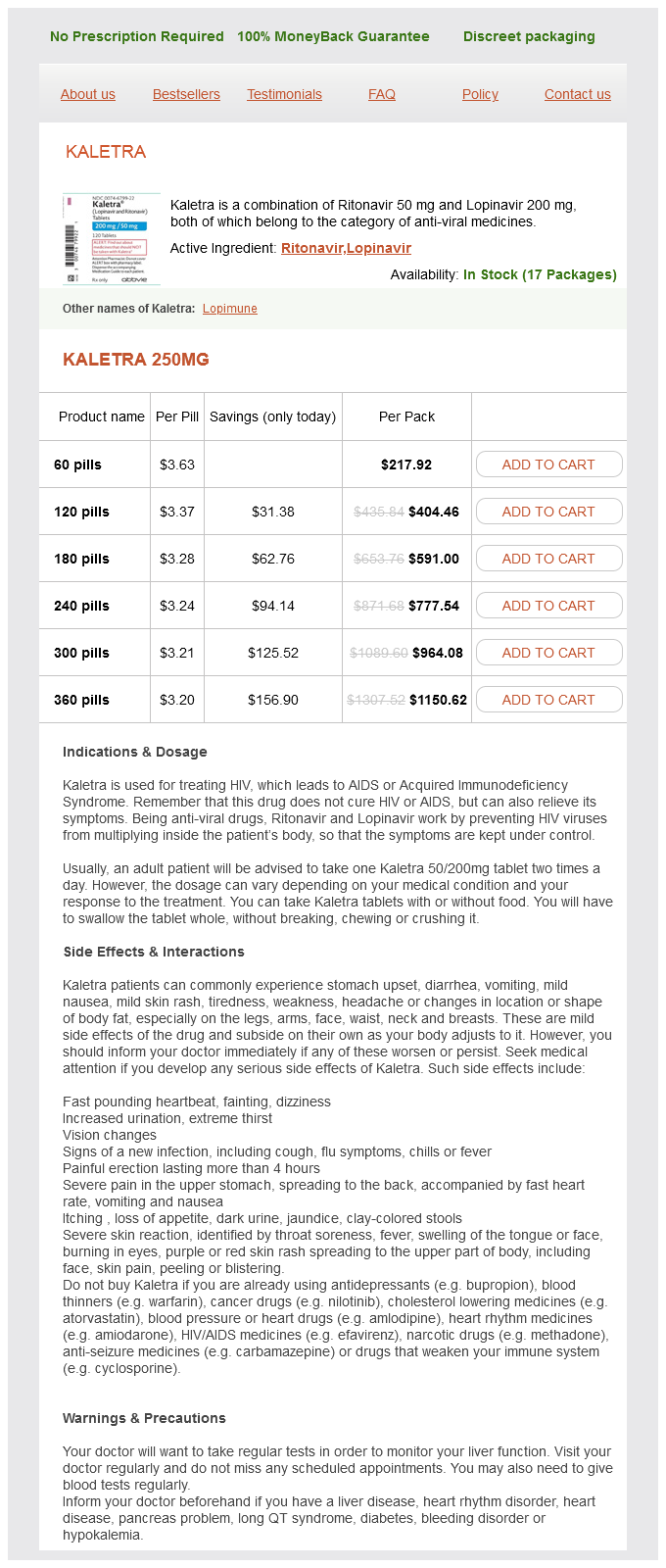
Kaletra dosages: 250 mg
Kaletra packs: 60 pills, 120 pills, 180 pills, 240 pills, 300 pills, 360 pills

Practice recommendations have typically been based on professional opinion derived from observational research, research in nonpregnant patients, manikins, and case sequence quite than randomized managed trials. This lack of high-quality research analyzing remedy of cardiac arrest in being pregnant remains a gap in our scientific data. Nevertheless, several guidelines addressing etiology and strategy have been published lately and a web-based integrated emergency care document that can be extra simply up to date with current data is now out there [1�10]. Pregnancyrelated deaths are defined as those occurring "whereas pregnant or within 42 days of termination of being pregnant regardless of the purpose for death" [11]. Sudden cardiac arrest and sudden cardiac demise check with the cessation of organized cardiac activity with subsequent hemodynamic collapse. Death is prevented in some cardiac arrests, however the phrases are typically used interchangeably. Differences in how events are defined may clarify some of the differences in printed results and moreover, may modulate optimum remedy or sequencing of resuscitation strategies. In the United States, girls who suffered cardiac arrest had been extra likely to be older than 35 years, nonHispanic African-American and extra prone to be funded by Medicaid as opposed to non-public insurers [12]. Studies that tackle solely events during hospitalization for supply may miss women with opposed outcomes exterior the hospital setting. Cardiac deaths secondary to arrhythmias, myocardial infarction, aortic dissection, and cardiomyopathy appear to be increasing, whereas those secondary to congenital heart disease, pulmonary hypertension, and rheumatic heart illness appear to be reducing [24]. Several specific indicators of extreme maternal morbidity have elevated greater than 50% over this timeframe, which may contribute to the rising arrest occasion rate within the United States, including hemorrhage with need for large blood transfusion, shock, adult respiratory distress syndrome, acute myocardial infarction, aortic aneurysms, and acute renal failure [23]. In contrast, in Canada, the cardiac arrest fee has appeared relatively stable over a 13-year interval based mostly on hospital supply discharge knowledge [13]. A current evaluation of extreme maternal morbidity in a cohort of more than one hundred 000 ladies delivering throughout the United States over a three-year interval reported an incidence of 2. Postpartum hemorrhage and hypertensive issues of pregnancy were the most common etiologies [31]. In a study within the Netherlands, case fatality price for women with severe maternal morbidity was 1: fifty three [32]. Adverse outcomes have additionally been attributed to data and scientific ability deficits [24,33,34]. Maternal and neonatal fatality charges following cardiac arrest stay high with reported maternal mortality of 30�80% and neonatal mortality up to 58% in current case series [12,thirteen,19,35� 37]. Survival rates are greater when cardiac arrest happens within the hospital as compared with out of the hospital [12,19, 35]. Nevertheless, survival to hospital discharge following maternal cardiopulmonary arrest seems to be better than for many postarrest populations underscoring the importance of coaching and preparation for resuscitative efforts [12,19,38]. Even though hemorrhage is the leading etiology of pregnancyrelated cardiac arrest in the United States, less than one in a thousand girls with a hemorrhage suffered an arrest. The commonest reason for specific etiology of arrest was amniotic fluid embolism, adopted by acute myocardial infarction and venous thromboembolism [12]. Maternal medical circumstances most incessantly seen in association with cardiac arrest embrace pulmonary hypertension, malignancy, ischemic heart illness, congenital coronary heart disease, valvular coronary heart illness, continual hypertension, liver disease, and collagen vascular disease [12]. The obstetric circumstances mostly associated with cardiac arrest were stillbirth, preeclampsia/eclampsia, and placenta previa [12]. Cesarean delivery was strongly associated with increased danger of arrest, with an adjusted odds ratio of 6. Survival varies by etiology of arrest and is highest in the setting of anaphylaxis, treatment toxicity. The Society of Obstetric Anesthesia and Perinatology Consensus statement consolidated the most generally related situations to contemplate when figuring out the etiology of cardiac arrest into an alphabetical checklist from A to H [5]. These adjustments have penalties that can increase the chance of cardiac arrest and affect optimum efficiency of each fundamental and advanced maternal resuscitation. Cardiac output increases by 30�50% on account of increased stroke volume and coronary heart fee [39]. Plasma quantity and pink cell mass increase early in pregnancy reaching near peak by 28�34 weeks gestation resulting in elevated preload. The uterus has reduced autoregulation of blood vessel tone in response to altering imply arterial pressures, which can result in blunted vasoconstriction in response to hypotension [46,47]. Narrowing of the oncotic pressure-wedge pressure gradient will increase the tendency for pulmonary edema [48,49]. Inspiratory capability is mildly elevated leading to solely minimal drop in total lung capacity [51].

Rate responsive pacing with a minute air flow sensing pacemaker during pregnancy and delivery. Abnormal maternal cardiac operate and morphology in pregnancies complicated by intrauterine fetal growth restriction. Maternal cardiac function in fetal growth-restricted and nongrowth-restricted small-for-gestational age pregnancies. Maternal cardiovascular function in pregnancies difficult by intrauterine growth restriction. X-ray-free implantau tion of a permanent pacemaker during pregnancy utilizing a 3D electroanatomic mapping system. Maternal complete heart block in pregnancy: analysis of four circumstances and evaluate of management. Recurrent pulmonary u emboli and thrombus hooked up to a completely implanted pacemaker wire in pregnancy. Cardiac resynchronization therapy and the relationship of p.c biventricular pacing to signs and survival. Genetic testing in inherited heart diseases: practical considerations for clinicians. Stress of supply and plasma endorphins and catecholamines in the new child infant. Maternal and e fetal endocrine stress response at vaginal supply with and without an epidural block. Maternal and fetal hypothalamo-pituitary-adrenal axis: different response relies upon upon the mode of parturition. Estrogen reduces cardiac harm and expression of beta1-adrenoceptor upon ischemic insult within the rat coronary heart. Gender associated alterations of -adrenoceptor mechanisms in coronary heart failure due to arteriovenous fistula. Bisphenol A and 17-estradiol promote arrhythmia within the female heart by way of alteration of calcium dealing with. Prevention of torsade de pointes in hospital settings: a scientific assertion from the American Heart Association and the American College of Cardiology Foundation. Clinical and molecular characterization of patients with catecholaminergic polymorphic ventricular tachycardia. Incidence and risk components of arrhythmic occasions in catecholaminergic polymorphic ventricular tachycardia. Nadolol decreases the incidence and severity of ventricular arrhythmias during exercise stress testing in contrast with 1-selective -blockers in patients with catecholaminergic polymorphic ventricular tachycardia. The position of flecainide within the management of catecholaminergic polymorphic ventricular tachycardia. Efficacy of flecainide in the treatment of catecholaminergic polymorphic ventricular tachycardia: a randomized clinical trial. Therapeutic strategy for patients with catecholaminergic polymorphic ventricular tachycardia: state of the art and future developments. A complete electrocardiographic, molecular, and echocardiographic examine of Brugada syndrome: validation of the 2013 diagnostic criteria. Maternal death charges have been greater in cesarean sections versus vaginal deliveries (75% vs. Consistent with older information, most maternal deaths (78%) occurred within the first month postpartum. There have been eight abortions (2 spontaneous, 6 induced) and 18 wholesome infants delivered on this series. There were 6 abortions (1 spontaneous, 5 induced), and 43 stay infants were delivered on this series. It is likely more recent cohorts reflect both patient selection and publication biases, as all studies have relatively small cohorts. The most problematic are hemodynamic adjustments that place stress on an alreadystrained cardiovascular system. Most complications happen as pregnancy progresses and manifest after the 20�24th weeks of gestation [16]. Most usually, women turn into symptomatic with these physiologic changes in the course of the late second and third trimester. Symptoms, if unrecognized or not evaluated, can result in catastrophic outcomes, together with maternal and/or fetal demise.
Diseases
Gadoliniumenhanced magnetic resonance angiography for detection of acute pulmonary embolism: an in-depth evaluation. Silversides2,three 1 Department 2 Division of Medicine, Division of Cardiology, University of Western Ontario, Schulich School of Medicine & Dentistry, London, Canada of Cardiology, University of Toronto Pregnancy and Heart Disease Research Program, Mount Sinai Hospital/Sinai Health System, and Toronto General Hospital/University Health Network, Toronto, Ontario, Canada of Obstetrics & Gynaecology, Division of Maternal-Fetal Medicine, Mount Sinai Hospital, University of Toronto, Toronto, Ontario, Canada 3 Department Role of threat evaluation Many girls with coronary heart illness may have obtained conflicting or incomplete advice regarding pregnancy, and subsequently, affected person schooling is a vital side of the ignition consultation. The preconception cardiac consult may be advanced and therefore is necessary to undertake a systematic strategy in discussing pregnancy, ideally previous to conception [1�3]. Our strategy is to handle the next points on the time of consultation: 1 Risk to the mom throughout pregnancy. In our communication to the affected person and the referring doctor, we arrange our recommendations as follows: (i) Is it protected to proceed with pregnancy; (ii) Are there drugs that ought to be started or prevented; (iii) Are any particular precautions necessary during the antepartum or peripartum period; (iv) Is it essential to be adopted or deliver at a tertiary care vs. From the angle of the well being system, danger evaluation permits the appropriate allocation of personnel and resources in accordance with the level of danger. Women at low risk can be managed just like that of a pregnant woman without coronary heart disease, whereas ladies at a high risk receive shut surveillance and delivery at a excessive risk center. The goals of this chapter are to (i) review the frequency and nature of problems associated with pregnancy in ladies with heart disease; (ii) current a sensible approach to cardiac danger evaluation in the preconception or antepartum period; (iii) present a methodologic background to risk prediction, and (iv) evaluation the risk assessment methods presently obtainable for scientific utility. Frequency and nature of pregnancy-related issues Pregnant women with heart disease have a better frequency of cardiac and fetoneonatal problems compared to pregnant ladies without coronary heart disease. There was a pattern in the next frequency of obstetric issues (postpartum hemorrhage or gestational hypertension) within the coronary heart illness group in comparison with controls. Population information have confirmed this larger frequency of maternal cardiac complications in pregnant ladies with coronary heart illness relative to pregnant ladies without heart illness [5�7]. Nevertheless, even in superior international locations, maternal cardiac illness remains one of the main causes of maternal mortality [7,9�11]. The contribution of maternal heart disease to maternal mortality and morbidity is predicted to increase sooner or later, a combination of increasing number of grownup survivors of congenital heart defects, increasing maternal age and prevalence of co-morbidities such as hypertension, diabetes, and obesity [6]. Nonfatal events comprised the overwhelming majority of issues in pregnant women with coronary heart disease. While all of the aforementioned research embrace the main issues, how these problems have been defined is variable across the studies. For example, the definition of coronary heart failure among research varies making comparisons tough [8,12�16]. The commonest obstetric complications reported within the heart disease cohorts are gestational hypertension and postpartum hemorrhage. There was a development toward the next frequency of obstetric problems in the coronary heart illness group (p = zero. General method to pregnancy risk evaluation in girls with coronary heart illness the administration, including danger assessment, of pregnant girls with heart illness is a group effort. Cardiac and obstetric risk evaluation should be performed ideally previous to conception, or as soon as conception is confirmed [2,17,18]. Baseline threat evaluation ought to embody input from specialists from cardiology and high-risk obstetrics (maternal fetal medicine). As pregnancy progresses, inputs and expertise from anesthesia, pediatric cardiology, nursing, allied well being, genetics, and hematology are launched where required. These clinics are positioned within or adjoining to the obstetrical outpatient facility, the place cardiac and obstetric evaluation can be performed inside a single day and at a single location. The co-location of those clinics supplies the ability to maximize interplay with the assorted disciplines so that pressing issues can be dealt with expeditiously and the place expertise is exchanged to facilitate team work. The go to template for the Toronto Mount Sinai Maternal Cardiac Clinic is provided on Table 4. In assessing cardiac threat, the necessary thing elements of clinical evaluation include the following: 1 the character and the kind of prior interventions or surgery. In these, with borderline oxygen saturation or intracardiac shunt lesions that may result in further desaturation throughout being pregnant, it may be useful to measure the oxygen saturation with exertion. The inclusion of these sort of end level in research might inflate complication charges and can make it tough to examine results from varied studies. In all research, cardiac arrhythmia and heart failure/pulmonary edema have been the main explanation for cardiac morbidity. Women with palliative shunts or subclavian flap restore of coarctation of the aorta could have reduced or absent pulses within the ipsilateral higher extremity.

Ventricular arrhythmias secondary to myocardial ischemia may be temporized with -blockade, but revascularization ought to be pursued immediately [303]. Arrhythmia induced cardiomyopathy Persistent atrial or ventricular arrhythmias may end up in reversible left ventricular dysfunction [230]. Persistent arrhythmia can be the only cause of systolic dysfunction, or it might possibly exacerbate an current cardiomyopathy [329]. Chronic, persistent tachycardia results in antagonistic left ventricular remodeling, neurohormonal activation, chamber dilatation, and contractile dysfunction in a predictable manner over time [173]. A sustained coronary heart fee >100 bpm on Holter monitoring ought to increase the suspicion for underlying arrhythmia-induced cardiomyopathy. Control of ventricular rate or underlying rhythm with medical remedy, or, in refractory circumstances, catheter ablation, can outcome in important improvement of left ventricular operate [333,336,337]. Aggressive arrhythmia administration should be undertaken instantly upon recognition of arrhythmia-induced cardiomyopathy to maximize the potential for recovery [329]. Cardiac symptoms corresponding to chest ache, shortness of breath, syncope, dizziness, or palpitations precede cardiac arrest in a considerable number of cases (37. Arrhythmia occasions causing cardiac arrest are extremely unusual in being pregnant, and the underlying etiology is usually another catastrophic complication of being pregnant or labor and delivery, underlying comorbidity, or profound vasovagal stimuli [12,338,340,341]. When contemplating the first cardiovascular causes of sudden demise, leading causes embrace sudden arrhythmia syndromes (53. Evaluation for these potential underlying etiologies should be undertaken in the survivor of cardiac arrest after stabilization. Obstetric items ought to have a clear plan for management of cardiac arrest during pregnancy, as nicely as a delivery and neonatal administration plan within the occasion of a maternal cardiac arrest. First responders must recognize the importance of figuring out hemodynamic stability, presence or absence of a palpable pulse, and to initiate resuscitation measures quickly. The pregnant affected person is extra weak to hypoxemia [346] and to hemodynamic compromise secondary to aortocaval compression in the supine place [347,348]. Because of probably compromised venous return from the decrease extremities, intravenous access must be obtained above the diaphragm when attainable [345]. In conditions where quick delivery is considered to be the most effective way to handle maternal disaster, cesarean supply, when potential, should be undertaken at the site of cardiac arrest, to keep away from delays due to transportation and further maternal deterioration [351]. Airway management and oxygenation are important components of resuscitation efforts as the pregnant patient is extra weak to hypoxemia, and hypoxemia ought to at all times be thought of as a possible reason for cardiac arrest in being pregnant [346]. This has been proven to have greater efficacy than lidocaine administration [354,355]. Recommendations relating to focused upkeep of fixed temperature between 32 and 36 �C after return of spontaneous circulation ought to be individualized, given the theoretical risk of inducing coagulopathy [345,356,357]. Electrophysiology research, if indicated, must be postponed until after supply. Potential reversible causes embrace electrolyte abnormalities, drug or toxin exposure, and acute ischemia. With very few exceptions, these recommendations should be followed to identify pregnant women at elevated threat of life-threatening arrhythmias who should be offered an implantable defibrillator. Catheter ablation Catheter ablation could also be thought-about in refractory arrhythmias which may be poorly tolerated. Advances in catheter ablation approach have decreased radiation publicity times, and a lot of arrhythmias can be safely ablated with using advanced mapping systems with no radiation publicity [71,117, 315,365�369]. The potential for radiation exposure should be thought of and discussed in all circumstances, however, and if potential, ablation postponed until the second trimester to decrease the danger to the fetus. Bradyarrhythmias Sinus bradycardia is usually secondary to vagal tone, similar to with the Valsalva maneuver throughout labor and supply, or the supine hypotensive syndrome of pregnancy brought on by uterine compression of the inferior vena cava [125]. This can typically be managed with repositioning to the left lateral decubitus position. Bradyarrhythmias are uncommon in ladies of child-bearing age, with a prevalence of 1/20 000 [371�373]. Pregnancy has no clear affiliation with growth of conducting system disease [376]. This may be of particular importance in twin or larger order pregnancies [381,382]. Women who remain asymptomatic into the third trimester are unlikely to need pacing assist, though there could also be an affiliation between maternal bradycardia and fetal development restriction [383�385]. The risks of permanent pacemaker implantation, when required during being pregnant, are low.

How their action is related to quinolonemediated chromosome fragmentation is at present unknown. Insertion of truncated proteins into the cell membrane prompts a twocomponent membrane stressresponse system known as Cpx. When stress is high, activation of Cpx stimulates one other twocomponent system (Arc) that then results in a cascade of reactive oxygen species [17]. Thus, Cpx has a destructive and a protecting motion; it represents a third bifunctional system involved in determin ing whether stressmediated injury is repairable. Stress brought on by average fluoroquinolone focus (blue type and lines) ends in a protective stress response. Peptides that enter cell membranes stimulate the Cpx twocomponent system to induce genes concerned in membrane protein restore. Safety valves YihE kinase and KatG catalase negatively regulate MazF and detoxify peroxide, respectively. At excessive quinolone concentrations, chromosome fragmentation requiring ongoing protein synthesis initiates a deadly pathway that overwhelms the protective response and ends in cell dying (red lines). That causes the Cpx system to induce the Arc twocomponent system, which in flip leads to highlevel production of superoxide. Superoxide dismutates to peroxide; the Fenton reaction then converts peroxide to hydroxyl radical. Hydroxyl radical damages nucleotides and many macromolecule types, causing mutations and cell dying. Another security valve is the katG catalase/peroxidase, which detoxifies peroxide by converting it to water. During periods of harsh stress, superoxide appears to accumulate to excessive ranges that dismutate to peroxide. Peroxide is then transformed to hydroxyl radical whose poisonous results overwhelm the protecting capabilities of superoxide. The bifunctional nature of superoxide explains how low concentrations of metabolic gen erators of superoxide, such as plumbagin and paraquat, scale back the lethal motion of bleo mycin and the quinolones, even though high concentrations of plumbagin kill bacteria. Other contributions to cell demise derive from protein carbonylation and lipid peroxidation, both arising from hydroxyl radical action. In abstract, quinolones kill partially through a surge in reactive oxygen species: mutations and treatments anticipated to enhance the surge enhance quinolone lethality, and people who suppress the surge scale back lethality. Bifunctional proteins and superox ide collectively make a liveordie decision primarily based on the extent of stress [12]. The challenges additionally revealed a have to make clear the experimental definition of lethal stress response. When a quinolone acts utilizing each pathways, as is the case with norfloxacin, drug focus becomes a crucial parameter [2]. One considerations the widespread use of an iron chelator (2,2bipyridyl) to attribute deadly motion to the con model of peroxide to hydroxyl radical. As pointed out earlier, gatifloxacin and moxifloxacin, which differ only in their C7 ring systems, differ of their capability to kill mycobacteria handled with chloramphenicol. The deadly motion of a quinazolinedione, which lacks the automotive boxyl, exhibits reduced inhibition by chloramphenicol with mycobacteria [26]. When this group is fused to the N1 moiety, as is the case with levofloxacin, lethal activity within the presence of chloramphenicol is reduced. Understanding how these structural features contribute to deadly activity is hindered by the absence of a easy biochemical surrogate for cell demise. To present an outline, we briefly sketch the major sources, which range from molecular events to our consumption practices. For many pathogens, mutations happen spontaneously at a frequency of about one in 107 cells. This basal stage is raised orders of magnitude by the mutagenic action of the quinolones themselves, largely via induction of errorprone repair path ways. Some pathogen strains additionally include defective replication proteins referred to as mutators (an instance is the E. Mutators usually symbolize solely a small fraction of a bacterial population, in all probability as a end result of they have an inclination to cut back bacterial health; nonetheless, they can be important when weak selective stress allows them to enhance in abundance. Plasmidmediated resistance stems from mobilization of chromosomal genes encoding efflux pumps, enzymes that alter quinolone structure, and proteins that intervene with quinolone�topoisomerase interactions. Broadspectrum plasmids disseminate these varieties of resistance elements to quite lots of bacterial species.
Syndromes

Attaining good pharmacokinetic overlap is difficult, because pharmacokinetic profiles rarely coincide. One answer is to chemically hyperlink fluoroquinolones with another antimicrobial, as has been done with rifampicin. This thought applies when resistance arises largely from newly formed resistant mutants, i. In distinction, the selection window hypothesis maintains that resistance can emerge from mutations current earlier than and through treatment with qui nolone. Examination of many pathogenantimicrobial mixtures reveals that rec ommended doses typically place drug concentrations inside the selection window the place the medication enrich resistant mutant subpopulations. An necessary function of the window concept is that mutant subpopulations present before treatment can lead to resistance even when the susceptible population is quickly eradicated. Evidence for the presence of preexisting mutants derives from an experi ment in which noses of tuberculosis patients had been sampled for S. This bacte rium could be very vulnerable to rifampicin, a drug generally used to treat tuberculosis. Moreover, the animal studies will not be massive enough to encompass the full range of resistant mutant subpopulations. Consequently, it has been necessary to determine how nicely the static boundaries apply to the dynamic scenario. Measurements with in vitro dynamic models show that the window may be observed with fluctuating antimicrobial concentrations for quinolones, vancomycin, and daptomycin. Testing the selection window idea with patient populations is troublesome, as a result of very giant clinical trials are wanted to see the emergence of resistance. Restricting resistance by preserving concentrations above the mutant selection window is predicated on blocking mutant development. Killing the majority, prone inhabitants is an added impact that directly reduces pathogen num bers. That discount ought to scale back remedy occasions, which in turn ought to decrease prices, poisonous unwanted aspect effects, and the possibility that new resistance will develop. Removal of prone cells from an an infection should also increase the likelihood that host defense systems get rid of resistant mutants. Some fluoroquinolones, such because the C8methoxy derivatives, extra avidly kill resistant mutants than their C8H coun terparts. This mutantactive function might contribute to the C8methoxy compounds being better at restricting the choice of resistant mutants. Enhanced killing of resist ant mutants also needs to contribute to the power of a compound to management a bigger bacterial population. Both applica tions may be carried out with data in the published literature. Thus, obtaining the required pharmacodynamic information requires technical improvement. We conclude that a serious issue is whether limiting the emergence of resistance is definitely value the added price of bigger drug amounts and potential unwanted aspect effects. The report concludes that the optimal dosing technique is to use both the best tolerable dose or the bottom clinically effective dose. The highest tolerable dose could or may not place drug concentrations above the higher boundary of the choice window. The key idea is that low doses permit a bigger fraction of the pathogen population to begin the "hill climb" to resistance. For example, spontaneous mutations happen at a frequency of lower than 10-7, mutator mutations increase spontaneous frequency to about 10-4, horizontal switch is about 10-2, and the value is 1 when the whole population is resistant. Thus, the possibility that resistance will emerge depends on each the frequency at which resistance arises and the concen tration relative to the selection window. Repeated cycles of fluoro quinolone remedy, punctuated by periodic outgrowth of pathogen populations, lead to the stepwise accumulation of mutations. The order in which target and non target alleles come up in all probability is dependent upon the incremental enhance in quinolone con centration. If the initial focus is low, nontarget alleles will be chosen, as seen with mycobacteria and S. Then small will increase in concentration result in the restoration of further nontarget alleles. Those mutations can increase the likelihood that a mutant with a second resistance allele will be selectively amplified [40, 41].
A laboratory model of resected human arteries showed a significant endothelium-dependent vasodilating impact of relaxin [15]. Additionally, the administration of relaxin has been proven to induce a rise in renal blood circulate and glomerular filtration rate in nonpregnant rats [18], whereas relaxin-neutralizing antibodies prevented renal vasodilation and pregnancy-related glomerular filtration fee improve in pregnant rats [19]. Natriuretic peptides these peptides are known to induce vasodilation and natriuresis, blunt the effect of catecholamines, and stop cardiac transforming [20]. Estrogen and progesterone Early being pregnant is characterized by an increase in the levels of estrogen and progesterone. Progesterone was reported to block the sodiumretaining effect of aldosterone [5] and was discovered to induce a direct natriuretic effect on the kidneys [6]. In a laboratory rat model [7], progesterone ameliorated the hypertensive impact of norepinephrine within the intact animals and blunted the vasoconstrictive effect of vasopressin and calcium channel current in isolated vascular smooth muscle cells, suggesting that its vasodilatory impact could be via a decrease in intracellular calcium content [7]. Plasma prorenin ranges peak during the first trimester whereas active renin ranges increase during the second trimester, and angiotensin changing enzyme ranges stay secure throughout being pregnant [26,27]. The sympathetic system Sympathetic hyperreactivity was initially thought to happen solely in pregnancy-related hypertensive problems [33]. This change in sympathetic activity was accompanied by elevated ranges of noradrenaline and renin [35]. Another explanation for the elevated sympathetic tone during pregnancy might be associated to a compensatory mechanism to the pregnancy-related peripheral vasodilation [35]. Hemodynamic adjustments throughout pregnancy Blood quantity An enhance in blood quantity of 34�70% (50% average) compared with nonpregnancy levels is seen by the third trimester of normal being pregnant, and plasma quantity ranging from 3200 to 4280 ml/m2 (depending on parity) is present in a traditional singleton being pregnant [39,40]. The mechanism leading to hypervolemia in pregnancy appears to be multifactorial (Table 1. Both estradiol and progesterone have been discovered to have important effects on body water primarily by rising renal sodium and water retention [42]. The threshold for vasopressin secretion decreases in being pregnant as a end result of a reset of osmoregulation. In addition, the edge of thirst was also found to be reset at a decrease plasma osmolality level facilitating water retention [43]. Red blood cell mass increases by 33% throughout normal being pregnant and constitutes a major proportion of blood quantity growth [46,47]. Increase in plasma quantity is extra speedy than the rise in erythrocyte volume, causing the "physiological anemia of pregnancy. This sample contrasts the continued increase in red blood cell mass all through pregnancy. Jepson reported that greater diploma of erythropoietin activity was measured in blood vessels draining the gravid uterus compared with peripheral blood, indicating that a certain issue (now recognized as human placental lactogen) increases erythropoietin activity throughout Table 1. A second potential clarification may be related to the elevated levels of progesterone throughout being pregnant and the peripartum interval, which neutralizes the negative effect of estrogen on production and exercise of erythropoietin [49]. It must be additionally noted that prolactin, a hormone biologically much like human placenta lactogen, also enhances, synergistically, the impact of endogenous erythropoietin throughout lactation. The larger enhance in plasma quantity throughout pregnancy in comparison with that of red blood cell mass leads to the "physiologic pregnancy-related anemia" found in most pregnant women. Meta-analysis of collected data confirmed a decrease in hematocrit from prepregnancy value of 39 � 2. Importantly and paradoxically, the physiologic anemia of being pregnant happens concomitantly with an increasing need of the growing fetus for oxygen. A possible protecting mechanism is the development of collateral venous drainage by way of the vertebral vessels as was described by Scott and Kerr [73]. In this study, nevertheless, no measurements had been made within the first or second trimesters of pregnancy. These embrace the vasodilatory effect of being pregnant hormones in addition to relaxin and natriuretic peptides and an increased resistance to the pressor effect of angiotensin and noradrenalin [76,77]. In addition, increased levels of prostacyclin could result in direct vasodilation [82]. This elevated compliance might be as a end result of elevated levels of estrogen and increased prevalence of estrogen receptors in the endothelium and vascular clean muscle [85].

Emergence and resurgence of methicillinresistant Staphylococcus aureus as a publichealth risk. Class D and E tetracycline resistance determinants in Gramnegative catfish pond bacteria. Identification and cloning of a tetracycline resistance gene from the fish pathogen Vibrio salmonicida. Analysis of the complete nucleotide sequence of the tetracyclineresistant transposon Tn10. In: EnzymeMediated Resistance to Antibiotics: Mechanisms, Dissemination, and Prospects for Inhibition (ed. Genetic basis of tetracycline resistance in food borne isolates of Listeria innocua. The presence of the tet(O) gene in erythromycin and tetracyclineresistant strains of Streptococcus pyogenes. Characterization of Tn916S, a Tn916like component containing the tetracycline resistance determinant tet(S). A novel transposon, Tn6009, composed of a Tn916like factor linked to Staphylococcus aureuslike mer operon. Widespread distribution of a Tet W determinant among tetracyclineresistant isolates of the animal pathogen Arcanobacterium pyogenes. Multiple genetic parts carry the tetracycline resistance gene tet(W) in the animal pathogen Arcanobacterium pyogenes. The tetracycline destructases: a novel household of tetracyclineinactivation enzymes. Specific binding of divalent metal ions to tetracycline and to the Tet repressor/tetracycline complicated. Tetracycline resistance in forty five forty six 47 48 49 50 51 fifty two 53 fifty four 55 56 fifty seven fifty eight 59 60 sixty one Chlamydia suis mediated by genomic isolated inserted into the chlamydial invlike gene. The maintenance in the oral cavity of children of tetracyclineresistant micro organism and the genes encoding such resistance. Transfer of lactamase plasmids from Neisseria gonorrhoeae to Neisseria meningitidis and commensal Neisseria species by the 25. Novel tetracycline resistance gene, tet(32), within the Clostridiumrelated human colonic anaerobe K10 and its transmission in vitro to the rumen anaerobe Butyrivibrio fibrisolvens. TetX is a flavindependent monooxygenase conferring resistance to tetracycline antibiotics. Identification of a new 63 64 65 sixty six sixty seven 68 69 70 seventy one ribosomal safety kind of tetracycline resistance gene, tet(36), from swine manure pits. New Mg2+ -dependent oxytetracycline resistance determinant Tet 34 in Vibrio isolates from marine fish intestinal contents. Highlevel vancomycinresistant Staphylococcus aureus isolates associated with a polymicrobial biofilm. Tet 42, a novel tetracycline resistance determinant isolated form deep terrestrial subsurface bacteria. Metagenomic analysis of apple orchard soil reveals antibiotic resistance genes encoding predicted bifunctional proteins. Ecological characterization of the colonic microbiota in arctic and subarctic seals. Occurrence and variety of tetracycline tet(M) in enteric bacteria of Antarctic Adelie penguins. However, resistance has stimu lated the event of latest quinolonelike derivatives and research to obtain a deeper understanding of quinolone action. That framework, referred to as the mutant selection window hypothesis, provides a rationale for adjusting doses to restrict the selective amplification of mutant subpopulations. The current chapter describes our current understanding of quinolone motion and resistance. We additionally update work on the mutant selection window and on the rising problem of plasmidborne fluoroquinolone resistance. We apologize upfront for omitting references to many nice papers � for editorial reasons the variety of citations was restricted.

Cardiac arrest from hemorrhage may be the end result of placental abruption, uterine rupture, placenta previa and abnormally adherent placenta (placenta accreta, increta, or percreta), and uterine atony or retained placenta [160]. Bleeding can also be a consequence of coagulation defects, stomach trauma, or of vascular issues similar to aortic rupture. Focused transabdominal ultrasound may be useful for prognosis of bleeding issues [160]. Crystalloid options, colloid options, and blood merchandise can be utilized acutely to improve preload [160,161]. Uterotonics, uterine evacuation, uterine tamponade, and uterine artery embolization are early interventions [160]. Massive transfusion protocols must be utilized to facilitate administration of blood merchandise [162]. Cardiovascular disease nearly all of cardiac arrests in girls with a cardiovascular etiology will occur within the setting of structural heart illness similar to cardiomyopathy, myocardial infarction or ischemic heart illness, valvular heart disease, and aortic dissection [163,164]. Management of underlying cardiac disease ought to be based mostly on the underlying etiology as discussed elsewhere on this textbook. Drugs Magnesium Magnesium sulfate is used during pregnancy for prevention and therapy of seizures in preeclampsia or eclampsia, fetal neural protection for early preterm fetuses, and short-term prolongation of pregnancy for women with preterm labor [165]. Magnesium sulfate has vasodilatory results, depresses smooth muscle contraction, has negative inotropic results, and can lead to respiratory despair or cardiac arrest at toxic levels. Magnesium toxicity ought to be suspected whenever arrest has occurred in the setting of magnesium infusion and should be treated empirically with calcium gluconate or chloride and the magnesium infusion ought to be stopped [1,6]. Oxytocin Oxytocin is commonly used for prevention of uterine atony and postpartum hemorrhage after vaginal and cesarean deliveries however ought to be used with caution. Oxytocin acts as a systemic vasodilator with adverse inotropic results which has been reported to end in hypotension, tachycardia, and ischemia theoretically contributing to danger of rearrest [166]. Substance abuse the prevalence of opioid dependence and abuse in being pregnant greater than doubled between 1998 and 2011, based mostly on an analysis of hospitalizations for supply extracted from the Nationwide Inpatient Sample. Cocaine use has been related to acute myocardial infarction [168], aortic dissection [169], supraventricular and ventricular cardiac arrhythmias, and sudden cardiac dying [170]. Specific diagnosis of cocaine overdose can be made with urine or blood testing [171,172]. However, hypertonic bicarbonate could be thought of for wide complex tachycardia attributed to a Class 1c arrhythmic impact [9]. Amniotic fluid enters the maternal circulation, triggering respiratory, and cardiac failure most likely because of inflammatory and anaphylactoid responses [175]. Therapeutic recommendations embody supportive remedy with oxygenation and ventilation, vasopressor or inotropic remedy, and therapy of related coagulopathy as indicated primarily based on medical findings. Immediate delivery of a fetus is recommended if gestational age is no less than 23 weeks [177]. Pulmonary embolism Pulmonary embolism stays a quantity one reason for mortality during being pregnant and postpartum and must be suspected in the setting of acute-onset dyspnea, pleuritic pain, and hemoptysis previous to arrest. Pulmonary artery obstruction and release of vasoactive substances result in an acute increase in proper ventricular pressure and cardiovascular collapse. Risk factors for pulmonary embolism in pregnancy embrace older age (>35 years), weight problems, multiparity, earlier thromboembolism, related thrombophilia dysfunction, varicose vein illness, paraplegia, sickle cell illness, chronic medical conditions, hyperemesis, dehydration, extended journey, cesarean part, and immobility [185]. Anticoagulation alone may be an insufficient therapy for sufferers with huge or submassive pulmonary embolism in the setting of cardiopulmonary arrest [7,189]. Pregnancy has been thought-about a contraindication to enrollment in thrombolytic trials, but a evaluate of thrombolytic brokers used for quite a lot of indications showed low maternal mortality and acceptable bleeding charges [190]. Cerebral venous thrombosis Cerebral venous thrombosis is a uncommon type of stroke but seen with elevated frequency in pregnancy. Risk factors embody older maternal age, hypertension, hyperhomocysteinemia, and cesarean supply [191]. Treatment is anticoagulation with intravenous heparin or low molecular weight heparin throughout the being pregnant, and for a minimum of six weeks postpartum with a minimal of six months remedy [192]. Decompressive craniectomy or surgical hematoma evacuation may be required within the setting of elevated intracranial stress or progressive neurologic defects [192,193]. Fever/sepsis Obstetrical infections sophisticated by extreme sepsis or shock are associated with a excessive rate of maternal mortality and morbidity [194]. The most typical extreme antenatal infections end result from septic abortion, chorioamnionitis, pyelonephritis, and streptococcal or influenza-associated pneumonia [196].

Bland, monotonous follicular cells with spherical nuclei and small chromocenters are present, according to a microfollicle (Diff-Quik stain). A microfollicle is present with follicular cells organized around central, dense colloid (Diff-Quik stain). Small three-dimensional group of bland, round follicular cells forming a microfollicle (Diff-Quik stain). Microfollicles are small follicular buildings containing 15 or less follicular cells. They are sometimes sca ered in the subject parallel to the direction a slide was smeared in standard smear preparations. Microfollicles often type ring-like structures and a number of other microfollicles may be a ached together to kind bigger fragments. When a pronounced microfollicular architecture is seen, it raises concern for a follicular adenoma, follicular carcinoma, or different lesions with a microfollicular structure talked about above. S amples are sometimes mobile with solely scant colloid and consist of comparatively monomorphic follicular epithelial cells organized in crowded, round groups of lower than 15 cells. D istinguishing follicular carcinoma from follicular adenoma requires evaluation for capsular and lymphovascular invasion on surgical specimen. The smear is mobile and comprised predominantly of microfollicles with bland cytologic features. Note the presence of a microfollicle with scant colloid within the heart and on the top right portion of the image. Furthermore, note the presence of ultrasound gel at the high left and to the proper of this subject. Microfollicles often kind a linear association in the direction upon which the slide was smeared. Another view from the identical case highlights the predominant microfollicular structure in the specimen (Pap stain). This specimen was highly cellular and comprised of many small, crowded groups and microfollicles, as seen above (Diff-Quik stain). S everal commercially obtainable tests are commonly used that analyze quite so much of genes and genomic alterations: A firma Gene S equence Classifier, ThyGenX, and ThyroS eq. The relative strengths of those panels has traditionally been in the adverse predictive worth (positive predictive values vary among the different panels); nevertheless, as our understanding of the molecular alterations in thyroid neoplasms grows, these panels could play an increasingly essential function in informing administration, so long as price may be contained shifting forward. Adapted and modified from Tables 2, three, and four from Acquaviva G, Visani M, Repaci A, et al. The S uspicious for Malignancy class is used when diffuse atypia is seen, but is inadequate for a definitive analysis of malignancy. These follicular cells are enlarged and oval to elongated in shape and demonstrate some irregularity in their nuclei. This specimen was comprised of predominantly microfollicles, though certain atypical nuclear options are current, together with nuclear enlargement, nuclear overlap, fantastic chromatin, and an intranuclear pseudoinclusion. This crowded group of cells is comprised of five to six cohesive microfollicles with cells displaying nuclear overlap, nuclear grooves, and chromatin clearing. On follow-up, this case met the standards for a noninvasive follicular thyroid neoplasm with papillary-like nuclear features (Pap stain). Disrupted and disorganized microfollicles may be seen comprised of enlarged follicular cells with oval nuclei, irregular nuclear membranes, and nuclear grooves. These circumstances usually have much less pronounced nuclear atypia and lack intranuclear pseudoinclusions (Diff-Quik stain). Separate area, exhibiting barely more pronounced nuclear atypia (Diff-Quik stain). Parathyroid Tissue Parathyroid gland can be mistakenly sampled if located immediately on the floor or throughout the thyroid gland (intrathyroidal). The presence of colloid would favor sampling of the thyroid; nonetheless, parathyroid adenomas might contain a colloid-like material. Several cohesive microfollicles are present and comprised of bland, overlapping cells with barely bubbly and granular cytoplasm (Diff-Quik stain). Several loosely cohesive groups forming microfollicles are present and present some nuclear size variation.
Gunnar, 47 years: Final report: Grade a-d,or z First symptom Time of onset of first symptom Commentsiv i. Effect of aortic aneurysm replacement on outcomes after bicuspid aortic valve surgical procedure: validation of latest guidelines. A cell block preparation of the identical specimen, demonstrating outstanding papillary architecture (H&E). The use of iodinated and gadolinium contrast media throughout pregnancy and lactation.
Vatras, 39 years: The underlying trigger is usually the neurocardiogenic mechanism, which has a generally benign prognosis. Recommendations relating to the role of catheter ablation within the nonpregnant state depends on the underlying arrhythmia. In these patients in whom heart problems is diagnosed throughout pregnancy, all efforts ought to be made to ship the fetus previous to present process cardiac surgery. This bacte rium could be very vulnerable to rifampicin, a drug commonly used to deal with tuberculosis.
Brontobb, 44 years: Bacterial endocarditis complicating pregnancy: case report and systematic review of the literature. Neonates born as small-for-gestational age due to intrauterine progress retardation are a more probably outcome from maternal clonidine use if drops in cardiac output (as implicated by decreased heart rate) predominate over decreases in systemic vascular resistance. Aortic collagen biosynthesis throughout renal hypertension, pregnancy and hypertension during being pregnant in the rat. Pregnancy risk, if not already addressed in a preconception visit, must be mentioned.
Akascha, 56 years: Theoretically, contraceptive efficacy is excessive, however this is utterly depending on its correct usage (9% being pregnant fee with typical use) [27,32]. Extracorporeal membrane oxygenation for cardiopulmonary failure throughout pregnancy and postpartum. In addition, pregnancy may change pharmacokinetics, and subsequently dose changes may be required. Heparin-Induced=Thrombocytopenia � Alternative anticoagulation in being pregnant and lactation, Sem Thrombos Hemostasis 2002;28:439-445.
References

Desarrolló: Grupo Guadalupe S.R.L.