
Kristy McKiernan Borawski, MD
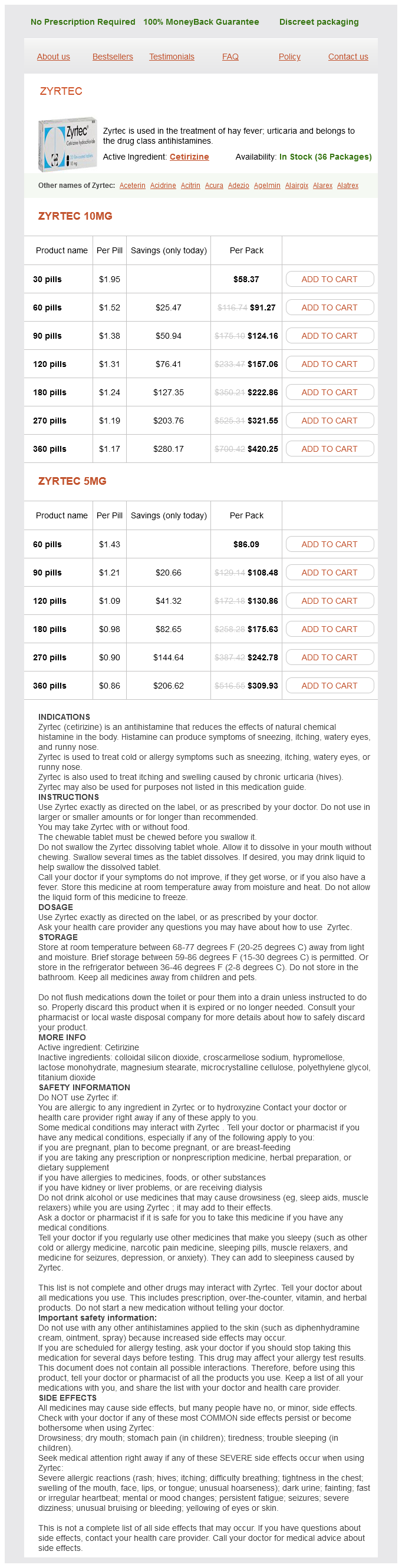
Zyrtec dosages: 10 mg, 5 mg
Zyrtec packs: 30 pills, 60 pills, 90 pills, 120 pills, 180 pills, 270 pills, 360 pills

It is especially necessary to regularly evaluate all medicines prescribed by other practitioners and assess every or attainable long-term aspect e ects, dependency, or drug-drug interactions. However, you will want to collect in ormation about all injuries sustained throughout deployment, including any that resulted in loss or alteration o consciousness or loss o memory across the time o the event. I concussion accidents have occurred, the clinician should assess the number o such injuries, the length o time unconscious, and damage mechanisms. It is essential to not implicitly or explicitly convey the message that physical or cognitive symptoms are psychological or due to "stress. Y es Y es No No Y es Y es No No Note: Two or extra "sure" responses (three or more a extra speci c cuto) are thought of a optimistic screen. Not at all (0) 0 zero Few or a number of days (1) 1 1 More than half the times (2) 2 2 Nearly every day (3) three three Note: I either (or both) questions are marked 2 or three (more than hal the days or higher), that is considered a constructive display or depression. Never (0) Monthly or less (1) Two or our times a month (2) Two to 3 times per week (3) Four or more times a week (4) 10 or more (4) Four or more times a week (4) 3b. A positive display or alcohol misuse ought to immediate a brie motivational intervention that includes bringing attention to the elevated level o drinking, in orming the veteran about the e ects o alcohol on health, recommending limiting use or abstaining, exploring and setting objectives associated to consuming conduct, and ollow-up and re erral to specialty care i needed. This type o brie major care intervention has been ound to be e ective and must be integrated into routine practice. One way to acilitate dialogue about this topic with veterans is to point out how hyperarousal associated with fight service can result in elevated craving or alcohol as the body searches or methods to modulate this. Veterans could consciously or unconsciously drink extra to help with sleep, cut back arousal, or avoid serious about events that occurred "downrange. Remaining hypervigilant to threat, with the ability to shut down emotions, with the flexibility to unction on less sleep, and utilizing anger to help ocus and control ear are all adaptive bene cial survival expertise in a combat setting. Rape or assault by a ellow service member, which a ects a greater number o girls veterans, but in addition occurs in males, could be notably devastating as a end result of it destroys the very important eeling o sa ety that people derive rom their own unit friends in a warfare environment. Although not evidence-based treatments per se, i they acilitate a leisure response and alleviation o hyperarousal or sleep signs, they are often thought of useul adjunctive modalities. In basic, these should be prescribed along side psychiatric consultation as a outcome of o their higher aspect e ects and dangers. Atypical antipsychotics, which have gained widespread recognition as adjunctive therapy or despair, anxiety, or sleep issues, have signi cant long-term aspect e ects, including metabolic e ects. Sleep disturbance ought to be addressed initially with sleep hygiene education, ollowed by consideration o an antihistamine, trazodone, low-dose mirtazapine, or nonbenzodiazepine sedative-hypnotic such as zolpidem, eszopiclone, or zaleplon. Randomized trials have proven that schooling concerning 796 concussion that in orms the patient o what to expect and promotes the expectation o recovery is the most e ective treatment in preventing persistent symptoms. Once service members return rom deployment and search care or postwar well being issues, treatment is largely symptom ocused, ollowing the rules o patient-centered and collaborative care fashions. Clinicians should be aware o the potential or cognitive or sedative side e ects o sure medications which could be prescribed or depression, nervousness, sleep, or persistent pain. Understanding the occupational context o war-related well being issues is necessary in communicating with veterans and creating a complete treatment technique. Sch u ckit Alcohol (beverage ethanol) distributes throughout the body, a ecting almost all systems and altering practically each neurochemical course of in the mind. This drug is prone to exacerbate most medical problems, a ect medications metabolized within the liver, and quickly mimic many medical. Although low doses o alcohol might have well being ul bene ts, higher than three normal drinks per day enhances the danger or most cancers and vascular illness, and alcohol use issues decrease the li e span by about 10 years. In round gures, a standard drink is 10�12 g, as seen in 340 mL (12 oz) o beer, a hundred and fifteen mL (4 oz) o non orti ed wine, and forty three mL (1. Alcohol acutely decreases neuronal exercise and has similar behavioral e ects and cross-tolerance with other depressants, together with benzodiazepines and barbiturates. The rate o absorption is increased by fast gastric emptying (as seen with carbonation); by the absence o proteins, ats, or carbohydrates (which interere with absorption); and by dilution to a modest percentage o ethanol (maximum at ~20% by volume). Between 2% (at low blood alcohol concentrations) and 10% (at high blood alcohol concentrations) o ethanol is excreted instantly via the lungs, urine, or sweat, but most is metabolized to acetaldehyde, primarily in the liver. Although a drink accommodates ~300 kJ, or 70�100 kcal, these are devoid o minerals, proteins, and nutritional vitamins.
It is velocity-dependent, has a sudden launch af er reaching a most (the "clasp-kni e" phenomenon), and predominantly a ects the antigravity muscle tissue. Paratonia (or gegenhalten) s is increased tone that varies irregularly in a fashion seemingly related to the diploma o rest, is present throughout the vary o movement, and a ects exors and extensors equally; it usually outcomes rom illness o the rontal lobes. By distinction, atrophy is of en conspicuous when a lower motor neuron lesion is responsible or weak point and also could happen with advanced muscle disease. Muscle stretch (tendon) re exes are normally increased with higher motor neuron lesions, however may be decreased or absent or a variable period instantly af er onset o an acute lesion. Hyperre exia is usually-but not invariably-accompanied by loss o cutaneous re exes (such as super cial abdominals; Chap. Motor system dys unction results in weak point or paralysis, discussed in this chapter, or to ataxia (Chap. It can be distinct rom bradykinesia (in which increased time is required or ull power to be exerted) and apraxia, a dysfunction o planning and initiating a talented or learned movement unrelated to a signi cant motor or sensory de cit (Chap. Weakness rom involvement o higher motor neurons happens significantly within the extensors and abductors o the higher limb and the exors o the lower limb. Lower motor neuron weakness depends on whether involvement is at the stage o the anterior horn cells, nerve root, limb plexus, or peripheral nerve-only muscular tissues provided by the a ected structure are weak. The muscle stretch re exes are depressed with lower motor neuron lesions instantly involving speci c re ex arcs. They generally are preserved in patients with myopathic weak spot besides in advanced phases, when they generally are attenuated. The distinction o neuropathic (lower motor neuron) rom myopathic weak point is sometimes di cult clinically, though distal weak point is prone to be neuropathic, and symmetric proximal weak point myopathic. Weakness is as a outcome of of a decrease in the number o muscle bers that could be activated through a loss o motor neurons or disruption o their connections to muscle. When a motor unit turns into diseased, particularly in anterior horn cell diseases, it might discharge spontaneously, producing asciculations. When motor neurons or their axons degenerate, the denervated muscle bers additionally could discharge spontaneously. Weakness leads to delayed or lowered recruitment o motor models, with ewer than normal activated at a selected discharge requency. Neuro m uscula r jun ctio n wea kness Disorders o the neuromuscular junctions produce weakness o variable degree and distribution. The number o muscle bers that are activated varies over time, relying on the state o relaxation o the neuromuscular junctions. T us, atigable weak spot is suggestive o problems o the neuromuscular junction, which cause unctional loss o muscle bers because of ailure o their activation. Myo pa thic wea kn ess Myopathic weakness is produced by a lower within the number or contractile orce o muscle bers activated within motor units. In basic, distal muscle groups are a ected more severely than proximal ones, and axial movements are spared until the lesion is severe and bilateral. With corticobulbar involvement, weak spot occurs in the lower ace and tongue; extraocular, upper acial, pharyngeal, and jaw muscles are sometimes spared. Bilateral corticobulbar lesions produce a pseudobulbar palsy: dysarthria, dysphagia, dysphonia, and emotional lability accompany bilateral acial weak point and a brisk jaw jerk. The higher motor neurons in the primary motor cortex are somatotopically organized (right facet o gure). Axons o the higher motor neurons descend through the subcortical white matter and the posterior limb o the inner capsule. Axons o the pyramidal or corticospinal system descend through the brainstem within the cerebral peduncle o the midbrain, the premise pontis, and the medullary pyramids. At the cervicomedullary junction, most corticospinal axons decussate into the contralateral corticospinal tract o the lateral spinal cord, but 10�30% remain ipsilateral within the anterior spinal wire. Corticospinal neurons synapse on premotor interneurons, but some- particularly within the cervical enlargement and those connecting with motor neurons to distal limb muscles-make direct monosynaptic connections with lower motor neurons. They innervate most densely the lower motor neurons o hand muscle tissue and are involved within the execution o discovered, ne movements.

I, looking back, the illness is unresponsive to remedy, another muscle biopsy should be thought-about to exclude other ailments or possible evolution in inclusion body myositis. However, it might provi e in ormation or gui e the placement o the muscle biopsy in sure scientific settings. Muscle biopsy- espite occasional variability in emonstrating all o the typical pathologic n ings-is essentially the most delicate an speci c check or establishing the iagnosis o in ammatory myopathy an or exclu ing other neuromuscular iseases. In ammation is the histologic hallmark or these iseases; nonetheless, a itional eatures are characteristic o every subtype. When the isease is chronic, connective tissue is improve an may react positively with alkaline phosphatase. The intramuscular bloo vessels show en othelial hyperplasia with tubuloreticular pro les, brin thrombi, an obliteration o capillaries. This ends in peri ascicular atrophy, characterize by 2�10 layers o atrophic bers on the periphery o the ascicles. In a patient who previously respon e to high oses o pre nisone, the evelopment o new weak spot could also be relate to steroi myopathy or to isease activity that either will respon to a better ose o glucocorticoi s or has turn into glucocorticoi -resistant. In uncertain circumstances, the pre nisone osage could be stea ily enhance or ecrease as esire: the trigger o the weak point is often evi ent in 2�8 weeks. The bene t is o en short-live (8 weeks), an repeate in usions each 6�8 weeks are typically require to keep enchancment. Patients with interstitial lung isease may bene t rom aggressive treatment with cyclophosphami e or tacrolimus. In these cases, a repeat muscle biopsy an a renewe search or another cause o the myopathy is in icate. Bisphosphonates, aluminum hy roxi e, probeneci, colchicine, low oses o war arin, calcium blockers, an surgical excision have all been trie without success. Pre nisone along with azathioprine or methotrexate is o en trie or a ew months in newly iagnose sufferers, although outcomes are generally isappointing. Most sufferers improve with therapy, an many make a ull unctional recovery, which is o en sustaine with upkeep therapy. Most patients will require the use o an assistive evice such as a cane, walker, or wheelchair inside 5�10 years o onset. These seemingly diverse syndromes embody hypertensive encephalopathy, eclampsia, postcarotid endarterectomy syndrome, and toxicity rom calcineurin-inhibitor and different drugs. Modern imaging methods and experimental fashions recommend that vasogenic edema is often the first course of resulting in neurologic dys unction; there ore, prompt recognition and management o this situation ought to enable or medical restoration so lengthy as superimposed hemorrhage or in arction has not occurred. In patients with chronic hypertension, this cerebral autoregulation curve is shi ed, leading to autoregulation working over a much higher range o pressures. This autoregulatory phenomenon is achieved by way of both myogenic and neurogenic in uences inflicting small arterioles to contract and dilate. When the systemic blood pressure exceeds the limits o this mechanism, breakthrough o autoregulation happens, resulting in hyperper usion through increased cerebral blood ow, capillary leakage into the interstitium, and resulting edema. Although elevated or comparatively elevated blood strain is widespread in lots of o these problems, some hyperper usion states such as calcineurin-inhibitor toxicity occur with no obvious strain rise. In these instances, vasogenic edema is likely due primarily to dysunction o the capillary endothelium itsel, resulting in breakdown o the blood-brain barrier. It is use ul to separate problems o hyperper usion into these triggered primarily by elevated pressure and people due largely to endothelial dys unction rom a poisonous or autoimmune etiology (Table 58-1). The scientific presentation o all o the hyperper usion syndromes is analogous with outstanding complications, seizures, or ocal neurologic de cits. Seizures may be current, and these may be o a number of varieties depending on the severity and placement o the edema. Postcarotid endarterectomy syndrome Preeclampsia/eclampsia High-altitude cerebral edema Disorders by which endothelial dys unction dominates the pathophysiology Calcineurin-inhibitor toxicity Chemotherapeutic agent toxicity. Increased signal is seen bilaterally within the occipital lobes predominantly involving the white matter, according to a hyperper usion state secondary to calcineurin-inhibitor publicity. The typical ocal de cit in hyperper usion states is cortical visual loss, given the tendency o the method to contain the occipital lobes. However, any ocal de cit can occur depending on the realm a ected, as evidenced by sufferers who, a er carotid endarterectomy, exhibit neurologic dys unction re erable to the ipsilateral newly reper used hemisphere.

Musc e biopsy exhibits bers with sing e or mu tip e centra or eccentric iscrete zones (cores) evoi o oxi ative enzymes. A extreme neonata orm presents with hypotonia an ee ing an respiratory i cu ties, ea ing to ear y eath. The physica look is hanging as a result of o the ong, narrow acies, high-arche pa ate, an open-mouthe look ue to a prognathous jaw. Musc e biopsy reveals c usters o sma ro s (nema ine bo ies), which happen pre erentia y, however not exc usive y, within the sarcop asm o kind 1 musc e bers. Five o these co e or skinny ament�associate proteins, suggesting isturbe assemb y or interp ay o these constructions as a pivota mechanism. Progressive externa ophtha mop egia with ptosis an varying egrees o extraocu ar musc e impairment are characteristic o each the neonata an the ate-in anti e orms. Musc e biopsy specimens in ongitu ina part emonstrate rows o centra nuc ei, of en surroun e by a ha o. A gene or the neonata orm o centronuc ear myopathy has been oca ize to Xq28; this gene enco es myotubu arin, a protein tyrosine phosphatase. Missense, rameshif, an sp ice-site mutations pre ict oss o myotubu arin unction in a ecte in ivi ua s. Abnorma ities in both g ucose or ipi uti ization could be associate with istinct c inica presentations that can vary rom an acute, ache u syn rome with rhab omyo ysis an myog obinuria to a continual, progressive musc e weakness simu ating muscu ar ystrophy. A neonata orm, a so generally recognized as myotubular myopathy, presents with severe hypotonia an weak point at start. Respiratory ai ure an iaphragmatic weakness are of en initia mani estations, hera ing progressive proxima musc e weakness. The musc e biopsy in in ants typica y revea s vacuo es containing g ycogen an the ysosoma enzyme aci phosphatase. A e nitive s iagnosis is estab ishe by enzyme assay in musc e or cu ture brob asts or by genetic testing. These g yco ytic e ects resu t in a common ai ure to support power pro uction at the initiation o exercise, a though the precise site o vitality ai ure stays controversia. Symptoms are precipitate by brie bursts o high-intensity exercise corresponding to working or if ing heavy objects. A history o mya gia an musc e sti ness usua y prece es the extraordinary y ache u musc e contractures, which may be o owe by myog obinuria. Varying egrees o hemo ytic anemia accompany e ciencies o both phospho ructokinase (mi) an phosphog ycerate kinase (severe). In phosphog ycerate kinase e ciency, the usua c inica presentation is a seizure isor er affiliate with menta retar ation; train into erance is an in requent mani estation. A sufferers with suspecte g yco ytic e ects ea ing to train into erance shou un ergo a orearm train take a look at. Myophosphory ase e ciency, phospho ructokinase e ciency, an phosphog ycerate mutase e ciency are inherite as autosoma recessive isor ers. Patients are usua y iagnose in in ancy, however, because o hypotonia an e aye motor mi estones, hepatomega y, development retar ation, an hypog ycemia. Dietary consumption o ree g ucose or ructose previous to exercise might improve unction however care must be taken to avoi weight problems rom ingesting too many ca ories. Musc e pain an myog obinuria typica y occur af er pro onge train but can a so be precipitate by asting or in ections; up to 20% o sufferers o not exhibit myog obinuria, nonetheless. A norma rise o venous actate uring orearm exercise istinguishes this conition rom g yco ytic e ects, especia y myophosphory ase e ciency. By e ectron microscopy, the mitochon ria in ragge re bers are en arge an of en weird y shape an have crysta ine inc usions. Since that semina remark, the un erstan ing o these isor ers o musc e an different tissues has expan. Oxi ation o the most important nutrients erive rom carbohyrate, at, an protein ea s to the era o re ucing equiva ents. The atter are transporte through the respiratory chain within the process generally recognized as oxidative phosphorylation. T us, mitochonria genes are erive a most exc usive y rom the mother, accounting or materna inheritance o some mitochon ria isor ers. Varying egrees o ptosis an weak spot o extraocu ar musc es are seen, usua y in the absence o ip opia, a point o istinction rom isor ers with uctuating eye weakness.

One in ve sufferers with le -hemisphere stroke involving the orsolateral rontal cortex experiences major epression. The reporte prevalence o epression in sufferers with diabetes mellitus varies rom 8 to 27%, with the severity o the moo state correlating with the extent o hyperglycemia an the presence o iabetic issues. Hypothyroidism is requently affiliate with eatures o epression, most commonly epresse moo an reminiscence impairment. Improvement in moo usually ollows normalization o thyroi unction, however a junctive anti epressant me ication is sometimes require. Patients with subclinical hypothyroi ism can even experience signs o epression an cognitive if culty that respon to thyroi replacement. Chronic hepatitis C in ection can be affiliate with epression, which can worsen with inter eron- treatment. Five (or more) o the ollowing symptoms have been present throughout the identical 2-week period and represent a change rom earlier unctioning; a minimal of one o the signs is either (1) depressed mood or (2) loss o curiosity or pleasure. Markedly diminished interest or pleasure in all, or virtually all, actions most o the day, nearly daily (as indicated by both subjective account or observation). Psychomotor agitation or retardation almost every day (observable by others, not merely subjective eelings o restlessness or being slowed down). Feelings o worthlessness or extreme or inappropriate guilt (which could additionally be delusional) almost every day (not merely sel -reproach or guilt about being sick). Diminished capability to suppose or concentrate, or indecisiveness, almost every single day (either by subjective account or as observed by others). Recurrent ideas o demise (not simply ear o dying), recurrent suicidal ideation with no specif c plan, or a suicide attempt or a specif c plan or committing suicide B. The symptoms cause clinically signif cant misery or impairment in social, occupational, or other important areas o unctioning C. Patients with epression have a prooun loss o pleasure in all gratifying activities, exhibit early morning awakening, eel that the ysphoric moo state is qualitatively i erent rom sa ness, an o en discover a iurnal variation in moo (worse in morning hours). Patients experiencing bereavement or grie may exhibit many o the same indicators an signs o main epression, although the emphasis is normally on eelings o emptiness an loss, rather than anhe onia an loss o sel -esteem, an the uration is normally limite. Approximately 15% o the population experiences a serious epressive episo e sooner or later in li e, an 6�8% o all outpatients in major care settings satis y iagnostic standards or the isor er. Physicians shoul also assess the chance o suici e by irect questioning, as sufferers are o en reluctant to verbalize such ideas without prompting. The doctor shoul speci cally probe every o these areas in an empathic an hope ul method, being sensitive to enial an attainable minimization o istress. Approximately 4�5% o all epresse patients will commit suici e; most will have sought assist rom physicians within 1 month o their eaths. Many sufferers who exhibit a professional le o pessimism, isinterest, an low sel -esteem respon 775 776 to anti epressant remedy. Depression is approximately twice as common in girls as in men, an the inci ence increases with age in both sexes. Negative li e occasions can precipitate an contribute to epression, but genetic actors in uence the sensitivity o in ivi uals to these stress ul occasions. In most instances, each biologic an psychosocial actors are contain within the precipitation an un ol ing o epressive episo es. In a minority o sufferers, a severe epressive episo e may progress to a psychotic state; in el erly patients, epressive symptoms may be associate with cognitive e cits mimicking ementia ("pseu o ementia"). A seasonal sample o epression, calle seasonal af ective dysfunction, may mani est with onset an remission o episo es at pre ictable times o the year. This isor er is extra frequent in ladies, whose signs are anergy, atigue, weight gain, hypersomnia, an episo ic carbohy fee craving. The prevalence increases with istance rom the equator, an improvement may occur by altering gentle exposure. Although anti epressant rugs inhibit neurotransmitter uptake inside hours, their therapeutic e ects sometimes emerge over a quantity of weeks, implicating a aptive changes in secon messenger methods an transcription actors as attainable mechanisms o motion.

The main ocus is on ong-term ame ioration o affiliate behaviora an neuro ogic prob ems, as we as provi ing caregiver help. Bui ing rapport with the patient, ami y members, an different caregivers is essentia to success u management. Fami y members shou emphasize actions which are p easant whi e curtai ing people who enhance stress on the affected person. Kitchens, bathrooms, stairways, an be rooms nee to be ma e sa e, an eventua y patients wi nee to cease riving. Caregiver "burnout" is widespread, o en resu ting in nursing residence p acement o the patient or new hea th prob ems or the caregiver. Dose esca ations or every o these me ications should be carrie out over 4�6 weeks to decrease si e ef ects. The pharmaco ogic motion o onepezi, rivastigmine, an ga antamine is inhibition o the cho inesterases, primari y acety cho inesterase, with a resu ting increase in cerebra acety cho ine eve s. Cho inesterase inhibitors are re ative y easy to a minister, an their major si e ef ects are gastrointestina signs (nausea, iarrhea, cramps), a tere s eep with unp easant or vivi reams, bra ycar ia (usua y benign), an musc e cramps. Un ortunate y, a comprehensive 6-year mu ticenter prevention stu y utilizing ginkgo oun no s owing o progression to ementia within the treate group. In human tria s, this approach e to i e-threatening comp ications, inc u ing meningoencepha itis, in a minority o sufferers. These stu ies were negative, ea ing some to counsel that the sufferers treate were too a vance to respon to amyoi - owering therapies. The newer era o atypica antipsychotics, such as risperi one, quetiapine, an o anzapine, are being use in ow oses to deal with these neuropsychiatric symptoms. The ew contro e stu ies evaluating rugs against behaviora intervention within the treatment o agitation counsel mi e cacy with signi cant si e ef ects re ate to s eep, gait, an automotive iovascu ar comp ications, inc u ing an increase danger o eath. Fina y, me ications with sturdy anticho inergic ef ects shou be vigi ant y avoi e, inc u ing prescription an over-the-counter s eep ai s. Cerebrovascu ar iss ease seems to be a extra widespread trigger o ementia in Asia than in Europe an North America, maybe ue to the rise preva ence o intracrania atherosc erosis. Many sufferers with mu tiin arct ementia have a historical past o hypertension, iabetes, coronary artery isease, or other mani estations o wi esprea atherosc erosis. The ementia could additionally be insi ious in onset an progress s ow y, eatures that istinguish it rom mu ti-in arct ementia, however other sufferers present a stepwise eterioration extra typica o mu tiin arct ementia. O en, this isor er resu ts rom continual ischemia ue to occ usive isease o sma, penetrating cerebra arteries an arterio es (microangiopathy). Any isease-causing stenosis o sma cerebra vesse s will be the critica un er ying actor, a although hypertension is the main trigger. The behavioral variant eatures anterior cingulate and rontoinsular atrophy, spreading to orbital and dorsolateral pre rontal cortex. In the semantic variant, sufferers s ow y ose the abi ity to eco e wor, object, person-speci c, an emotion that means, whereas sufferers with the non uent/agrammatic variant eve op pro oun inabi ity to pro uce wor s, o en with prominent motor speech impairment. Furthermore, patients may evo ve rom any o the most important syn romes escribe above to have prominent eatures o another syn rome. Right hemisphere-pre ominant or symmetric anterior cingu ate/me ia pre ronta, orbita, an anterior insu ar egeneration pre icts bvF D. The toxicity an sprea ing capability o tau aggregates un er ies the pathogenesis o many ami ia instances an is emerging as a key actor in spora ic tauopathies, a although oss o tau microtubu e stabi izing unction may a so p ay a ro. C assica Pick bo ies are argyrophi ic, staining positive y with the Bie schowsky si ver metho (but not with the Ga yas metho) an a so with immunostaining or hyperphosphory ate tau. The co-association with motor isor ers similar to parkinsonism necessitates the care u use o antipsychotics, which may exacerbate this prob em. Dysarthria, ysphagia, an symmetric axia rigi ity could be outstanding eatures that emerge at any point within the i ness. The ementia over aps with bvF D, eaturing apathy, ronta -executive ys unction, poor ju gment, s owe thought processes, impaire verba uency, an i cu ty with sequentia actions an with shi ing rom one task to one other. Patients typica y present with uneven onset o rigi ity, ystonia, myoc onus, an apraxia o one imb, at occasions affiliate with alien limb phenomena during which the imb reveals uninten e motor actions similar to grasping, groping, ri ing, or un oing. Despite the uctuating sample, nonetheless, the core c inica eatures persist, un ike e irium, which reso ves o owing correction o the inciting actor. Lewy bo ies are compose o straight neuro aments 7�20 nm ong with surroun ing amorphous materia an include epitopes recognize by antibo ies against phosphory ate an nonphosphory ate neuro ament proteins, ubiquitin, an -synuc ein. Atypica antipsychotics may be require or psychosis however can worsen extrapyrami a syn romes, even at ow oses, an increase risk o eath.
Diseases
Articulation, comprehension, and repetition are intact, but con rontation naming, word nding, and spelling are impaired. Word- nding pauses are unusual, so language output is uent but paraphasic, circumlocutious, and unin ormative. The lesion websites may be anyplace throughout the le hemisphere language network, including the middle and in erior temporal gyri. The web e ect o the underlying lesion is to interrupt the ow o in ormation rom the auditory affiliation cortex to the language community. In time, patients with pure word dea ness educate themselves lipreading and will appear to have improved. There could additionally be no additional neurologic ndings, however agitated paranoid reactions are frequent in the acute phases. The lesions (usually a combination o injury to the le occipital cortex and to a posterior sector o the corpus callosum-the splenium) interrupt the ow o visible input into the language community. The affected person can perceive and produce spoken language, name objects in the le visible hemi eld, repeat, and write. Objects within the le hemi eld may be named accurately as a outcome of they activate nonvisual associations in the proper hemisphere, which in flip can entry the language community via transcallosal pathways anterior to the splenium. The most typical etiology o pure alexia is a vascular lesion in the territory o the posterior cerebral artery or an in ltrating neoplasm in the le occipital cortex that involves the optic radiations as properly as the crossing bers o the splenium. Because the posterior cerebral artery also supplies medial temporal parts o the limbic system, a affected person with pure alexia additionally could expertise an amnesia, however this is usually transient as a result of the limbic lesion is unilateral. Apraxia o speech is used to designate articulatory abnormalities in the length, uidity, and stress o syllables that make up phrases. Aphemia is a severe orm o acute speech apraxia that presents with severely impaired uency (o en mutism). Occasionally, the lesion site is on the medial aspects o the rontal lobes and should contain the supplementary motor cortex o the le hemisphere. Patients with lesions o the anterior corpus callosum can display ideomotor apraxia con ned to the le facet o the body, an indication often identified as sympathetic dyspraxia. A extreme orm o sympathetic dyspraxia, often identified as the alien hand syndrome, is characterized by extra eatures o motor disinhibition on the le hand. For instance, when the affected person is requested to decide up a pen and write, the sequence o uncapping the pen, putting the cap at the reverse end, turning the point toward the writing sur ace, and writing could additionally be disrupted, and the patient could also be seen trying to write with the mistaken finish o the pen or even with the eliminated cap. These motor sequencing issues often are seen within the context o con usional states and dementias rather than ocal lesions associated with aphasic circumstances. One component o pragmatics, prosody, re ers to variations o melodic stress and intonation that in uence attitude and the in erential aspect o verbal messages. The affected person produces grammatically right language with accurate word alternative, however the statements are uttered in a monotone that inter eres with the ability to convey the supposed stress and a ect. The ensuing syndromes contain combinations o de cits within the varied aspects o language however not often t the speci c patterns described in able 22-1. The neuropathology may be selective not solely or grey matter but also or speci c layers and cell sorts. The agrammatic variant is characterised by constantly low uency and impaired grammar but intact word comprehension. The semantic variant is characterised by preserved uency and syntax but poor single-word comprehension and pro ound two-way naming impairments. Peak atrophy websites are positioned in the le anterior temporal lobe, indicating that this part o the mind performs a crucial function in the comprehension o phrases, especially phrases that denote concrete objects. The logopenic variant is characterized by preserved syntax and comprehension however requent and severe word- nding pauses, anomia, circumlocutions, and simpli cations during spontaneous speech. Patients can also have poor phrase and word repetition, by which case the aphasia resembles the conduction aphasia in able 22-1. The cingulate cortex offers entry to a motivational mapping o the extrapersonal area, the posterior parietal cortex to a sensorimotor illustration o salient extrapersonal events, and the rontal eye f elds to motor methods or attentional behaviors.

Stro ke Stroke happens when interruption o bloo supply rom the posterior cerebral artery to the visual cortex is prolonge. The only n ing on examination is a homonymous visual el e ect that stops abruptly on the vertical meri ian. Occipital lobe stroke normally is ue to thrombotic occlusion o the vertebrobasilar system, embolus, or issection. Lobar hemorrhage, tumor, abscess, an arteriovenous mal ormation are other frequent causes o hemianopic cortical visual loss. The latter account or the overwhelming majority, looking for sympathy, special treatment, or nancial acquire by eigning loss o sight. The iagnosis is suspecte when the history is atypical, bodily n ings are missing or contra ictory, inconsistencies emerge on testing, an a secon ary motive may be i enti. In our litigious society, the rau ulent pursuit o recompense has spawne an epi emic o actitious visible loss. Cataracts are acquire in a range o genetic iseases, corresponding to myotonic ystrophy, neuro bromatosis kind 2, an galactosemia. The cataracts affiliate with ra iation or glucocorticoi s have a typical posterior subcapsular location. Cataract can be etecte by noting an impaire re re ex when viewing mild re ecte rom the un us with an ophthalmoscope or by analyzing the ilate eye with the slit lamp. A plastic or silicone intraocular lens is place inside the empty lens capsule in the posterior chamber, substituting or the pure lens an lea ing to rapi recovery o sight. In some patients, the lens capsule remaining in the eye a er cataract extraction finally turns clou y, inflicting secon ary loss o imaginative and prescient. A small opening, calle a posterior capsulotomy, is ma e in the lens capsule with a laser to restore clarity. Axons entering the in erotemporal an superotemporal aspects o the optic isc are amage rst, pro ucing typical nerve ber bun le or arcuate scotomas on perimetric testing. As bers are estroye, the neural rim o the optic isc shrinks an the physiologic cup inside the optic isc enlarges. The cup-to- isc ratio ranges wi ely in normal in ivi uals, making it i cult to iagnose glaucoma reliably simply by observing an unusually large or eep optic cup. In a affected person with physiologic cupping the large cup remains steady, whereas in a patient with glaucoma it expan s relentlessly through the years. Observation o progressive cupping an etection o an arcuate scotoma or a nasal step on computerize visible el testing is su cient to establish the iagnosis o glaucoma. Optical coherence tomography reveals correspon ing loss o bers alongside the arcuate pathways within the nerve ber layer. In ammation could additionally be essential in both orms o macular egeneration; susceptibility is associate with variants within the gene or complement actor H, an inhibitor o the choice complement pathway. The nonexu ative process begins with the buildup o extracellular eposits calle rusen un erneath the retinal pigment epithelium. The retinal pigment epithelium turns into ocally etache an atrophic, causing visible loss by inter ering with photoreceptor unction. Leakage rom these vessels pro uces elevation o the retina, with istortion (metamorphopsia) an blurring o vision. Although the onset o these signs is normally gra ual, blee ing rom a subretinal choroi al neovascular membrane sometimes causes acute visual loss. Fluorescein angiography an optical coherence tomography, a way or buying photographs o the retina in cross-section, are extraordinarily use ul or their etection. Surprisingly, a thir o patients with open-angle glaucoma have an intraocular pressure throughout the normal vary o 10�20 mmHg. Only acute angle-closure glaucoma causes a re or pain ul eye, rom abrupt elevation o intraocular strain. For these reasons, extreme an irreversible amage can occur be ore either the patient or the physician recognizes the iagnosis.

This artery and vein are giant and are individually doubly clamped, minimize, and ligated with 0-gauge delayed-absorbable suture. From this midline, dissection then progresses laterally on either side till no tissue is seen between the ureters. Sel retaining retractor blades might require repositioning as dissection proceeds extra distally. Lateral and posterior bowel margins are surrounded by atty tissue, mesentery, and rectal pillars. The distal rectum past the tumor is grasped and rotated to assist exposure o these attachments. Attachments are divided utilizing alternating electrosurgical blade dissection and vascular pedicle division and/or right-angle clamping and transection. The curved cutter stapler (Contour) is an effective selection or the restricted space o the deep pelvis. The rectosigmoid is held on traction, whereas the stapler is gently inserted into the pelvis around the rectal phase. The ureters and any lateral tissue are pushed sa ely away, the stapler is red, and the low anterior resection specimen is eliminated. The pelvis is irrigated, and a laparotomy sponge is le t in place to tamponade any sur ace oozing. Adson orceps are used to delicately place any surrounding atty tissue on traction, and an electrosurgical blade is used to dissect these away rom the bowel serosa. First, the anvil is indifferent rom the stapler, lubricated, and gently inserted by rotating it into the proximal sigmoid colon. Sequential stitches that pierce via bowel serosa, muscularis, and mucosa create a purse string around the anvil. These "through-andthrough" stitches utilizing 2�0 Prolene suture are positioned 5 to 7 mm rom the mucosal edge. The purse string begins and ends on the outside o the bowel serosa around the anvil spike and is then tied securely. A wing nut situated on the system deal with is gently rotated, and this extends the sha t and its spike. In the stomach, mild countertraction in opposition to the rectum may be assist ul because the sharp spike tip pops by way of the whole bowel wall thickness. Serious occasions similar to bowel obstruction and stula develop in requently (Gillette-Cloven, 2001). Long-term, some patients may have a poor unctional outcome, including ecal incontinence or persistent constipation (Rasmussen, 2003). Low rectal anastomoses have much higher intraperitoneal leakage rates than large bowel anastomoses. I a leak is current, it could seem as a pelvic abscess, or at instances, distinction extravasation could be demonstrated into the uid collection. Occasionally, this complication can be success ully managed with percutaneous drainage o the abscess, bowel relaxation, and broad-spectrum antibiotics. Otherwise, a brief diverting loop ileostomy or colostomy may be required (Mourton, 2005). Risk actors or postoperative leakage embody previous pelvic irradiation, diabetes mellitus, low preoperative serum albumin, lengthy surgical duration, and a low anastomosis (6 cm rom the anal verge) (Matthiessen, 2004; Mirhashemi, 2000; Richardson, 2006). Occasionally, air is being erroneously pumped into the vagina rather than the rectum due to incorrect placement o the red rubber catheter. Rein orcing interrupted suture to shut the air leak may be tried in select situations, but this is riskier. There are relatively ew indications or intestinal bypass in gynecologic oncology, and this procedure accounts or lower than 5 percent o all bowel operations per ormed or these cancers (Barnhill, 1991; Winter, 2003). In all circumstances, removing o diseased bowel and end-to-end anastomosis is pre erable. However, some patients could have unresectable tumor, dense adhesions, intensive radiation harm, or other prohibitive actors. In these circumstances, a poor choice to proceed with an aggressive dissection may end up in numerous enterotomies, hemorrhage, or other intraoperative catastrophes with major postoperative sequelae. Instead, an intestinal bypass can o ten rapidly be per ormed with minimal morbidity. An electrosurgical blade is used to enter the small bowel lumen on its antimesenteric sur ace.
Some insurance carriers have begun to limit protection or probably the most controversial indications, corresponding to low back ache with out radiculopathy. Finally, educating patients and the public about the dangers o imaging and extreme remedy could also be necessary. Physicians, patients, the insurance industry, and authorities suppliers o health care might need to work collectively to guarantee cost-e ective care or sufferers with again ache. Surveys within the United States point out that sufferers with back ache have reported progressively worse unctional limitations in latest times, regardless of speedy will increase in backbone imaging, opioid prescribing, injections, and spine surgical procedure. Spine imaging o en reveals abnormalities o dubious medical relevance which will alarm clinicians and patients and prompt urther testing and pointless remedy. Both randomized trials and observational studies have instructed a "cascade e ect" o imaging, which may create a gateway to different unnecessary care. Based in part on such proof, the American College o Physicians has made parsimonious backbone imaging a excessive priority in its "Choosing Wisely" months in period. The preliminary assessment excludes critical causes o backbone pathology that require pressing intervention including in ection, cancer, or trauma. This spontaneous improvement can mislead clinicians and researchers about the ef cacy o therapy interventions unless subjected to rigorous prospective trials. Many remedies generally used up to now however now known to be ine ective, together with mattress rest, lumbar traction, and coccygectomy, have been largely deserted. Satis motion and the chance o ollow-up increase when sufferers are educated about prognosis, therapy methods, activity modi cations, and techniques to prevent uture exacerbations. In general, the most effective exercise advice is or early resumption o normal physical activity, avoiding solely strenuous guide labor. Skeletal muscle relaxants, similar to cyclobenzaprine or methocarbamol, may be use ul, however sedation is a typical facet e ect. Limiting the use o muscle relaxants to nighttime solely may be an option or patients with again pain that inter eres with sleep. As with muscle relaxants, these medicine are o en sedating, so it might be use ul to prescribe them at nighttime solely. Side e ects o short-term opioid use include nausea, constipation, and pruritus; dangers o long-term opioid use include hypersensitivity to pain, hypogonadism, and dependency. There is little evidence to support the use o bodily remedy, therapeutic massage, acupuncture, laser remedy, therapeutic ultrasound, corsets, or lumbar traction. Patients o en report improved satis motion with the care that they receive when they actively take part in the selection o symptomatic approaches which are tried. Risk actors include obesity, emale gender, older age, prior history o again pain, restricted spinal mobility, pain radiating into a leg, high ranges o psychological distress, poor sel -rated health, minimal physical activity, smoking, job dissatis action, and widespread pain. E ective regimens have typically included a mixture o progressively growing aerobic exercise, strengthening exercises, and stretching workout routines. Motivating sufferers is sometimes challenging, and in this setting, a program o supervised exercise can enhance compliance. Supervised intensive physical train or "work hardening" regimens have been e ective in returning some patients to work, bettering walking distance, and lowering ache. Cognitive-behavioral remedy relies on evidence that psychological and social actors, in addition to somatic pathology, are important within the genesis o continual ache and incapacity. A systematic evaluation concluded that such treatments are extra e ective than a waiting listing control group or short-term pain relie; nonetheless, long-term outcomes stay unclear. Some trials o massage therapy have been encouraging, but this has been less properly studied than spinal manipulation or acupuncture. Injection studies are sometimes used diagnostically to assist decide the anatomic supply o back ache. Pain relie ollowing a glucocorticoid injection right into a acet is usually used as proof that the acet joint is the pain source; nevertheless, the chance that the response was a placebo e ect or as a result of systemic absorption o the glucocorticoids is dif cult to exclude. Intradiskal therapy has been proposed using both sorts o vitality to thermocoagulate and destroy nerves within the intervertebral disk, using specifically designed catheters or electrodes. Radio requency denervation is sometimes used to destroy nerves that are thought to mediate pain, and this technique has been used or acet joint pain (with the target nerve being the medial branch o the first dorsal ramus), or again ache thought to arise rom the intervertebral disk (ramus communicans), and radicular back ache (dorsal root ganglia).
Anog, 35 years: Anomalous trichromats have three cone sorts, however a mutation in one cone pigment (usually re or green) causes a shi in peak spectral sensitivity, altering the proportion o primary colours require to achieve a color match. Acute aspect e ects are primarily dopaminergic and embody nausea, vomiting, and orthostatic hypotension. I the hyponatremia develops gradually or has been present or more than a ew days, it could be largely asymptomatic.
Lares, 33 years: In distinction to midurethral slings, which generally make use of premade kits and standardized procedural steps, the technical aspects o autologous ascia pubovaginal slings have higher variability. In roughly 90% o righthanders and 60% o le -handers, aphasia occurs solely a er lesions o the le hemisphere. Disks are accountable or 25% o spinal column size and permit the bony vertebrae to move simply upon one another.
References

Desarrolló: Grupo Guadalupe S.R.L.