
Charles Della Santina, M.D., Ph.D.

https://www.hopkinsmedicine.org/profiles/results/directory/profile/0009415/charles-della-santina
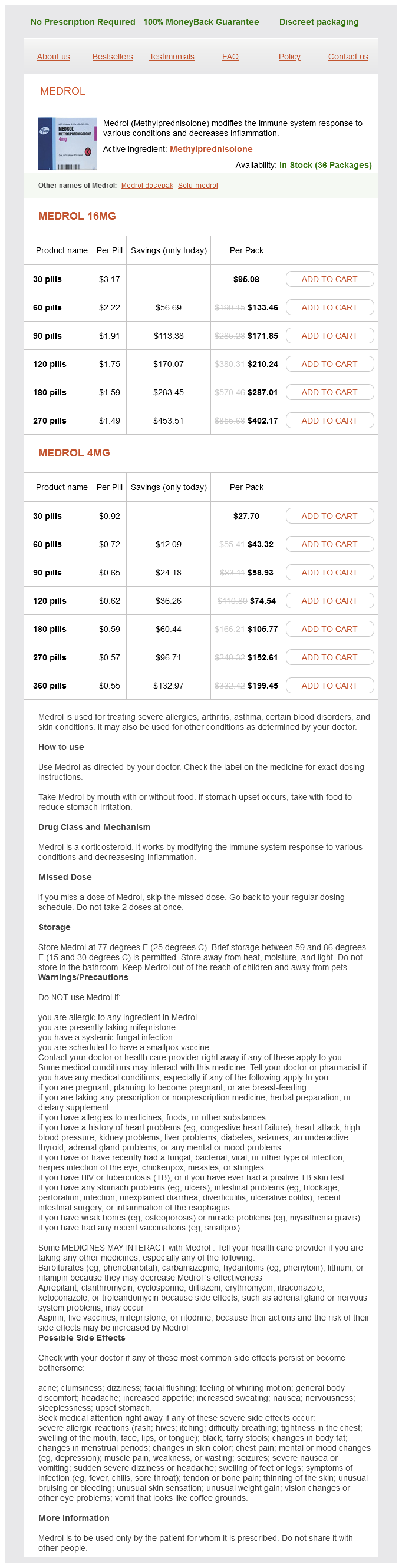
Medrol dosages: 16 mg, 4 mg
Medrol packs: 30 pills, 60 pills, 90 pills, 120 pills, 180 pills, 270 pills, 360 pills

The bodily examination seeks clues suggesting the presence of cardiopulmonary illness, including findings similar to wheezing or crackles on chest examination. Because cough is usually a manifestation of a systemic illness such as sarcoidosis or vasculitis, a thorough common examination is likewise necessary. In just about all situations, analysis of persistent cough deserves a chest radiograph. The listing of diseases that may cause persistent cough with out different signs and with out detectable abnormalities on physical examination is lengthy. An irregular chest movie prompts an analysis aimed toward explaining the radiographic abnormality. In a patient with persistent productive cough, examination of expectorated sputum is warranted, as a result of figuring out the cause of mucus hypersecretion is critically necessary. Purulent-appearing sputum ought to be sent for routine bacterial tradition and, in certain circumstances, mycobacterial tradition as nicely. Cytologic examination of mucoid sputum could additionally be helpful to assess for malignancy and oropharyngeal aspiration and to distinguish neutrophilic from eosinophilic bronchitis. Expectoration of blood- whether or not streaks of blood, blood blended with airway secretions, or pure blood-deserves a particular strategy to assessment and management. In current years, the idea of a definite "cough hypersensitivity syndrome" has emerged, emphasizing the putative position of sensitized sensory nerve endings and afferent neural pathways in causing persistent refractory cough, akin to persistent neuropathic ache. It presents with a dry or minimally productive cough and a tickle or sensitivity in the throat, made worse with talking, laughing, or exertion. Specific diagnostic standards are missing; the prognosis is suspected when various etiologies are excluded by diagnostic testing or failed therapeutic trials. It is uncertain whether or not persistent every day coughing elicits an inflammatory response and is thereby self-perpetuating. Failure to observe a decrease in cough after 1 month off treatment argues strongly towards this etiology. Postnasal drainage of any etiology can cause cough as a response to stimulation of sensory receptors of the cough-reflex pathway in the hypopharynx or aspiration of draining secretions into the trachea. Clues suggesting this etiology embody postnasal drip, frequent throat clearing, and sneezing and rhinorrhea. On speculum examination of the nostril, extra mucoid or purulent secretions, inflamed and edematous nasal mucosa, and/or polyps may be seen; as well as, secretions or a cobblestoned appearance of the mucosa along the posterior pharyngeal wall could additionally be noted. In many cases, this analysis must depend on subjective data provided by the affected person. It is thought that reflux of gastric contents into the lower esophagus could trigger cough by way of reflex pathways initiated within the esophageal mucosa. Retrosternal burning after meals or on recumbency, frequent eructation, hoarseness, and throat pain may be indicative of gastroesophageal reflux. Quantification of the frequency and degree of reflux requires a somewhat invasive procedure to measure esophageal pH (either nasopharyngeal placement of a catheter with a pH probe into the esophagus for twenty-four h or endoscopic placement of a radiotransmitter capsule into the esophagus) and, with newer techniques, non-acid reflux. The exact interpretation of check results that allows an etiologic linking of reflux occasions and cough stays debated. Cough alone as a manifestation of asthma is frequent amongst youngsters but not among adults. Cough because of asthma in the absence of wheezing, shortness of breath, and chest tightness is referred to as "cough-variant asthma. Objective testing can establish the prognosis of asthma (airflow obstruction on spirometry that varies over time or reverses in response to a bronchodilator) or exclude it with certainty (a negative response to a bronchoprovocation challenge-e. In a affected person capable of taking reliable measurements, residence expiratory peak circulate monitoring is often a cost-effective technique to help or discount a analysis of asthma. Chronic eosinophilic bronchitis causes chronic cough with a standard chest radiograph. This condition is characterized by sputum eosinophilia in extra of 3% with out airflow obstruction or bronchial hyperresponsiveness and is successfully handled with inhaled glucocorticoids. Treatment of persistent cough in a affected person with a standard chest radiograph is often empirical and is focused at the most likely cause(s) of cough as decided by historical past, bodily examination, and presumably pulmonary-function testing. Therapy for postnasal drainage depends on the presumed etiology (infection, allergy, or vasomotor rhinitis) and may embody systemic antihistamines; decongestants; antibiotics; nasal saline irrigation; and nasal pump sprays with glucocorticoids, antihistamines, or anticholinergics. Antacids, histamine type 2 (H2) receptor antagonists, and proton-pump inhibitors are used to neutralize or decrease the production of gastric acid in gastroesophageal reflux illness; dietary adjustments, elevation of the head and torso during sleep, and medicines to enhance gastric emptying are additional therapeutic measures. Cough-variant asthma sometimes responds nicely to inhaled glucocorticoids and intermittent use of inhaled -agonist bronchodilators.
If the affected person has a "tunneled" catheter (which consists of an entrance web site, a subcutaneous tunnel, and an exit site), a red streak over the subcutaneous part of the road (the tunnel) is grounds the oral cavity is wealthy in aerobic and anaerobic micro organism (Chap. The antimetabolic effects of chemotherapy cause a breakdown of mucosal host defenses, resulting in ulceration of the mouth and the potential for invasion by resident micro organism. Mouth ulcerations afflict most patients receiving cytotoxic chemotherapy and have been associated with viridans streptococcal bacteremia. Fluconazole is clearly effective in the remedy of each local infections (thrush) and systemic infections (esophagitis) due to Candida albicans. Noma (cancrum oris), commonly seen in malnourished kids, is a penetrating illness of the delicate and onerous tissues of the mouth and adjacent sites, with ensuing necrosis and gangrene. It has a counterpart in immunocompromised patients and is believed to be because of invasion of the tissues by Bacteroides, Fusobacterium, and different regular inhabitants of the mouth. Failure to take away the catheter may lead to necrosis of the concerned space requiring skin grafts sooner or later. Evidence of Infection, Negative Blood Cultures Blood Culture�Positive Infections Coagulase-negative staphylococci Line elimination optimum however could also be pointless if patient is clinically secure and responds to antibiotics Recommended Usually, begin with vancomycin. Treat with antibiotics to which the organism is sensitive, with duration based on the scientific setting. Organisms like Stenotrophomonas, Pseudomonas, and Burkholderia are notoriously onerous to deal with, as are carbapenem-resistant organisms. The characteristic image is that of persistent fever unresponsive to antibiotics, abdominal ache and tenderness or nausea, and elevated serum ranges of alkaline phosphatase in a patient with hematologic malignancy who has just lately recovered from neutropenia. The diagnosis of this disease (which may current in an indolent method and persist for several months) is predicated on the discovering of yeasts or pseudohyphae in granulomatous lesions. The pathology (a granulomatous response) and the timing (with decision of neutropenia and an elevation in granulocyte count) recommend that the host response to Candida is an important part of the manifestations of illness. In many circumstances, though organisms are visible, cultures of biopsied material may be adverse. The designation hepatosplenic candidiasis or hepatic candidiasis is a misnomer as a result of the disease often entails the kidneys and other tissues; the time period persistent disseminated candidiasis could also be more applicable. Typhlitis Typhlitis (also referred to as necrotizing colitis, neutropenic colitis, necrotizing enteropathy, ileocecal syndrome, and cecitis) is a clinical syndrome of fever and right-lower-quadrant (or generalized abdominal) tenderness in an immunosuppressed host. This syndrome is classically seen in neutropenic sufferers after chemotherapy with cytotoxic medication. Physical examination reveals right-lower-quadrant tenderness, with or with out rebound tenderness. Although surgical procedure is typically tried to avoid perforation from ischemia, most instances resolve with medical therapy alone. The illness is sometimes related to constructive blood cultures (which normally yield aerobic gram-negative bacilli), and remedy is recommended for a broad spectrum of micro organism (particularly gram-negative bacilli, that are more doubtless to be found within the bowel flora). Clostridium difficile�Induced Diarrhea Patients with cancer are predisposed to the event of C. As famous previously, splenectomized Diffuse encephalitis a High-dose glucocorticoid remedy, cytotoxic chemotherapy. Other cancer patients, nevertheless, due to their faulty cellular immunity, are more probably to be infected with different pathogens (Table 70-3). Chronic viral infections may be related to dementia and encephalitic presentations. Infections associated with mass lesions could additionally be caused by micro organism (particularly Nocardia), fungi (particularly Cryptococcus or Aspergillus), or parasites (Toxoplasma). Bacterial pneumonia in neutropenic patients could present without purulent sputum-or, in reality, without any sputum at all-and may not produce physical findings suggestive of chest consolidation (rales or egophony). In granulocytopenic sufferers with persistent or recurrent fever, the chest x-ray pattern could help to localize an an infection and thus to decide which investigative tests and procedures ought to be undertaken and which therapeutic choices ought to be thought of (Table 70-7). The difficulties encountered within the management of pulmonary infiltrates relate partly to the difficulties of performing diagnostic procedures on the sufferers involved. Lavage fluid ought to be cultured for Mycoplasma, Chlamydia, Legionella, Nocardia, more common bacterial pathogens, fungi, and viruses. The traits of the infiltrate may be useful in decisions about additional diagnostic and therapeutic maneuvers. It is worth noting that while bacterial pneumonias classically present as lobar infiltrates in regular hosts, bacterial pneumonias in granulocytopenic hosts present with a paucity of indicators, signs, or radiographic abnormalities; thus, the analysis is troublesome. Although this fungus might trigger aspergillomas in a beforehand current cavity or might produce allergic bronchopulmonary disease in some sufferers, the main drawback posed by this genus in neutropenic patients is invasive illness, primarily due to Aspergillus fumigatus or Aspergillus flavus.

In the suitable medical setting, thyroid, adrenal, and pituitary operate must also be examined; hypothyroidism and secondary adrenal failure as a outcome of pituitary insufficiency are necessary causes of euvolemic hyponatremia, whereas main adrenal failure causes hypovolemic hyponatremia. A cosyntropin stimulation check is critical to assess for primary adrenal insufficiency. Urine electrolytes and osmolality are essential exams within the preliminary analysis of hyponatremia. First, the presence and/or severity of symptoms determine the urgency and targets of therapy. Patients with acute hyponatremia (Table 49-2) current with symptoms that may range from headache, nausea, and/or vomiting, to seizures, obtundation, and central herniation; patients with persistent hyponatremia, current for >48 h, are much less more likely to have extreme signs. Once the urgency in correcting the plasma Na+ focus has been established and acceptable therapy instituted, the primary target ought to be on remedy or withdrawal of the underlying cause. Finally, patients with hyponatremia due to beer potomania and low solute consumption will respond very quickly to intravenous saline and the resumption of a normal food plan. Water deprivation has lengthy been a cornerstone of the therapy of chronic hyponatremia. The urine-toplasma electrolyte ratio (urinary [Na+] + [K+]/plasma [Na+]) can be exploited as a quick indicator of electrolyte-free water excretion (Table 49-3); sufferers with a ratio of >1 ought to be extra aggressively restricted (<500 mL/d), these with a ratio of ~1 should be restricted to 500�700 mL/d, and those with a ratio <1 must be restricted to <1 L/d. Administer deficit over 48�72 h, with out decrease in plasma Na+ focus by >10 mM/24 h Ongoing Water Losses 4. Add components to determine water deficit and ongoing water loss; correct the water deficit over 48�72 h and exchange day by day water loss. Plasma Na+ concentration may even tend to respond to an increase in dietary solute intake, which will increase the ability to excrete free water; this could be completed with oral salt tablets and with newly obtainable, palatable preparations of oral urea. Patients in whom remedy with fluid restriction, potassium alternative, and/or increased solute consumption fails could benefit pharmacologic remedy to increase their plasma Na+ focus. Conivaptan, the one out there intravenous vaptan, is a combined V1A/V2 antagonist, with a modest threat of hypotension due to V1A receptor inhibition. Therapy with vaptans should be initiated in a hospital setting, with a liberalization of fluid restriction (>2 L/d) and close monitoring of plasma Na+ focus. Although accredited for the administration of all but hypovolemic hyponatremia and acute hyponatremia, the scientific indications are restricted. Abnormalities in liver perform tests have been reported with persistent tolvaptan therapy; therefore, the use of this agent ought to be restricted to <1�2 months. Treatment of acute symptomatic hyponatremia should embrace hypertonic 3% saline (513 mM) to acutely enhance plasma Na+ concentration by 1�2 mM/h to a complete of 4�6 mM; this modest increase is usually enough to alleviate extreme acute symptoms, after which corrective tips for chronic hyponatremia are applicable (see below). A variety of equations have been developed to estimate the required rate of hypertonic saline, which has an Na+-Cl� focus of 513 mM. The traditional approach is to calculate an Na+ deficit, the place the Na+ deficit = 0. Regardless of the tactic used to determine the rate of administration, the rise in plasma Na+ concentration can be highly unpredictable during treatment with hypertonic saline, as a result of speedy changes in the underlying physiology; plasma Na+ concentration should be monitored every 2�4 h during therapy, with acceptable adjustments in remedy based on the observed price of change. The administration of supplemental oxygen and ventilatory help can be important in acute hyponatremia, in the occasion that sufferers develop acute pulmonary edema or hypercapneic respiratory failure. Intravenous loop diuretics will assist deal with acute pulmonary edema and also will increase free water excretion, by interfering with the renal countercurrent multiplication system. Considerably less widespread than hyponatremia, hypernatremia is nonetheless associated with mortality rates of as high as 40�60%, principally because of the severity of the associated underlying disease processes. Hypernatremia is normally the results of a mixed water and electrolyte deficit, with losses of H2O in extra of Na+. Elderly individuals with reduced thirst and/or diminished entry to fluids are on the highest danger of creating hypernatremia. Hypernatremia can develop following the loss of water via both renal and nonrenal routes. Insensible losses of water may improve within the setting of fever, exercise, warmth exposure, severe burns, or mechanical ventilation. Altered mental status is the most frequent manifestation, starting from gentle confusion and lethargy to deep coma.

Receptor potentials recorded embody the cochlear microphonic, generated by the outer hair cells of the organ of Corti, and the summating potential, generated by the inside hair cells in response to sound. The complete nerve motion potential representing the composite firing of the first-order neurons can also be recorded throughout electrocochleography. In response to sound, five distinct electrical potentials arising from completely different stations alongside the peripheral and central auditory pathway (eighth nerve, cochlear nucleus, superior olivary complex, lateral lemniscus, and inferior colliculus) may be recognized utilizing computer averaging from scalp surface electrodes. They are also used to assess the integrity of the auditory nerve and brainstem in varied scientific situations, including intraoperative monitoring, and in determination of brain death. By reducing the value of listening to aids to shoppers, promoting innovation, and rising competition, this new class of gadgets could fundamentally change the way hearing rehabilitation is delivered. Patients with unilateral deafness have issue with sound localization and lowered readability of listening to in background noise. Increasingly, cochlear implants are being investigated for the therapy of sufferers with single-sided deafness; early reports present nice promise in not solely restoring listening to and reducing tinnitus, but additionally improving sound localization and performance in background noise. In many conditions, including lectures and the theater, hearingimpaired persons benefit from assistive gadgets which are based on the precept of having the speaker closer to the microphone than any source of noise. Hearing aids with telecoils can additionally be used with correctly outfitted telephones in the same means. Criteria for implantation embrace severe to profound hearing loss with open-set sentence cognition of 40% under best-aided circumstances. Cochlear implants are neural prostheses that convert sound power to electrical vitality and can be utilized to stimulate the auditory division of the eighth nerve immediately. In most cases of profound hearing impairment, the auditory hair cells are misplaced but the ganglionic cells of the auditory division of the eighth nerve are preserved. Cochlear implants include electrodes which would possibly be inserted into the cochlea through the spherical window, speech processors that extract acoustical elements of speech for conversion to electrical currents, and a way of transmitting the electrical power through the skin. Usually, throughout the first 3�6 months after implantation, grownup sufferers can understand speech with out visual cues. With the current generation of multichannel cochlear implants, practically 75% of sufferers are in a position to converse on the phone. Bilateral cochlear implantations are increasingly being carried out, particularly in youngsters; these sufferers perform better in background noise, have higher sound localization, and are much less fatigued by the "work" in comparison with monaural hearing. The first hybrid cochlear implant for the therapy of highfrequency hearing loss has now been accredited by the U. The hybrid implant has been particularly designed for this affected person population; it has a shorter electrode than a standard cochlear implant and could be launched into the cochlea atraumatically, thus preserving low-frequency hearing. Currently, brainstem implants provide sound awareness however unfortunately speech understanding stays elusive. As for background noise, tinnitus can degrade speech comprehension in individuals with listening to impairment. Therapy for tinnitus is normally directed toward minimizing the appreciation of tinnitus. The use of a tinnitus masker is often followed by several hours of inhibition of the tinnitus. Antidepressants have additionally been shown to be beneficial in serving to patients deal with tinnitus. Hard-of-hearing people typically benefit from a reduction in unnecessary noise in the surroundings. Speech comprehension is aided by lip studying; due to this fact, the impaired listener must be seated so that the face of the speaker is properly illuminated and easily seen. Although speech should be in a loud, clear voice, one should be conscious that in sensorineural listening to losses in general and in hard-of-hearing elderly particularly, recruitment (abnormal perception of loud sounds) could also be troublesome. Loss of vestibular function and deafness because of aminoglycoside antibiotics can largely be prevented by careful monitoring of serum peak and trough ranges. Some 10 million Americans have noise-induced listening to loss, and 20 million are exposed to hazardous noise in their employment.

Diseases

Localized illness can sometimes be treated with topical or intralesional glucocorticoids; extra lively circumstances can normally be controlled with systemic glucocorticoids either alone or in combination with other immunosuppressive agents. Flaccid bullae are simply ruptured, resulting in a quantity of erosions and crusted plaques. Involvement of the oral mucosa, which is type of invariable, might current with erosions on the gingiva, buccal mucosa, palate, posterior pharynx, or tongue. Specifically, direct immunofluorescence microscopy of perilesional skin demonstrates IgG on the floor of keratinocytes. Biopsies of lesional pores and skin from these sufferers show varying combos of acantholysis, keratinocyte necrosis, and vacuolar-interface dermatitis. Initial lesions could encompass urticarial plaques; most sufferers eventually show tense blisters on 358 In some situations, azathioprine (2�2. The lesions are normally distributed over the lower stomach, groin, and flexor floor of the extremities; oral mucosal lesions are found in some patients. As lesions evolve, tense blisters are most likely to rupture and get replaced by erosions with or with out surmounting crust. Biopsies of early lesional pores and skin demonstrate subepidermal blisters and histologic features that roughly correlate with the scientific character of the actual lesion under examine. Lesions on normal-appearing pores and skin usually include a sparse perivascular leukocytic infiltrate with some eosinophils; conversely, biopsies of inflammatory lesions typically show an eosinophil-rich infiltrate at websites of vesicle formation and in perivascular areas. In addition to eosinophils, cell-rich lesions also comprise mononuclear cells and neutrophils. The sera of ~70% of these patients comprise circulating IgG autoantibodies that bind the epidermal basement membrane of regular human pores and skin in indirect immunofluorescence microscopy. Extensive involvement might result in widespread erosions and compromise cutaneous integrity; elderly and/or debilitated patients could die. Local or minimal illness can sometimes be controlled with topical glucocorticoids alone; extra in depth lesions typically respond to systemic glucocorticoids both alone or together with other immunosuppressive agents. Lesions are often distributed over the stomach, trunk, and extremities; mucous membrane lesions are uncommon. Skin lesions in these patients could also be fairly polymorphic and include erythematous urticarial papules and plaques, vesiculopapules, and/or frank bullae. Brief flare-ups of disease could happen with resumption of menses and may develop in patients later uncovered to oral contraceptives. Biopsies of early lesional pores and skin present teardrop-shaped subepidermal vesicles forming in dermal papillae in affiliation with an eosinophil-rich leukocytic infiltrate. Mild cases (or temporary flare-ups) may be managed by vigorous use of potent topical glucocorticoids. If systemic glucocorticoids are administered, newborns are at risk for development of reversible adrenal insufficiency. Primary lesions on this disorder encompass papules, papulovesicles, or urticarial plaques. Because pruritus is distinguished, patients could present with excoriations and crusted papules however no observable main lesions. Patients sometimes report that their pruritus has a distinctive burning or stinging part; the onset of such native symptoms reliably heralds the event of distinct medical lesions 12�24 h later. Biopsy of early lesional skin reveals neutrophil-rich infiltrates within dermal papillae. Neutrophils, fibrin, edema, and microvesicle formation at these websites are characteristic of early illness. Older lesions might reveal nonspecific options of a subepidermal bulla or an excoriated papule. Because the scientific and histologic options of this illness can be variable and resemble those of other subepidermal blistering issues, the analysis is confirmed by direct immunofluorescence microscopy of normal-appearing perilesional pores and skin. IgA deposits within the skin are unaffected by management of disease with medication; nonetheless, these immunoreactants diminish in depth or disappear in sufferers maintained for long intervals on a strict gluten-free food regimen (see below). As is true for patients with celiac illness, this gastrointestinal abnormality could be reversed by a glutenfree diet. Subsequent gluten exposure in such sufferers alters the morphology of their small bowel, elicits a flare-up of their pores and skin disease, and is related to the reappearance of IgA in their epidermal basement membrane zones. Patients reply rapidly (24�48 h) to dapsone (50�200 mg/d), however require careful pretreatment analysis and close follow-up to be positive that problems are prevented or controlled.
The capacity to sustain a excessive reticulocyte manufacturing index reflects the ability of the erythroid marrow to compensate for hemolysis and, in the case of extravascular hemolysis, the efficient recycling of iron from the destroyed red cells to assist red cell production. With intravascular hemolysis, similar to paroxysmal nocturnal hemoglobinuria, the lack of iron could limit the marrow response. The degree of response is dependent upon the severity of the anemia and the nature of the underlying illness process. Hemoglobinopathies, corresponding to sickle cell disease and the thalassemias, current a blended picture. The reticulocyte index could additionally be excessive however is inappropriately low for the diploma of marrow erythroid hyperplasia (Chap. Some seem suddenly as an acute, self-limited episode of intravascular or extravascular hemolysis, a presentation sample often seen in sufferers with autoimmune hemolysis or with inherited defects of the Embden-Meyerhof pathway or the glutathione reductase pathway. Patients with inherited problems of the hemoglobin molecule or purple cell membrane typically have a lifelong medical historical past typical of the disease course of. Those with chronic hemolytic illness, such as hereditary spherocytosis, may very well present not with anemia however with a complication stemming from the prolonged improve in purple cell destruction similar to symptomatic bilirubin gallstones or splenomegaly. Patients with persistent hemolysis are additionally prone to aplastic crises if an infectious process interrupts purple cell production. The differential prognosis of an acute or persistent hemolytic occasion requires the careful integration of family history, the pattern of medical presentation, and-whether the illness is congenital or acquired- cautious examination of the peripheral blood smear. Precise analysis might require extra specialized laboratory exams, similar to hemoglobin electrophoresis or a display for red cell enzymes. Acquired defects in pink cell survival are sometimes immunologically mediated and require a direct or indirect antiglobulin take a look at or a cold agglutinin titer to detect the presence of hemolytic antibodies or complement-mediated pink cell destruction (Chap. Rarely, in the acute setting, anemia could also be so extreme that pink cell transfusions are required earlier than a specific analysis is out there. Whether the anemia is of acute or gradual onset, the number of the suitable treatment is set by the documented cause(s) of the anemia. For instance, a patient with extreme rheumatoid arthritis who has been taking anti-inflammatory medicine could have a hypoproliferative anemia related to continual irritation as well as chronic blood loss associated with intermittent gastrointestinal bleeding. The stimulated erythropoiesis is reflected in the blood smear by the looks of increased numbers of polychromatophilic macrocytes. The purple cell indices are usually normocytic or slightly macrocytic, reflecting the increased quantity remedy of megaloblastic anemia is discussed in Chap. Therapeutic choices for the remedy of anemias have expanded dramatically through the past 30 years. Eventually, sufferers with inherited issues of globin synthesis or mutations within the globin gene, such as sickle cell disease, may benefit from the successful introduction of targeted genetic therapy (Chap. If the purple cell mass is regular (<36 mL/kg in men, <32 mL/kg in women), the patient has spurious or relative polycythemia. As a practical matter, few facilities assess red cell mass in the setting of an elevated hemoglobin degree. Tests that help the analysis of polycythemia vera include elevated white blood cell depend, increased absolute basophil depend, and thrombocytosis. This enhance may be actual or solely obvious because of a lower in plasma volume (spurious or relative polycythemia). The term erythrocytosis may be used interchangeably with polycythemia, but some draw a distinction between them: erythrocytosis implies documentation of increased purple cell mass, whereas polycythemia refers to any increase in pink cells. Often sufferers with polycythemia are detected via an incidental finding of elevated hemoglobin or hematocrit ranges. Concern that the hemoglobin level may be abnormally high is normally triggered at one hundred seventy g/L (17 g/dL) for men and one hundred fifty g/L (15 g/dL) for girls. Hematocrits >60% in men and >55% in ladies are virtually invariably associated with an increased purple cell mass. Given that the machine that quantitates pink cell parameters truly measures hemoglobin concentrations and calculates hematocrits, hemoglobin ranges may be a greater index. Features of the clinical historical past that are helpful within the differential prognosis embody smoking historical past; current living at high altitude; or a history of diuretic use, congenital coronary heart illness, sleep apnea, or persistent lung illness. Patients with polycythemia could also be asymptomatic or expertise signs related to the increased red cell mass or the underlying illness course of that leads to the increased red cell mass. The dominant symptoms from an increased red cell mass are related to hyperviscosity and thrombosis (both venous and arterial), as a end result of the blood viscosity increases logarithmically at hematocrits >55%.
To distinguish a solute diuresis from a water diuresis and to determine whether or not the diuresis is acceptable for the scientific circumstances, urine osmolality is measured. The common individual excretes between 600 and 800 mosmol of solutes per day, primarily as urea and electrolytes. If the urine output is >3 L/d and the urine is dilute (<250 mosmol/L), complete osmolar excretion is regular and a water diuresis is present. This circumstance could arise from polydipsia, insufficient secretion of vasopressin (central diabetes insipidus), or failure of renal tubules to reply to vasopressin (nephrogenic diabetes insipidus). If the urine quantity is >3 L/d and urine osmolality is >300 mosmol/L, a solute diuresis is clearly present and a seek for the accountable solute(s) is mandatory. Excessive filtration of a poorly reabsorbed solute similar to glucose or mannitol can depress reabsorption of NaCl and water in the proximal tubule and result in enhanced excretion within the urine. Poorly managed diabetes mellitus with glucosuria is the most common cause of a solute diuresis, leading to volume depletion and serum hypertonicity. Since the urine sodium focus is less than that of blood, extra water than sodium is misplaced, inflicting hypernatremia and hypertonicity. Common iatrogenic solute diuresis occurs in affiliation with mannitol administration, radiocontrast media, and high-protein feedings (enteral or parenteral), resulting in elevated urea manufacturing and excretion. In these so-called salt-wasting problems, the tubule harm ends in direct impairment of sodium reabsorption and indirectly reduces the responsiveness of the tubule to aldosterone. Formation of enormous volumes of dilute urine is often because of polydipsic states or diabetes insipidus. Primary polydipsia can result from habit, psychiatric disorders, neurological lesions, or medications. Central diabetes insipidus may be idiopathic in origin or secondary to quite lots of situations, together with hypophysectomy, trauma, neoplastic, inflammatory, vascular, or infectious hypothalamic illnesses. Idiopathic central diabetes insipidus is associated with selective destruction of the vasopressin-secreting neurons within the supraoptic and paraventricular nuclei and may either be inherited as an autosomal dominant trait or happen spontaneously. Alternatively, a water deprivation test plus exogenous vasopressin could distinguish main polydipsia from central and nephrogenic diabetes insipidus. Acknowledgment this text was tailored and up to date from the prior version written by Julie Lin and Bradley Denker. Fluid movement between the intravascular and interstitial spaces occurs throughout the capillary wall and is determined by Starling forces, i. The transcapillary hydraulic strain gradient exceeds the corresponding oncotic pressure gradient, thereby favoring the movement of plasma ultrafiltrate into the extravascular house. The solute or particle concentration of a fluid is named its osmolality, expressed as milliosmoles per kilogram of water (mOsm/kg). Diagram showing the location of the major transport proteins concerned; a loop the influence of renal sympathetic innervation; regionally generof Henle is depicted on the left, collecting duct on the best. However, water, salt, and solute transport by both proximal and distal nephron segments participates within the renal organs. Arterial perfusion and circulatory integrity are, in turn, decided by renal Na+ retention or excretion, along with the modulation of systemic arterial resistance. Within the kidney, Na+ is filtered by the glomeruli after which sequentially reabsorbed by the renal tubules. When vasopressin stimulation ends, water channels are retrieved by an endocytic process and water permeability returns to its low basal rate. Hereditary defects in renal transport proteins are also related to lowered reabsorption of filtered Na+-Cl� and/ or water. Finally, tubulointerstitial injury, as occurs in interstitial nephritis, acute tubular harm, or obstructive uropathy, can reduce distal tubular Na+-Cl� and/or water absorption. Accumulations of fluid within specific tissue compartments, typically the interstitium, peritoneum, or gastrointestinal tract, also can cause hypovolemia. Approximately 9 L of fluid enter the gastrointestinal tract daily, 2 L by ingestion and seven L by secretion; nearly 98% of this quantity is absorbed, such that daily fecal fluid loss is just 100�200 mL. Impaired gastrointestinal reabsorption or enhanced secretion of fluid could cause hypovolemia.

The imbalance is commonly slight, in order that the distinction between cell delivery and cell demise is <1%. This explains why tumorigenesis-the journey from a traditional cell to a typical malignant, stable tumor-often takes a long time. We now know the precise nature of the genetic alterations responsible for almost all malignancies and are beginning to perceive how these alterations promote the distinct levels of tumor progress. Multiple cumulative mutational events are invariably required for the development of a tumor from normal to fully malignant phenotype. Based on observations of cancer frequency will increase during growing older, the epidemiologists Armitage and Doll and Nordling independently proposed that cancer is a result of three discrete cellular changes. Remarkably, this early model has been validated by intensive sequencing of most cancers genomes. These studies revealed that just three causal mutations are required for the event of a number of of the most common cancers. One or two mutations is As briefly talked about above, there are two main forms of cancer genes. The first sort contains genes that positively affect growth and are known as tumor-suppressor genes. Both oncogenes and tumor-suppressor genes exert their effects on tumor growth via their capability to determine cell fates, affect cell survival and contribute to genome upkeep. While tightly regulated in regular cells, oncogenes acquire mutations that usually relieve this control and lead to increased activity of the gene products. This activating mutational occasion occurs in a single allele and acts in a dominant fashion. In contrast, the conventional operate of tumor-suppressor genes is often to restrain cell growth, and this operate is misplaced in most cancers. Because of the diploid nature of mammalian cells, both alleles must be inactivated for a cell to fully lose the operate of a tumor-suppressor gene. Thus, it requires two genetic occasions to inactivate a tumor-suppressor gene mutation, while only one genetic occasion is required to activate an oncogene. A subset of tumor-suppressor genes controls the power of the cell to maintain the integrity of its genome. Cells with a deficiency in these genes purchase an elevated number of mutations all through their genomes, together with these in oncogenes and tumor-suppressor genes. This "mutator" phenotype was first hypothesized by Loeb to clarify how the multiple rare mutational events required for tumorigenesis can happen in the lifetime of a person. Genetic instability (microsatellite or chromosomal) oncogenes in comparison with that of tumor-suppressor accelerates the progression by increasing the likelihood of mutation at every step. Many of these cancers, nonetheless, seem to harbor a at residues that can one way or the other lead to a rise within the exercise of the completely different kind of genetic instability, affecting the loss or positive aspects of whole encoded protein underneath specific circumstances inside the cell. The non-mutated cellular homologues of these viral genes are thus pinpointing chromosomal areas prone to contain genes imporcalled proto-oncogenes and are often targets of mutation or aberrant tant within the improvement or progression of most cancers. Indeed, antigen receptor genes are commonly concerned in the translocations, implying that an imperfect regulation of receptor gene rearrangement may be involved in their pathogenesis. In addition to transcription components and signal transduction molecules, translocation could outcome in the overexpression of cell cycle regulatory proteins or proteins such as cyclins and of proteins that regulate cell dying. Recurrent translocations have extra recently been identified in strong tumors corresponding to prostate cancers. The chromosomal alterations in human strong tumors similar to carcinomas are heterogeneous and complicated and happen on account of the frequent chromosomal instability noticed in these tumors (see below). The breakpoints of recurring chromosome abnormalities usually occur on the site of mobile oncogenes. Table 67-2 lists consultant examples of recurring chromosome alterations in malignancy and the related gene(s) rearranged or deregulated by the chromosomal rearrangement. These abnormalities reflect an underlying defect in cancer cells generally identified as chromosomal instability.
Umbrak, 38 years: Dyspnea, weak spot, fatigue, oliguria, and purpura However, some sufferers current with diffuse interstitial infiltrates, an are also common initial symptoms and findings. At the molecular stage, endogenous circadian rhythmicity is driven by self-sustaining transcriptional/ translational suggestions loops. Older individuals, particularly men >60, have worse prognoses, a finding that has been defined partly by a tendency towards later prognosis (and thus thicker tumors) and partly by a better proportion of acral melanomas in males. Left-sided murmurs may be greatest heard at finish expiration, when lung volumes are minimized and the heart and great vessels are brought closer to the chest wall.
Eusebio, 51 years: Incidence and mortality rates among Hispanics and Native and Asian Americans are 40�50% those of whites. Failure to right with mixing can additionally be because of the presence of other inhibitors or interfering substances corresponding to heparin, fibrin split merchandise, and paraproteins. Clinically, these problems are characterised by morbidity (pain, pruritus, disfigurement) and, in some instances, end in dying (largely as a result of lack of epidermal barrier function and/or secondary infection). The presence of an aural polyp obscuring the tympanic membrane can be highly suggestive of an underlying cholesteatoma.
References

Desarrolló: Grupo Guadalupe S.R.L.